Light bulb: Difference between revisions
No edit summary |
No edit summary |
||
| Line 11: | Line 11: | ||
|h = 3 | |h = 3 | ||
|v = 0.12 | |v = 0.12 | ||
|symmetry = n | |||
|rotor = Filament | |rotor = Filament | ||
|discoveryear = 1971 | |discoveryear = 1971 | ||
| Line 42: | Line 43: | ||
}} | }} | ||
==References== | == References == | ||
<references> | <references> | ||
<ref name="pddict">{{LinkGoLDictionary|Filament|filament}}</ref> | <ref name="pddict">{{LinkGoLDictionary|Filament|filament}}</ref> | ||
</references> | </references> | ||
==External links== | == External links == | ||
* {{LinkLexicon|lex_l.htm#lightbulb}} | * {{LinkLexicon|lex_l.htm#lightbulb}} | ||
* {{LinkPentadecathlonObject|23P2.760}} | * {{LinkPentadecathlonObject|23P2.760}} | ||
Latest revision as of 20:37, 7 August 2024
| Light bulb | |||||||||||||||
| View animated image | |||||||||||||||
| View static image | |||||||||||||||
| Pattern type | Oscillator | ||||||||||||||
|---|---|---|---|---|---|---|---|---|---|---|---|---|---|---|---|
| Oscillator type | Babbling brook | ||||||||||||||
| Billiard table | |||||||||||||||
| Number of cells | 23 | ||||||||||||||
| Bounding box | 7 × 9 | ||||||||||||||
| Period | 2 (mod: 2) | ||||||||||||||
| Heat | 3 | ||||||||||||||
| Volatility | 0.12 | 0.12 | ||||||||||||||
| Kinetic symmetry | n | ||||||||||||||
| Rotor type | Filament | ||||||||||||||
| Discovered by | Unknown | ||||||||||||||
| Year of discovery | 1971 | ||||||||||||||
| |||||||||||||||
| |||||||||||||||
| |||||||||||||||
| |||||||||||||||
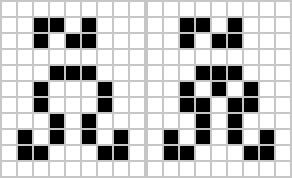
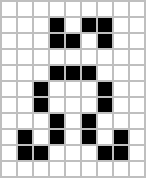
Light bulb is a period-2 oscillator that was found in 1971.[1][2] Its rotor, known as the filament,[3] is the only known 3-cell period 2 rotor, and it can be embedded in a slightly smaller stator, giving the 21-cell variant shown below. Two other variants of this oscillator are also known.[4] Various other small induction coils can also be used in place of the snake at the top of the bulb, including house and bookend, (the latter of which has a known 6-glider synthesis for the resulting oscillator[5]) though these lead to larger bounding boxes.
First soup-based syntheses for this oscillator were discovered by Mark Niemiec on December 17, 2004 based on results from Andrzej Okrasinski's census, costing 11 gliders for the house-stabilized version and 16 gliders for the bookend-stabilized version.[6]
| A variant of the light bulb that is 2 cells smaller (click above to open LifeViewer) RLE: here Plaintext: here Catagolue: here |
References
- ↑ Robert Wainwright (September 1971). Lifeline, vol 3, page 3.
- ↑ Dean Hickerson's oscillator stamp collection. Retrieved on March 14, 2020.
- ↑ Heinrich Koenig. Filament. Game of Life Dictionary.
- ↑ "Period 2 Oscillator Rotors". Retrieved on March 16, 2009.
- ↑ xp2_03lkmzojc0cjo at Adam P. Goucher's Catagolue
- ↑ Jason Summers' jslife pattern collection. Retrieved on January 5, 2020.
External links
- Light bulb at the Life Lexicon
- 23P2.760 at Heinrich Koenig's Game of Life Object Catalogs
- Lightbulb Construction at Game of Life News. Posted by Heinrich Koenig on December 18, 2004.
- Light bulb at Adam P. Goucher's Catagolue
- Patterns
- Oscillators with 23 cells
- Periodic objects with minimum population 23
- Patterns with 23 cells
- Patterns found in 1971
- Patterns that can be constructed with 23 gliders
- Patterns that can be constructed with 6 gliders
- Oscillators
- Babbling brooks
- Billiard tables
- Oscillators with period 2
- Oscillators with mod 2
- Oscillators with heat 3
- Oscillators with volatility 0.12
- Oscillators with strict volatility 0.12
- Oscillators with n symmetry
- Oscillators with rotor Filament
- Rumbling rivers