Figure eight: Difference between revisions
Haycat2009 (talk | contribs) m →Construction: there is possible |
not unique — 3b5o3$5o! |
||
| Line 74: | Line 74: | ||
|viewerconfig = #C [[ THUMBSIZE 3 HEIGHT 560 THEME Book ZOOM 48 ]] | |viewerconfig = #C [[ THUMBSIZE 3 HEIGHT 560 THEME Book ZOOM 48 ]] | ||
|position = center | |position = center | ||
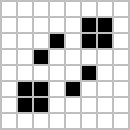
|caption = The | |caption = The smallest predecessor for figure eight (and also for any period-8 oscillator or constellation containing one). | ||
}} | }} | ||
Revision as of 13:53, 21 January 2024
| Figure eight | |||||||||
| View animated image | |||||||||
| View static image | |||||||||
| Pattern type | Oscillator | ||||||||
|---|---|---|---|---|---|---|---|---|---|
| Number of cells | 12 | ||||||||
| Bounding box | 10 × 10 | ||||||||
| Frequency class | 23.4 | ||||||||
| Period | 8 (mod: 8) | ||||||||
| Heat | 16.5 | ||||||||
| Volatility | 1.00 | 1.00 | ||||||||
| Kinetic symmetry | Unspecified | ||||||||
| Discovered by | Simon Norton | ||||||||
| Year of discovery | 1970 | ||||||||
| |||||||||
| |||||||||
| |||||||||
| |||||||||
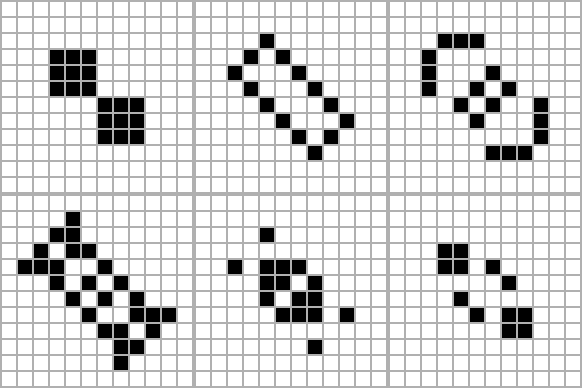
Figure eight (or less frequently, big beacon[1] or lemniscate) is a period-8 oscillator found by Simon Norton in 1970.[2] With 12 cells in its smallest phase, it is the smallest known period 8 oscillator, ahead of blocker at 15 cells. It is known that no period 8 oscillators exist with 10 or fewer cells.[3]
Producing a domino spark, it is useful for constructing larger oscillators with period that is a multiple of eight. For example, it appears in tumbling T-tetson (period 8), sailboat (period 16), caterer on figure eight (the smallest period-24 oscillator), and a p64 pi-heptomino hassler; the latter two are shown below in Gallery. It is also the key component in the p8 bouncer.
-
 One of the phases of the oscillator, which led to both of its names

Construction
| The reaction of the 4-glider synthesis of figure eight (click above to open LifeViewer) RLE: here Plaintext: here |
A diagonally symmetric collision between two gliders and a teardrop, which costs two gliders, produces a figure eight cleanly, leading to its 4-glider synthesis.
A four-object 21-cell one-glider seed for figure eight with bounding box 14 × 14 is known.[4]
|
|
Its smallest possible predecessor by population has 10 cells.[5]
| The smallest predecessor for figure eight (and also for any period-8 oscillator or constellation containing one). (click above to open LifeViewer) |
Occurrence
- See also: List of common oscillators
Figure eight is the tenth most common naturally-occurring oscillator in Achim Flammenkamp's census, being less common than the great on-off but more common than the spark coil.[6] On Catagolue, it is the most common period 8 oscillator, being more common than blocker.[7]
Figure eight occurs in final patterns of two out of the collisions catalogued in the octo3obj database.[8]
Gallery
|
|
In other rules
In B35i8/S23, a teardrop evolves into a figure eight.
In B3/S234q8, a the oscillator has period 9 instead of 8, with an extra phase that consists of a diagonal 4×3 grid.
See also
References
- ↑ "Big beacon". The Life Lexicon. Stephen Silver. Retrieved on June 14, 2011.
- ↑ Dean Hickerson's oscillator stamp collection. Retrieved on March 14, 2020.
- ↑ 3.0 3.1 Life Period-8 Oscillators at Mark D. Niemiec's Life Page (download pattern file: 12/12fg.rle)
- ↑ 4.0 4.1 Re: One Glider Seeds (discussion thread) at the ConwayLife.com forums
- ↑ Nick Gotts (June 8, 2019). Re: Systematic survey of small patterns (discussion thread) at the ConwayLife.com forums
- ↑ Achim Flammenkamp (September 7, 2004). "Most seen natural occurring ash objects in Game of Life". Retrieved on January 15, 2009.
- ↑ Adam P. Goucher. "Statistics". Catagolue. Retrieved on October 27, 2018.
- ↑ The headerless RLEs of the two collisions are 2b2o$2b2o3$4b2o2b2o$2o2b2o2b2o2b2o$2o9b2o$13bo$7b2o$7b2o! and 3b2o$3b2o2b2o$7b2o4$bo5b2o$obo3bo2bo$obo4b2o$bo$9bo$8b2o$8bobo!
External links
- Figure-8 at the Life Lexicon
- Figure-8 at Adam P. Goucher's Catagolue
- 12P8.1 at Heinrich Koenig's Game of Life Object Catalogs
- Patterns
- Patterns with Catagolue frequency class 23
- Natural periodic objects
- Oscillators with 12 cells
- Periodic objects with minimum population 12
- Patterns with 12 cells
- Patterns found by Simon Norton
- Patterns found in 1970
- Patterns that can be constructed with 4 gliders
- Oscillators
- Oscillators with period 8
- Oscillators with mod 8
- Oscillators with heat 16
- Oscillators with volatility 1.00
- Oscillators with strict volatility 1.00
- Patterns with rectangular diagonal symmetry
- Sparkers
- Sparkers with period 8
- Domino sparkers
- Moderate sparkers