Eater/block frob: Difference between revisions
Carson Cheng (talk | contribs) Update synthesis cost |
No edit summary |
||
| Line 10: | Line 10: | ||
|v = 0.55 | |v = 0.55 | ||
|sv = 0.55 | |sv = 0.55 | ||
|symmetry = n | |||
|discoverer = David Buckingham | |discoverer = David Buckingham | ||
|rulemin = B3/S23 | |rulemin = B3/S23 | ||
| Line 33: | Line 34: | ||
[[Carson Cheng]] found an {{gliders|11}} [[synthesis]] of this oscillator on June 30, {{year|2022}}.<ref name="post147639" /> | [[Carson Cheng]] found an {{gliders|11}} [[synthesis]] of this oscillator on June 30, {{year|2022}}.<ref name="post147639" /> | ||
This was reduced to an {{gliders|8|text=8-glider}} synthesis in August {{year|2023}} by [[MathAndCode]], based on a 6-glider component that converts an [[eater 1]] into this oscillator. <ref name="post165306" /><ref name="j4895883719" /> | This was reduced to an {{gliders|8|text=8-glider}} synthesis in August {{year|2023}} by [[MathAndCode]], based on a 6-glider component that converts an [[eater 1]] into this oscillator. <ref name="post165306" /><ref name="j4895883719" /> | ||
== Occurrence and variants == | == Occurrence and variants == | ||
This oscillator first appeared [[natural]]ly on April 3, {{year|2022}}, in a [[soup]] found by [[Charity Engine]] using [[apgsearch]],<ref name="post143749" /> though {{LinkCatagolue|xp4_y6gjjzy28k4520442s0gz33w784py3ch07w66zy312198a511zy666|patternname=a seminatural C4_1 tetramerisation|style=raw}} occurred on March 4, 2022, 30 days earlier,<ref>{{cata|attribute/xp4_y6gjjzy28k4520442s0gz33w784py3ch07w66zy312198a511zy666/b3s23/C4_1|attribute page}}, {{cata|hashsoup/C4_1/c_xprrYNydUVTb329272464/b3s23|first soup}}</ref> in which each quadrant's eater head is fused to the roughly-melusine to form a roughly-[[fuse with tail and nine]]. The reduction of the 5 cells in the eater body and melusine tail seems to make it easier to find than the monomer, despite each quadrant having to occur at a fixed displacement from the centre. On May 17, 2022, Charity Engine also found {{LinkCatagolue|xp4_y83rgxgr3zy3ggs26w23032w62sggzcc08o0j2yd2j0o80cczgg0go5dyfd5og0ggz11y06a8oy9o8a6y011zy51230oa606ao0321zy866y166|patternname=a D8_1 oscillator|style=raw}}, that contains the frob's rotor in each of its octants, with the roughly-melusine's eater tail's stabilisation fulfilled by gutter preservation, and has 4.5 fewer cells per octant than the monomer. | This oscillator first appeared [[natural]]ly on April 3, {{year|2022}}, in a [[soup]] found by [[Charity Engine]] using [[apgsearch]],<ref name="post143749" /> though {{LinkCatagolue|xp4_y6gjjzy28k4520442s0gz33w784py3ch07w66zy312198a511zy666|patternname=a seminatural C4_1 tetramerisation|style=raw}} occurred on March 4, 2022, 30 days earlier,<ref>{{cata|attribute/xp4_y6gjjzy28k4520442s0gz33w784py3ch07w66zy312198a511zy666/b3s23/C4_1|attribute page}}, {{cata|hashsoup/C4_1/c_xprrYNydUVTb329272464/b3s23|first soup}}</ref> in which each quadrant's eater head is fused to the roughly-melusine to form a roughly-[[fuse with tail and nine]]. The reduction of the 5 cells in the eater body and melusine tail seems to make it easier to find than the monomer, despite each quadrant having to occur at a fixed displacement from the centre. On May 17, 2022, Charity Engine also found {{LinkCatagolue|xp4_y83rgxgr3zy3ggs26w23032w62sggzcc08o0j2yd2j0o80cczgg0go5dyfd5og0ggz11y06a8oy9o8a6y011zy51230oa606ao0321zy866y166|patternname=a D8_1 oscillator|style=raw}}, that contains the frob's rotor in each of its octants, with the roughly-melusine's eater tail's stabilisation fulfilled by gutter preservation, and has 4.5 fewer cells per octant than the monomer. | ||
{{gallery top}} | {{gallery top}} | ||
| Line 144: | Line 145: | ||
* [[Hooks]] | * [[Hooks]] | ||
==References== | == References == | ||
<references> | <references> | ||
<ref name="j4895883719">{{CiteCatagolueJob|job=4895883719|date=August 18, 2023}}</ref> | <ref name="j4895883719">{{CiteCatagolueJob|job=4895883719|date=August 18, 2023}}</ref> | ||
| Line 177: | Line 178: | ||
</references> | </references> | ||
==External links== | == External links == | ||
* {{LinkLexicon|lex_e.htm#eaterblockfrob}} | * {{LinkLexicon|lex_e.htm#eaterblockfrob}} | ||
* {{LinkCatagolue|xp4_64k8wc871zx1ro}} | * {{LinkCatagolue|xp4_64k8wc871zx1ro}} | ||
Latest revision as of 20:35, 7 August 2024
| Eater/block frob | |||||||||
| View animated image | |||||||||
| View static image | |||||||||
| Pattern type | Oscillator | ||||||||
|---|---|---|---|---|---|---|---|---|---|
| Number of cells | 20 | ||||||||
| Bounding box | 10 × 10 | ||||||||
| Period | 4 (mod: 4) | ||||||||
| Heat | 8.5 | ||||||||
| Volatility | 0.55 | 0.55 | ||||||||
| Kinetic symmetry | n | ||||||||
| Discovered by | David Buckingham | ||||||||
| Year of discovery | Unknown | ||||||||
| |||||||||
| |||||||||
| |||||||||
| |||||||||


|
This article may require cleanup to meet LifeWiki's quality standards. |
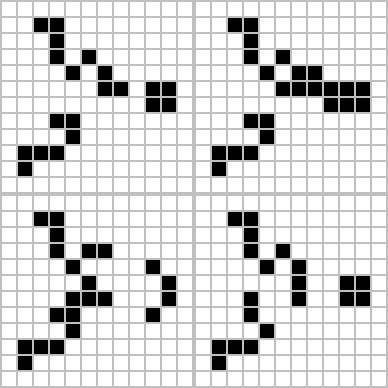
Eater/block frob is a period-4 oscillator found by David Buckingham in 1976 or earlier.[1] Composed of an eater 1, a block, and what is roughly a melusine, it is essentially a tub-with-tail eater constantly being hassled. "Frob" is used by MIT as a generic term meaning "thing".[2]
The block can be replaced with a long hook with tail, and the eater 1 can be replaced with an eater bridge eater or an emulator.
Its grin makes it useful in the p4 bumper.
Carson Cheng found an 11-glider synthesis of this oscillator on June 30, 2022.[3] This was reduced to an 8-glider synthesis in August 2023 by MathAndCode, based on a 6-glider component that converts an eater 1 into this oscillator. [4][5]
Occurrence and variants
This oscillator first appeared naturally on April 3, 2022, in a soup found by Charity Engine using apgsearch,[6] though a seminatural C4_1 tetramerisation occurred on March 4, 2022, 30 days earlier,[7] in which each quadrant's eater head is fused to the roughly-melusine to form a roughly-fuse with tail and nine. The reduction of the 5 cells in the eater body and melusine tail seems to make it easier to find than the monomer, despite each quadrant having to occur at a fixed displacement from the centre. On May 17, 2022, Charity Engine also found a D8_1 oscillator, that contains the frob's rotor in each of its octants, with the roughly-melusine's eater tail's stabilisation fulfilled by gutter preservation, and has 4.5 fewer cells per octant than the monomer.
| (click above to open LifeViewer) |
| (click above to open LifeViewer) Catagolue: here |
| (click above to open LifeViewer) Catagolue: here |
A similar replacement of the roughly-melusine to that in the D8_1 variant above can be achieved with a dimer with a tub. Two eater/block frobs can also hassle a beacon (that replaces the block for each), in either a cis- or trans- configuration, from which another D8_1 variant has also occurred seminaturally, with the eaters on the outside.
See also
References
- ↑ Dean Hickerson's oscillator stamp collection. Retrieved on March 14, 2020.
- ↑ Mark Niemiec (November 27, 2016). Re: Help with names (discussion thread) at the ConwayLife.com forums
- ↑ Carson Cheng (June 28, 2022). Re: Synthesising Oscillators (discussion thread) at the ConwayLife.com forums
- ↑ MathAndCode (August 18, 2023). Re: Synthesising Oscillators (discussion thread) at the ConwayLife.com forums
- ↑ shinjuku (#4895883719) (August 18, 2023). Job triggered by Adam P. Goucher at GitLab Catagolue project.
- ↑ Ian07 (April 3, 2022). Re: Soup search results (discussion thread) at the ConwayLife.com forums
- ↑ attribute page, first soup
External links
- Eater/block frob at the Life Lexicon
- Eater/block frob at Adam P. Goucher's Catagolue
- The 23 twenty-bit period 4 oscillators at Mark D. Niemiec's Life Page (download pattern file: 20/20eebf.rle)
- 20P4.4 at Heinrich Koenig's Game of Life Object Catalogs
- Eater/long hook with tail frob at Adam P. Goucher's Catagolue
- Eater bridge eater/block frob at Adam P. Goucher's Catagolue
- Patterns
- Oscillators with 20 cells
- Periodic objects with minimum population 20
- Patterns with 20 cells
- Patterns found by David Buckingham
- Patterns that can be constructed with 8 gliders
- Oscillators
- Oscillators with period 4
- Oscillators with mod 4
- Oscillators with heat 8
- Oscillators with volatility 0.55
- Oscillators with strict volatility 0.55
- Oscillators with n symmetry
- Sparkers
- Sparkers with period 4
- Weak sparkers
- Natural periodic objects