Dove: Difference between revisions
Jump to navigation
Jump to search
→Gallery: fmt |
No edit summary |
||
| Line 15: | Line 15: | ||
|plaintext = true | |plaintext = true | ||
|rle = true | |rle = true | ||
|viewerconfig = [[ ZOOM 57 ]] | |||
}} | }} | ||
The '''dove''' (or '''R-mango''' or '''R-havoc''') is a simple [[induction coil]] and [[Polyplet|nonoplet]]. | The '''dove''' (or '''R-mango''' or '''R-havoc''') is a simple [[induction coil]] and [[Polyplet|nonoplet]]. | ||
Revision as of 18:48, 14 May 2023
| Dove | |||||||||
| View static image | |||||||||
| Pattern type | Induction coil | ||||||||
|---|---|---|---|---|---|---|---|---|---|
| Number of cells | 9 | ||||||||
| Bounding box | 5 × 4 | ||||||||
| Static symmetry | Unspecified | ||||||||
| Discovered by | Unknown | ||||||||
| Year of discovery | Unknown | ||||||||
| |||||||||
| |||||||||
| |||||||||
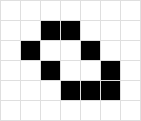
The dove (or R-mango or R-havoc) is a simple induction coil and nonoplet.
If left to evolve on its own, it stabilizes at generation 200 as a fairly sparse formation of 3 blocks and 2 blinkers.
The stairstep hexomino, if half of it is deleted after the two halves initially separate, forms a dove in 42 generations. The dove forms a lumps of muck sequence (although through a different predecessor) in what is effectively 20 generations. This is the basis of the p124 lumps of muck hassler; 2×(42+20) = 124.
Dove-dove still lifes
As mentioned previously, it can act as an induction coil. Two doves suffice to make a still life, with five possible isomers:


A sixth still life exists in which physical connection between both dove exists:

Gallery
| A dove along with one of its second cousins; in two generations, the two sequences converge (click above to open LifeViewer) RLE: here Plaintext: here |
See also
External links
- Dove at the Life Lexicon