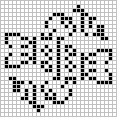
'''Max''' is a [[spacefiller]] that was found by [[Tim Coe]]<ref>{{LinkCallahan|patterns/sf/sfiller.html|patternname=Coe's improvements on the spacefiller}}</ref> in October {{year|1995}} that fills the plane with [[zebra stripes]]. In terms of its 187 [[cell]]s, it was formerly tied with [[spacefiller 2]] as the smallest known spacefiller, and in terms of its {{times|27|27}} [[bounding box]] it was the outright smallest for many years.<ref>Spacefiller.lif in [[Alan Hensel]]'s [http://www.ibiblio.org/lifepatterns/ lifebc.zip pattern collection].</ref>
'''Max''' is a [[spacefiller]] that was found by [[Tim Coe]]<ref>{{LinkCallahan|patterns/sf/sfiller.html|patternname=Coe's improvements on the spacefiller}}</ref> in October {{year|1995}} that fills the plane with [[zebra stripes]]. In terms of its 187 [[cell]]s, it was formerly tied with [[spacefiller 2]] as the smallest known spacefiller, and in terms of its {{times|27|27}} [[bounding box]] it was the outright smallest for many years.<ref>Spacefiller.lif in [[Alan Hensel]]'s [http://www.ibiblio.org/lifepatterns/ lifebc.zip pattern collection].</ref>
In February {{year|2020}}, [[Alex Greason]] and [[Adam P. Goucher]] found {{times|26|26}} and {{times|25|25}} [[predecessor]]s to Max that improved on the bounding box at the cost of increased [[population]].<ref name="message678458385414488064" /><ref name="message678530168649678850" /> In April, [[Mateusz Naściszewski]] found a {{times|25|25}} predecessor with a population of only 215,<ref name="message700361705988816907" /> as well as a Max variant with a {{times|27|27}} bounding box but a population of only 183 cells.<ref name="message700583344085139496" /> In November {{year|2021}}, [[Rocknlol]] found several new patterns with [[LogicLifeSearch]] which separately break the records for smallest population (151) and bounding box ({{times|23|23}}) of known Max predecessors.<ref name="post137788" /> In December 2022, iNoMed constructed a 127-cell {{times|27|23}} variant of Rocknlol's 151-cell pattern<ref name="post155354" />,l; a few days later Rocknlol found a 134-cell {{times|21|21}} variation as well as a 110-cell {{times|27|23}} variation. Both of these were reduced further still to a 107-cell predecessor and a {{times|21|19}} predecessor.
In February {{year|2020}}, [[Alex Greason]] and [[Adam P. Goucher]] found {{times|26|26}} and {{times|25|25}} [[predecessor]]s to Max that improved on the bounding box at the cost of increased [[population]].<ref name="message678458385414488064" /><ref name="message678530168649678850" /> In April, [[Mateusz Naściszewski]] found a {{times|25|25}} predecessor with a population of only 215,<ref name="message700361705988816907" /> as well as a Max variant with a {{times|27|27}} bounding box but a population of only 183 cells.<ref name="message700583344085139496" /> In November {{year|2021}}, [[Rocknlol]] found several new patterns with [[LogicLifeSearch]] which separately break the records for smallest population (151) and bounding box ({{times|23|23}}) of known Max predecessors.<ref name="post137788" /> In December 2022, iNoMed constructed a 127-cell {{times|27|23}} variant of Rocknlol's 151-cell pattern<ref name="post155354" />,l; a few days later Rocknlol found a 134-cell {{times|21|21}} variation as well as a 110-cell {{times|27|23}} variation. Both of these records were reduced further still to a 107-cell predecessor and a {{times|21|19}} predecessor.
Max is a spacefiller that was found by Tim Coe[1] in October 1995 that fills the plane with zebra stripes. In terms of its 187 cells, it was formerly tied with spacefiller 2 as the smallest known spacefiller, and in terms of its 27 × 27bounding box it was the outright smallest for many years.[2]
In February 2020, Alex Greason and Adam P. Goucher found 26 × 26 and 25 × 25predecessors to Max that improved on the bounding box at the cost of increased population.[3][4] In April, Mateusz Naściszewski found a 25 × 25 predecessor with a population of only 215,[5] as well as a Max variant with a 27 × 27 bounding box but a population of only 183 cells.[6] In November 2021, Rocknlol found several new patterns with LogicLifeSearch which separately break the records for smallest population (151) and bounding box (23 × 23) of known Max predecessors.[7] In December 2022, iNoMed constructed a 127-cell 27 × 23 variant of Rocknlol's 151-cell pattern[8],l; a few days later Rocknlol found a 134-cell 21 × 21 variation as well as a 110-cell 27 × 23 variation. Both of these records were reduced further still to a 107-cell predecessor and a 21 × 19 predecessor.
Alternatively, the term Max may be used to describe whatever the smallest-known spacefiller is at the current time. The term represents the fact that the growth rate is the fastest possible of any pattern in Conway's Game of Life.[9]