Bipole: Difference between revisions
No edit summary |
Preparing to update ['xp2_31ago'] |
||
| Line 29: | Line 29: | ||
|viewerconfig = #C [[ LOOP 2 GPS 2 THUMBSIZE 2 ]] | |viewerconfig = #C [[ LOOP 2 GPS 2 THUMBSIZE 2 ]] | ||
}} | }} | ||
The '''bipole''' is the [[barberpole]] of length 2 and is thus an [[oscillator]] of | The '''bipole''' is the [[barberpole]] of length 2 and is thus an [[oscillator]] of {{period|2|text=period 2}}. It is the smallest possible barberpole. Its [[rotor]] is identical to [[blinker]] and [[fore and back]]. | ||
Adding one cell in the middle gives [[integral sign]], while adding two cells gives [[very long ship]]. | Adding one cell in the middle gives [[integral sign]], while adding two cells gives [[very long ship]]. | ||
== [[ | {{EmbedViewer | ||
|pname = p736gun | |||
|position = center | |||
|viewerconfig = #C [[ GPS 12 THUMBSIZE 2 ZOOM 10 WIDTH 600 HEIGHT 480 THEME Book AUTOSTART T 0 PAUSE 3 T 184 PAUSE 1 LOOP 185 ]] | |||
|caption = An unusual use of a bipole in a period-736 glider gun, where a snake-type catalyst is needed, but using a still life would interfere with another part of the gun | |||
|style = width:300px; | |||
}} | |||
== | == Construction == | ||
{{EmbedViewer | {{EmbedViewer | ||
| | |rle = x = 34, y = 31, rule = B3/S23 | ||
obo$b2o16bo$bo15b2o$18b2o5$32b2o$31bobo2$29bobo$29b2o3$13b2o$13bobo$13bo11$24b3o$24bo$25bo! | |||
|viewerconfig = #C [[ HEIGHT 460 THEME Book ZOOM 12 AUTOSTART GPS 12 T 0 PAUSE 1 T 20 PAUSE 3 T 60 PAUSE 1 T 69 PAUSE 2 LOOP 70 ]] | |||
|position = center | |position = center | ||
|caption = A 4G synthesis of the bipole<ref name="j2349746851" /> | |||
|caption = | |style = width:300px; | ||
|style = width: | |||
}} | }} | ||
On April 19, {{year|2022}}, a {{gliders|4}} [[Glider synthesis|synthesis]] of the bipole was submitted to [[Catagolue]] by [[Carson Cheng]].<ref name="message997664404323709048" /> However, because he did not further publicize his discovery at the time, it remained unnoticed by the wider community until June of that year.<ref name="post146998" /> | |||
== Occurrence == | |||
{{related|List of common oscillators}} | |||
The bipole is the seventh most [[common]] oscillator in [[Achim Flammenkamp's census]], being less common than the [[clock]] and [[pentadecathlon]] but more common than the [[quadpole]].<ref>{{citeAchim|accessdate=January 15, 2009}}</ref> It is the seventh most common oscillator on [[Adam P. Goucher]]'s [[Catagolue]]. | |||
There is a [[three-glider collision]] with an occurrence of bipole in the ash.{{refn|Headerless RLE: {{headerlessRLE|o$b2o$2o25$73bo$71b2o$72b2o$68bo$69bo$67b3o!}}}} Bipole occurs in final patterns of two collisions in the [[octo3obj database]].{{refn|{{headerlessRLE|2o7b2o$2o7b2o2$2o7b2o$2o7b2o2$11b3o$6b3o2bo$12bo!}} and {{headerlessRLE|2o$2o4$3b2o$2bo2bo2b2o$3b2o3b2o2$4bo$3b2o$3bobo!}}}} | |||
== References == | == References == | ||
| Line 63: | Line 74: | ||
|date = June 12, 2022 | |date = June 12, 2022 | ||
}}</ref> | }}</ref> | ||
<ref name="j2349746851">{{CiteCatagolueJob|job=2349746851|date=April 19, 2022}}</ref> | |||
</references> | </references> | ||
== External links == | == External links == | ||
{{LinkLexicon|filename=lex_b.htm#bipole}} | * {{LinkLexicon|filename=lex_b.htm#bipole}} | ||
{{LinkCatagolue|xp2_31ago}} | * {{LinkCatagolue|xp2_31ago}} | ||
{{LinkPentadecathlonObject|8P2.1}} | * {{LinkPentadecathlonObject|8P2.1}} | ||
* {{LinkNiemiec|p2.htm#p2-8|The 1 eight-bit period 2 oscillator|rle=0/8bp.rle}} | |||
{{Symmetry|180degree|osc=flip}} | {{Symmetry|180degree|osc=flip}} | ||
__NOTOC__ | __NOTOC__ | ||
Revision as of 08:30, 15 November 2022
| Bipole | |||||||||
| View animated image | |||||||||
| View static image | |||||||||
| Pattern type | Oscillator | ||||||||
|---|---|---|---|---|---|---|---|---|---|
| Oscillator type | Muttering moat | ||||||||
| Family | Barberpole | ||||||||
| Number of cells | 8 | ||||||||
| Bounding box | 5 × 5 | ||||||||
| Frequency class | 21.7 | ||||||||
| Period | 2 (mod: 1) | ||||||||
| Heat | 4 | ||||||||
| Volatility | 0.40 | 0.40 | ||||||||
| Kinetic symmetry | Unspecified | ||||||||
| Rotor type | Pole 2 | ||||||||
| Discovered by | MIT group | ||||||||
| Year of discovery | 1970 | ||||||||
| |||||||||
| |||||||||
| |||||||||
| |||||||||
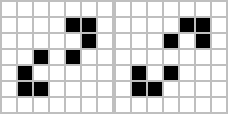

The bipole is the barberpole of length 2 and is thus an oscillator of period 2. It is the smallest possible barberpole. Its rotor is identical to blinker and fore and back.
Adding one cell in the middle gives integral sign, while adding two cells gives very long ship.
| An unusual use of a bipole in a period-736 glider gun, where a snake-type catalyst is needed, but using a still life would interfere with another part of the gun (click above to open LifeViewer) RLE: here Plaintext: here |
Construction
| A 4G synthesis of the bipole[1] (click above to open LifeViewer) |
On April 19, 2022, a 4-glider synthesis of the bipole was submitted to Catagolue by Carson Cheng.[2] However, because he did not further publicize his discovery at the time, it remained unnoticed by the wider community until June of that year.[3]
Occurrence
- See also: List of common oscillators
The bipole is the seventh most common oscillator in Achim Flammenkamp's census, being less common than the clock and pentadecathlon but more common than the quadpole.[4] It is the seventh most common oscillator on Adam P. Goucher's Catagolue.
There is a three-glider collision with an occurrence of bipole in the ash.[5] Bipole occurs in final patterns of two collisions in the octo3obj database.[6]
References
- ↑ shinjuku (#2349746851) (April 19, 2022). Job triggered by Adam P. Goucher at GitLab Catagolue project.
- ↑ Carson Cheng (July 15, 2022). Message in #cgol on the Conwaylife Lounge Discord server
- ↑ Ian07 (June 12, 2022). Re: 4 glider syntheses (discussion thread) at the ConwayLife.com forums
- ↑ Achim Flammenkamp (September 7, 2004). "Most seen natural occurring ash objects in Game of Life". Retrieved on January 15, 2009.
- ↑ Headerless RLE: o$b2o$2o25$73bo$71b2o$72b2o$68bo$69bo$67b3o!
- ↑ 2o7b2o$2o7b2o2$2o7b2o$2o7b2o2$11b3o$6b3o2bo$12bo! and 2o$2o4$3b2o$2bo2bo2b2o$3b2o3b2o2$4bo$3b2o$3bobo!
External links
- Bipole at the Life Lexicon
- Bipole at Adam P. Goucher's Catagolue
- 8P2.1 at Heinrich Koenig's Game of Life Object Catalogs
- The 1 eight-bit period 2 oscillator at Mark D. Niemiec's Life Page (download pattern file: 0/8bp.rle)
- Patterns
- Patterns with Catagolue frequency class 21
- Natural periodic objects
- Oscillators with 8 cells
- Periodic objects with minimum population 8
- Patterns with 8 cells
- Patterns found by MIT group
- Patterns found in 1970
- Patterns that can be constructed with 4 gliders
- Oscillators
- Barberpole variants
- Muttering moats
- Oscillators with period 2
- Oscillators with mod 1
- Oscillators with heat 4
- Oscillators with volatility 0.40
- Oscillators with strict volatility 0.40
- Oscillators with rotor Pole 2
- Patterns with 180-degree rotation symmetry
- Flipping oscillators