Diuresis: Difference between revisions
Jump to navigation
Jump to search
m On reflection, removed un-necessary trivia from the Etymology section. |
m added pattern files |
||
| Line 1: | Line 1: | ||
{{Oscillator|name=Diuresis|pname=Diuresis|p=90 |c=121 |bx=29 |by=25 |animated= | {{Oscillator|name=Diuresis|pname=Diuresis|p=90 |c=121 |bx=29 |by=25 |h=33.2 |animated=true|rle=true|life105=true|life106=true|plaintext=true|discoverer=David Eppstein |discoveryear=1998}} | ||
'''Diuresis''' is a [[period]] 90 oscillator consisting of two | '''Diuresis''' is a [[period]] [[:Category:oscillators with period 90|90]] [[oscillator]] consisting of two [[bookend]]s [[hassle]]d by complicated [[eaters]]. The original oscillator was found by [[David Eppstein]], and was hassled by [[pentadecathlon]]s. Later that same day, [[Dean Hickerson]] replaced the pentadecathlons with the [[still life]] arrangement. The form to the right shows two still life arrangements, one with the minimal population (left) and one with the minimal bounding box (right). | ||
== Etymology == | ==Etymology== | ||
The name is due to Bill Gosper, who compared the bookends to kidneys. | The name is due to Bill Gosper, who compared the bookends to kidneys. | ||
Revision as of 22:29, 16 December 2009
| Diuresis | |||||||
| View animated image | |||||||
| View static image | |||||||
| Pattern type | Oscillator | ||||||
|---|---|---|---|---|---|---|---|
| Number of cells | 121 | ||||||
| Bounding box | 29 × 25 | ||||||
| Period | 90 (mod: Unknown) | ||||||
| Heat | 33.2 | ||||||
| Volatility | Unknown | Unknown | ||||||
| Kinetic symmetry | Unspecified | ||||||
| Discovered by | David Eppstein | ||||||
| Year of discovery | 1998 | ||||||
| |||||||

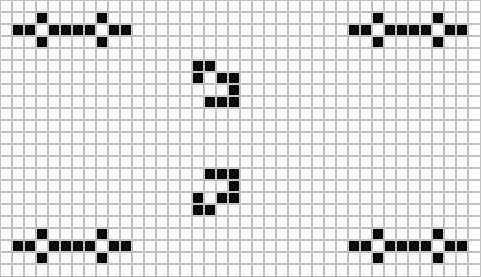
Diuresis is a period 90 oscillator consisting of two bookends hassled by complicated eaters. The original oscillator was found by David Eppstein, and was hassled by pentadecathlons. Later that same day, Dean Hickerson replaced the pentadecathlons with the still life arrangement. The form to the right shows two still life arrangements, one with the minimal population (left) and one with the minimal bounding box (right).
Etymology
The name is due to Bill Gosper, who compared the bookends to kidneys.