Diuresis: Difference between revisions
Carson Cheng (talk | contribs) The centuries don't reappear after 45 generations in their canonical forms; instead the combination is destroyed by the boats |
m formatting |
||
| Line 24: | Line 24: | ||
|animated = true | |animated = true | ||
|apgcode = xp90_4r4yb4r4z4r4yb4r4zzy03d8ey1e8d3zz0oydoz1u1yb1u1z161yb161 | |apgcode = xp90_4r4yb4r4z4r4yb4r4zzy03d8ey1e8d3zz0oydoz1u1yb1u1z161yb161 | ||
|viewerconfig = #C [[ GPS | |viewerconfig = #C [[ THUMBSIZE 2 ZOOM 10 GPS 10 LOOP 90 ]] | ||
}} | }} | ||
'''Diuresis''' is a {{period|90}} [[oscillator]] consisting of two [[bookend]]s being [[hassle]]d by oscillators or stable [[catalyst]]s. The original oscillator was found by [[David Eppstein]] on October 11, {{year|1998}},<ref>{{CiteSummersPattern|name=jslife|accessdate=March 14, 2020}}</ref> and was hassled by [[pentadecathlon]]s. With a minimum population of {{cells|66}} | '''Diuresis''' is a {{period|90}} [[oscillator]] consisting of two [[bookend]]s being [[hassle]]d by oscillators or stable [[catalyst]]s. The original oscillator was found by [[David Eppstein]] on October 11, {{year|1998}},<ref>{{CiteSummersPattern|name=jslife|accessdate=March 14, 2020}}</ref> and was hassled by [[pentadecathlon]]s. With a minimum population of {{cells|66|text=66 cells}}, this is still the smallest known form of the oscillator in terms of cell count. Later that same day, [[Dean Hickerson]] replaced the pentadecathlons with the [[still life]] arrangement. The form below shows two still life arrangements, one with the minimal population (left) and one with the minimal bounding box (right). | ||
The name is due to [[Bill Gosper]], who compared the bookends to kidneys. | The name is due to [[Bill Gosper]], who compared the bookends to kidneys. | ||
| Line 33: | Line 33: | ||
{{EmbedViewer | {{EmbedViewer | ||
|pname = diuresisvariant | |pname = diuresisvariant | ||
|viewerconfig = #C [[ WIDTH 600 HEIGHT 600 THUMBSIZE 2 ZOOM 16 GPS 15 AUTOSTART LOOP 90 ]] | |||
|viewerconfig = #C [[ | |position = center | ||
|caption = Diuresis supported by stable catalysts | |caption = Diuresis supported by stable catalysts | ||
|style = width:300px; | |||
}} | }} | ||
| Line 43: | Line 44: | ||
==External links== | ==External links== | ||
{{LinkLexicon|lex_d.htm#diuresis}} | * {{LinkLexicon|lex_d.htm#diuresis}} | ||
{{LinkCatagolue|xp90_4r4yb4r4z4r4yb4r4zzy03d8ey1e8d3zz0oydoz1u1yb1u1z161yb161}} | * {{LinkCatagolue|xp90_4r4yb4r4z4r4yb4r4zzy03d8ey1e8d3zz0oydoz1u1yb1u1z161yb161}} | ||
{{LinkCatagolue|xp90_8k80u178cy8c871s6zwg85ligx6asy4gil9abgzw11da0hyah0ad11zw31pl91xca7y419lp13zy1gs26y862sg|patternname=Diuresis w/ stable catalysts}} | * {{LinkCatagolue|xp90_8k80u178cy8c871s6zwg85ligx6asy4gil9abgzw11da0hyah0ad11zw31pl91xca7y419lp13zy1gs26y862sg|patternname=Diuresis w/ stable catalysts}} | ||
{{Symmetry|orthogonal2|osc=flip}} | {{Symmetry|orthogonal2|osc=flip}} | ||
Revision as of 00:11, 19 May 2023
| Diuresis | |||||||||||
| View animated image | |||||||||||
| View static image | |||||||||||
| Pattern type | Oscillator | ||||||||||
|---|---|---|---|---|---|---|---|---|---|---|---|
| Oscillator type | Shuttle | ||||||||||
| Number of cells | 66 | ||||||||||
| Bounding box | 44 × 27 | ||||||||||
| Period | 90 (mod: 45) | ||||||||||
| Heat | 121.51 | ||||||||||
| Volatility | 1.00 | 0.42 | ||||||||||
| Kinetic symmetry | Unspecified | ||||||||||
| Discovered by | David Eppstein | ||||||||||
| Year of discovery | 1998 | ||||||||||
| |||||||||||
| |||||||||||
| |||||||||||
| |||||||||||

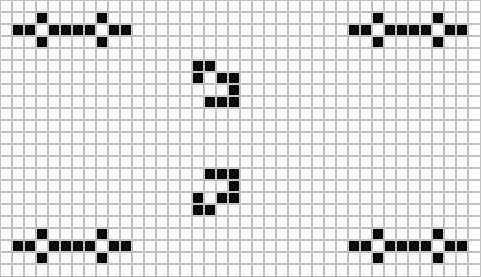
Diuresis is a period-90 oscillator consisting of two bookends being hassled by oscillators or stable catalysts. The original oscillator was found by David Eppstein on October 11, 1998,[1] and was hassled by pentadecathlons. With a minimum population of 66 cells, this is still the smallest known form of the oscillator in terms of cell count. Later that same day, Dean Hickerson replaced the pentadecathlons with the still life arrangement. The form below shows two still life arrangements, one with the minimal population (left) and one with the minimal bounding box (right).
The name is due to Bill Gosper, who compared the bookends to kidneys.
The combination of bookends in this oscillator reappear 45 generations later if two intermediate boats are removed. Therefore, there are many options to the sparkers and catalysts supporting this oscillator.
| Diuresis supported by stable catalysts (click above to open LifeViewer) RLE: here Plaintext: here |
References
- ↑ Jason Summers' jslife pattern collection. Retrieved on March 14, 2020.
External links
- Patterns
- Oscillators with 66 cells
- Periodic objects with minimum population 66
- Patterns with 66 cells
- Patterns found by David Eppstein
- Patterns found in 1998
- Patterns that can be constructed with 20 gliders
- Outer-totalistically endemic patterns
- Oscillators
- Shuttles
- Oscillators with period 90
- Oscillators with mod 45
- Oscillators with heat between 120 and 129
- Oscillators with volatility 1.00
- Oscillators with strict volatility 0.42
- Patterns with bilateral orthogonal symmetry
- Flipping oscillators