Bipole: Difference between revisions
Jump to navigation
Jump to search
synth ref |
credit Carson Cheng |
||
| Line 35: | Line 35: | ||
== [[Glider synthesis]] == | == [[Glider synthesis]] == | ||
On April 19, {{year|2022}}, a {{gliders|4}} [[synthesis]] of the bipole was submitted to [[Catagolue]] by | On April 19, {{year|2022}}, a {{gliders|4}} [[synthesis]] of the bipole was submitted to [[Catagolue]] by [[Carson Cheng]].<ref name="message997664404323709048" /> However, because he did not further publicize his discovery at the time, it remained unnoticed by the wider community until June of that year.<ref name="post146998" /> | ||
== Gallery == | == Gallery == | ||
| Line 49: | Line 49: | ||
== References == | == References == | ||
<references> | <references> | ||
<ref name="message997664404323709048">{{CiteDiscord | |||
|author = Carson Cheng | |||
|date = July 15, 2022 | |||
|channel = cgol | |||
|id = 997664404323709048 | |||
}}</ref> | |||
<ref name="post146998">{{LinkForumThread | <ref name="post146998">{{LinkForumThread | ||
|format = ref | |format = ref | ||
Revision as of 01:14, 16 July 2022
| Bipole | |||||||||
| View animated image | |||||||||
| View static image | |||||||||
| Pattern type | Oscillator | ||||||||
|---|---|---|---|---|---|---|---|---|---|
| Oscillator type | Muttering moat | ||||||||
| Family | Barberpole | ||||||||
| Number of cells | 8 | ||||||||
| Bounding box | 5 × 5 | ||||||||
| Frequency class | 21.7 | ||||||||
| Period | 2 (mod: 1) | ||||||||
| Heat | 4 | ||||||||
| Volatility | 0.40 | 0.40 | ||||||||
| Kinetic symmetry | Unspecified | ||||||||
| Rotor type | Pole 2 | ||||||||
| Discovered by | MIT group | ||||||||
| Year of discovery | 1970 | ||||||||
| |||||||||
| |||||||||
| |||||||||
| |||||||||
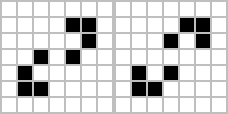

The bipole is the barberpole of length 2 and is thus an oscillator of period 2. It is the smallest possible barberpole.
The bipole is the seventh most common oscillator in Achim Flammenkamp's census, being less common than the clock and pentadecathlon but more common than the quadpole.[1] It is the seventh most common oscillator on Adam P. Goucher's Catagolue.
On April 19, 2022, a 4-glider synthesis of the bipole was submitted to Catagolue by Carson Cheng.[2] However, because he did not further publicize his discovery at the time, it remained unnoticed by the wider community until June of that year.[3]
Gallery
|
References
- ↑ Achim Flammenkamp (September 7, 2004). "Most seen natural occurring ash objects in Game of Life". Retrieved on January 15, 2009.
- ↑ Carson Cheng (July 15, 2022). Message in #cgol on the Conwaylife Lounge Discord server
- ↑ Ian07 (June 12, 2022). Re: 4 glider syntheses (discussion thread) at the ConwayLife.com forums
External links
- Bipole at the Life Lexicon
- 8P2.1 at Heinrich Koenig's Game of Life Object Catalogs
Categories:
- Patterns
- Patterns with Catagolue frequency class 21
- Natural periodic objects
- Oscillators with 8 cells
- Periodic objects with minimum population 8
- Patterns with 8 cells
- Patterns found by MIT group
- Patterns found in 1970
- Patterns that can be constructed with 4 gliders
- Oscillators
- Barberpole variants
- Muttering moats
- Oscillators with period 2
- Oscillators with mod 1
- Oscillators with heat 4
- Oscillators with volatility 0.40
- Oscillators with strict volatility 0.40
- Oscillators with rotor Pole 2
- Patterns with 180-degree rotation symmetry
- Flipping oscillators