RF48H: Difference between revisions
links, formatting, +1 red link gencols |
m relink, formatting |
||
| Line 16: | Line 16: | ||
'''RF48H''' is an [[elementary]] [[converter]] discovered by [[Stephen Silver]] with [[gencols]] in October {{year|1997}}, which transforms an [[R-pentomino]] to a [[Herschel]] in 48 generations. In the pattern shown to the right, a [[ghost Herschel]] marks the output location. | '''RF48H''' is an [[elementary]] [[converter]] discovered by [[Stephen Silver]] with [[gencols]] in October {{year|1997}}, which transforms an [[R-pentomino]] to a [[Herschel]] in 48 generations. In the pattern shown to the right, a [[ghost Herschel]] marks the output location. | ||
The original version consists of a single [[transparent]] [[loaf]] that is not restored until generation 87, and the rest of [[spark]] does not vanish until generation 130. To avoid hitting the spark and causing an explosion, the output Herschel's [[first natural glider]] must be suppressed by connecting the converter to a [[dependent conduit]], or by using a [[tub-with-tail eater]] or [[sidesnagger]]. Moreover, the low input clearance only allows for [[Paul Callahan]]'s [[Herschel receiver]] to be the preceding conduit, leading to a high [[repeat time]] of 151 ticks. | The original version consists of a single [[Transparent object|transparent]] [[loaf]] that is not restored until generation 87, and the rest of [[spark]] does not vanish until generation 130. To avoid hitting the spark and causing an explosion, the output Herschel's [[first natural glider]] must be suppressed by connecting the converter to a [[dependent conduit]], or by using a [[tub-with-tail eater]] or [[sidesnagger]]. Moreover, the low input clearance only allows for [[Paul Callahan]]'s [[Herschel receiver]] to be the preceding conduit, leading to a high [[repeat time]] of 151 ticks. | ||
As of June 2020 this converter has six known elementary variants. | As of June 2020 this converter has six known elementary variants. | ||
| Line 23: | Line 23: | ||
== External links == | == External links == | ||
*{{LinkLexicon|lex_r.htm#rf48h}} | * {{LinkLexicon|lex_r.htm#rf48h}} | ||
*{{LinkCallahan|patterns/ssrefl/ssrefl.html|patternname=Stephen Silver on Stable Reflectors}} | * {{LinkCallahan|patterns/ssrefl/ssrefl.html|patternname=Stephen Silver on Stable Reflectors}} | ||
Revision as of 16:08, 15 March 2023
| RF48H | |||||||
| View static image | |||||||
| Pattern type | Conduit | ||||||
|---|---|---|---|---|---|---|---|
| Conduit type | Converter | ||||||
| Input | R-pentomino | ||||||
| Output | Herschel | ||||||
| Number of cells | 7 | ||||||
| Step | 48 ticks | ||||||
| Recovery time (ignoring FNG if any) |
Unknown | ||||||
| Minimum overclock period (ignoring FNG if any) |
Unknown | ||||||
| Spartan? | Yes | ||||||
| Discovered by | Stephen Silver | ||||||
| Year of discovery | 1997 | ||||||
| |||||||
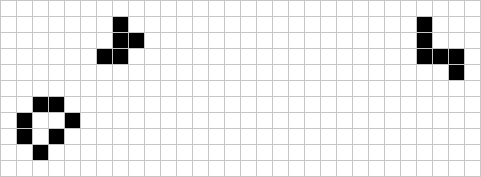
RF48H is an elementary converter discovered by Stephen Silver with gencols in October 1997, which transforms an R-pentomino to a Herschel in 48 generations. In the pattern shown to the right, a ghost Herschel marks the output location.
The original version consists of a single transparent loaf that is not restored until generation 87, and the rest of spark does not vanish until generation 130. To avoid hitting the spark and causing an explosion, the output Herschel's first natural glider must be suppressed by connecting the converter to a dependent conduit, or by using a tub-with-tail eater or sidesnagger. Moreover, the low input clearance only allows for Paul Callahan's Herschel receiver to be the preceding conduit, leading to a high repeat time of 151 ticks.
As of June 2020 this converter has six known elementary variants.
The loaf can be shifted one cell up and flipped to produce a different conduit, RF28B, with an improved recovery time. The extra block of the B-heptomino is not cleaned up in that case, unless an elementary conduit with a B-heptomino input such as BF20H or BFx59H is added.
External links
- RF48H at the Life Lexicon
- Stephen Silver on Stable Reflectors at Paul Callahan's Page of Conway's Life Miscellany