L156: Difference between revisions
shed the red |
LinkCallahan and layout improvement |
||
| Line 21: | Line 21: | ||
|plaintext = true | |plaintext = true | ||
|rle = true | |rle = true | ||
|viewerconfig = #C [[ ZOOM 8 | |viewerconfig = #C [[ ZOOM 8 GPS 20 LOOP 157 PAUSE 2 T 69 PAUSE 2 T 97 PAUSE 2 T 156 PAUSE 2 WIDTH 480 HEIGHT 480 THUMBSIZE 2 ]] | ||
}} | }} | ||
'''L156''' is a [[composite conduit]], one of the original sixteen [[Herschel conduit]]s, discovered by [[Dave Buckingham]] on August 7, {{year|1996}}. | '''L156''' is a [[composite conduit]], one of the original sixteen [[Herschel conduit]]s, discovered by [[Dave Buckingham]] on August 7, {{year|1996}}. It is made up of three [[elementary conduit]]s: HLx69R, [[RF28B]], and [[BFx59H]]. After 156 ticks, it produces a [[Herschel]] turned 90 degrees counterclockwise at (17, -41) relative to the input. | ||
==Variants== | Its [[recovery time]] is 62 ticks. It can be made [[Spartan]] by replacing the [[snake]] with an [[eater 1]] in one of two orientations. In the pattern shown in the infobox, a [[ghost Herschel]] marks the output location. | ||
Three variants are shown below. | |||
== Variants == | |||
Three variants are shown below. The first is the one in the infobox. The second uses an alternative RF28B to produce a glider in a different direction. The third uses a structure similar to [[RNE-19T84]] to produce two extra gliders and convert the conduit into a [[period doubler]]. | |||
{{EmbedViewer | {{EmbedViewer | ||
| Line 32: | Line 34: | ||
|pname = l156variants | |pname = l156variants | ||
|caption = Three L156 variants<br/> | |caption = Three L156 variants<br/> | ||
|viewerconfig = #C [[ AUTOSTART THUMBSIZE 2 ZOOM 10 WIDTH | |viewerconfig = #C [[ AUTOSTART THUMBSIZE 2 ZOOM 10 WIDTH 800 HEIGHT 1000 GPS 16 PAUSE 2 T 73 PAUSE 2 T 97 PAUSE 2 T 156 PAUSE 2 LOOP 157 ]] | ||
}} | }} | ||
==Gallery== | The third L156 variant produces an extra block, which blocks the next Herschel. For it not to be period-doubling, it must be deleted using either a [[reflector]] (such as the [[p8 bumper]] + [[dependent conduit]]) or a set of conduits (e.g. [[R64]] + [[F117]], at the cost of impractically high repeat time). | ||
== Gallery == | |||
{|class="wikitable" style="text-align:center" | {|class="wikitable" style="text-align:center" | ||
|[[Image:hlx69r.png|128px]]<br/>HLx69R|| <b>+</b> || [[Image:rf28b.png|128px]]<br/>RF28B|| <b>+</b> || [[Image:conduit1.png|128px]]<br/>BFx59H | |[[Image:hlx69r.png|128px]]<br/>HLx69R|| <b>+</b> || [[Image:rf28b.png|128px]]<br/>RF28B|| <b>+</b> || [[Image:conduit1.png|128px]]<br/>BFx59H | ||
| Line 43: | Line 46: | ||
|} | |} | ||
==See also== | == See also == | ||
* [[L112]] | * [[L112]] | ||
== External links == | |||
==External links== | |||
{{LinkLexicon|lex_l.htm#l156}} | {{LinkLexicon|lex_l.htm#l156}} | ||
{{LinkCallahan|patterns/bhept/bhept.html|patternname=Buckingham on B-heptominos in oscillators}} | |||
Revision as of 15:40, 29 April 2022
| L156 | |||||||||
| View static image | |||||||||
| Pattern type | Conduit | ||||||||
|---|---|---|---|---|---|---|---|---|---|
| Conduit type | Composite | ||||||||
| Input | Herschel | ||||||||
| Number of cells | 56 | ||||||||
| Output orientation | Turned left | ||||||||
| Output offset | (17, -41) | ||||||||
| Step | 156 ticks | ||||||||
| Recovery time (ignoring FNG if any) |
62 ticks | ||||||||
| Minimum overclock period (ignoring FNG if any) |
Unknown | ||||||||
| Spartan? | Yes | ||||||||
| Dependent? | No | ||||||||
| Discovered by | David Buckingham | ||||||||
| Year of discovery | 1996 | ||||||||
| |||||||||
| |||||||||
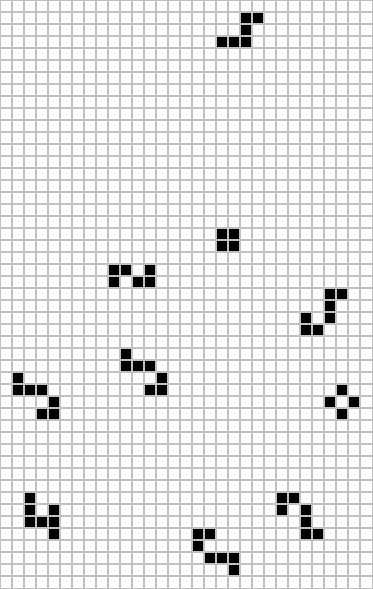
L156 is a composite conduit, one of the original sixteen Herschel conduits, discovered by Dave Buckingham on August 7, 1996. It is made up of three elementary conduits: HLx69R, RF28B, and BFx59H. After 156 ticks, it produces a Herschel turned 90 degrees counterclockwise at (17, -41) relative to the input.
Its recovery time is 62 ticks. It can be made Spartan by replacing the snake with an eater 1 in one of two orientations. In the pattern shown in the infobox, a ghost Herschel marks the output location.
Variants
Three variants are shown below. The first is the one in the infobox. The second uses an alternative RF28B to produce a glider in a different direction. The third uses a structure similar to RNE-19T84 to produce two extra gliders and convert the conduit into a period doubler.
| Three L156 variants (click above to open LifeViewer) RLE: here Plaintext: here |
The third L156 variant produces an extra block, which blocks the next Herschel. For it not to be period-doubling, it must be deleted using either a reflector (such as the p8 bumper + dependent conduit) or a set of conduits (e.g. R64 + F117, at the cost of impractically high repeat time).
Gallery
 HLx69R |
+ |  RF28B |
+ |  BFx59H |
| The elementary conduits that form L156 | ||||
See also
External links
- L156 at the Life Lexicon
Buckingham on B-heptominos in oscillators at Paul Callahan's Page of Conway's Life Miscellany