L156: Difference between revisions
m →top: AutoWikiBrowser - per Nathaniel, and requested by GUYTU6J, replaced: www.conwaylife.com → conwaylife.com |
shed the red |
||
| Line 23: | Line 23: | ||
|viewerconfig = #C [[ ZOOM 8 X 0 Y 0 GPS 20 LOOP 157 PAUSE 2 T 156 PAUSE 2 WIDTH 480 HEIGHT 480 THUMBSIZE 2 ]] | |viewerconfig = #C [[ ZOOM 8 X 0 Y 0 GPS 20 LOOP 157 PAUSE 2 T 156 PAUSE 2 WIDTH 480 HEIGHT 480 THUMBSIZE 2 ]] | ||
}} | }} | ||
'''L156''' is a [[composite conduit]], one of the original sixteen [[Herschel conduit]]s, discovered by [[Dave Buckingham]] on August 7, {{year|1996}}.<ref>{{cite web|url=https://conwaylife.com/ref/lifepage/patterns/bhept/bhept.html|title=My Experience with B-heptominos in Oscillators|author=David Buckingham|work=Paul Callahan's Page of Conway's Life Miscellany|date=October 12, 1996|accessdate=November 9, 2020}}</ref> It is made up of three [[elementary conduit]]s: | '''L156''' is a [[composite conduit]], one of the original sixteen [[Herschel conduit]]s, discovered by [[Dave Buckingham]] on August 7, {{year|1996}}.<ref>{{cite web|url=https://conwaylife.com/ref/lifepage/patterns/bhept/bhept.html|title=My Experience with B-heptominos in Oscillators|author=David Buckingham|work=Paul Callahan's Page of Conway's Life Miscellany|date=October 12, 1996|accessdate=November 9, 2020}}</ref> It is made up of three [[elementary conduit]]s: HLx69R, [[RF28B]], and [[BFx59H]]. After 156 ticks, it produces a [[Herschel]] turned 90 degrees counterclockwise at (17, -41) relative to the input. Its [[recovery time]] is 62 ticks. It can be made [[Spartan]] by replacing the [[snake]] with an [[eater 1]] in one of two orientations. In the pattern shown in the infobox, a [[ghost Herschel]] marks the output location. | ||
==Variants== | |||
Three variants are shown below. The first is the one in the infobox. The second uses an alternative [[RF28B]] to produce a glider in a different direction. The third uses an [[RNE-19T84]] to produce two extra gliders and convert the conduit into a [[period doubler]]. | Three variants are shown below. The first is the one in the infobox. The second uses an alternative [[RF28B]] to produce a glider in a different direction. The third uses an [[RNE-19T84]] to produce two extra gliders and convert the conduit into a [[period doubler]]. | ||
| Line 34: | Line 35: | ||
}} | }} | ||
The third L156 variant produces an extra block, which is period-doubling. In the viewer, a Herschel coming 77 generations earlier will be blocked. For it not to be period-doubling, it must be deleted using either a [[reflector]] (such as the [[p8 bumper]] + [[dependent conduit]]) or a set of conduits (e.g. [[R64]] + [[F117]], at the cost of impractically high repeat time). | The third L156 variant produces an extra block, which is period-doubling. In the viewer, a Herschel coming 77 generations earlier will be blocked. For it not to be period-doubling, it must be deleted using either a [[reflector]] (such as the [[p8 bumper]] + [[dependent conduit]]) or a set of conduits (e.g. [[R64]] + [[F117]], at the cost of impractically high repeat time). | ||
==Gallery== | |||
{|class="wikitable" style="text-align:center" | |||
|[[Image:hlx69r.png|128px]]<br/>HLx69R|| <b>+</b> || [[Image:rf28b.png|128px]]<br/>RF28B|| <b>+</b> || [[Image:conduit1.png|128px]]<br/>BFx59H | |||
|- | |||
| colspan="5" | The elementary conduits that form L156 | |||
|} | |||
==See also== | ==See also== | ||
Revision as of 23:19, 27 April 2022
| L156 | |||||||||
| View static image | |||||||||
| Pattern type | Conduit | ||||||||
|---|---|---|---|---|---|---|---|---|---|
| Conduit type | Composite | ||||||||
| Input | Herschel | ||||||||
| Number of cells | 56 | ||||||||
| Output orientation | Turned left | ||||||||
| Output offset | (17, -41) | ||||||||
| Step | 156 ticks | ||||||||
| Recovery time (ignoring FNG if any) |
62 ticks | ||||||||
| Minimum overclock period (ignoring FNG if any) |
Unknown | ||||||||
| Spartan? | Yes | ||||||||
| Dependent? | No | ||||||||
| Discovered by | David Buckingham | ||||||||
| Year of discovery | 1996 | ||||||||
| |||||||||
| |||||||||
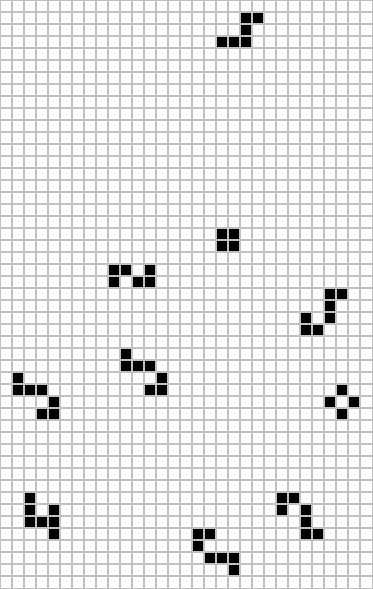
L156 is a composite conduit, one of the original sixteen Herschel conduits, discovered by Dave Buckingham on August 7, 1996.[1] It is made up of three elementary conduits: HLx69R, RF28B, and BFx59H. After 156 ticks, it produces a Herschel turned 90 degrees counterclockwise at (17, -41) relative to the input. Its recovery time is 62 ticks. It can be made Spartan by replacing the snake with an eater 1 in one of two orientations. In the pattern shown in the infobox, a ghost Herschel marks the output location.
Variants
Three variants are shown below. The first is the one in the infobox. The second uses an alternative RF28B to produce a glider in a different direction. The third uses an RNE-19T84 to produce two extra gliders and convert the conduit into a period doubler.
| Three L156 variants (click above to open LifeViewer) RLE: here Plaintext: here |
The third L156 variant produces an extra block, which is period-doubling. In the viewer, a Herschel coming 77 generations earlier will be blocked. For it not to be period-doubling, it must be deleted using either a reflector (such as the p8 bumper + dependent conduit) or a set of conduits (e.g. R64 + F117, at the cost of impractically high repeat time).
Gallery
 HLx69R |
+ |  RF28B |
+ |  BFx59H |
| The elementary conduits that form L156 | ||||
See also
References
- ↑ David Buckingham (October 12, 1996). "My Experience with B-heptominos in Oscillators". Paul Callahan's Page of Conway's Life Miscellany. Retrieved on November 9, 2020.
External links
- L156 at the Life Lexicon