69P48: Difference between revisions
m New page: {{Oscillator|name=69P48|pname=69p48|c=69|p=48|bx=19|by=15|h=7.5|animated=true|rle=true}} '''69P48''' is an unnamed period 48 oscillator tha... |
No edit summary |
||
| (23 intermediate revisions by 7 users not shown) | |||
| Line 1: | Line 1: | ||
{{Oscillator|name=69P48|pname=69p48|c=69 | {{Oscillator | ||
'''69P48''' is an unnamed | |name = 69P48 | ||
|pname = 69p48 | |||
|c = 69 | |||
|bx = 19 | |||
|by = 15 | |||
|p = 48 | |||
|m = 48 | |||
|h = 7.5 | |||
|v = 0.42 | |||
|sv = 0.07 | |||
|symmetry = n | |||
|discoverer = Noam Elkies | |||
|discoveryear = 2002 | |||
|rulemin = B3/S23 | |||
|rulemax = B38/S23678 | |||
|rulespecial = [[Conway's Game of Life|Conway Life]] | |||
|isorulemin = B3-ck/S23 | |||
|isorulemax = B34ce6cen7c8/S234ektw5-er678 | |||
|plaintext = true | |||
|rle = true | |||
|apgcode = xp48_31e8xgxgx8e13z0ojd55lkkmkk55d93zwc4gv0pi6221 | |||
|pentadecathlonid = 69P48.1 | |||
|animated = true | |||
|viewerconfig = #C [[ GPS 8 ZOOM 12 LOOP 48 ]] | |||
}} | |||
'''69P48''' is an unnamed {{period|48}} [[oscillator]] discovered by [[Noam Elkies]] on November 12, {{year|2002}}.<ref>{{CiteSummersPattern|name=all-osc|accessdate=June 25, 2009}}</ref> It is composed of the [[rotor]]s of both [[burloaferimeter]] and an unnamed 55P16 that interact in such a way so as to form a non-trivial period 48 oscillator (''figure 1''). In terms of its {{cells|69}} cells, it had been the smallest known non-trivial period 48 oscillator before the discovery of [[65P48]] in {{year|2014}}. | |||
The oscillator works by having [[cell]]s from the rotors of both oscillating parts converge in [[generation]] 20, causing the death of a single cell in the common [[stator]] of each oscillating part in generation 21 (''figure 2''). This has no effect on the progression of the period | The oscillator works by having [[cell]]s from the rotors of both oscillating parts converge in [[generation]] 20, causing the death of a single cell in the common [[stator]] of each oscillating part in generation 21 (''figure 2''). This has no effect on the progression of the period {{period|16|brief}} rotor, but, in the succeeding two generations, it [[Phase#Phase_change|changes]] the [[phase]] of the burloaferimeter rotor (''figure 3'') so that it comes back to the state of generation 20 in only 6 generations. Since burloaferimeter oscillates at a period of {{period|7|brief}}, in the full oscillation of a period 48 oscillator it should oscillate six times and progress another six generations, leaving it just shy of its normal oscillation in 49 generations. The result of the phase change, however, compensates by removing one of the necessary generations required for the burloaferimeter rotor to return to its initial state, resulting in a period of 49 - 1 = 48. | ||
== | == Gallery == | ||
{| | {| | ||
|[[File:69P48 figure1.png|thumb|left|'''Figure 1''': The normal rotors of burloaferimeter (red) and 55P16 (green) and the extra rotor interaction (blue)]] | |||
|[[ | |[[File:69P48 figure2.png|thumb|left|'''Figure 2''': Generation 21 shows the single dead cell (light green) that results from [[Conway's Game of Life#Rules|overcrowding]] from the two almost-distinct rotors.]] | ||
|[[ | |[[File:69P48 figure3.png|thumb|left|'''Figure 3''': Generation 23 shows the burloaferimeter rotor shifted ahead by one generation.]] | ||
|[[ | |||
|} | |} | ||
==References== | == See also == | ||
<references/> | * [[123P27.1]] | ||
* [[p48 toad hassler]] | |||
== References == | |||
<references /> | |||
== External links == | |||
{{LinkCatagolue|xp48_31e8xgxgx8e13z0ojd55lkkmkk55d93zwc4gv0pi6221}} | |||
{{LinkPentadecathlonObject|69P48.1}} | |||
[[Category:Unnamed periodic objects]] | |||
[[Category:Least-common-multiple oscillators]] | |||
__NOTOC__ | |||
Latest revision as of 20:21, 7 August 2024
| 69P48 | |||||||||
| View animated image | |||||||||
| View static image | |||||||||
| Pattern type | Oscillator | ||||||||
|---|---|---|---|---|---|---|---|---|---|
| Number of cells | 69 | ||||||||
| Bounding box | 19 × 15 | ||||||||
| Period | 48 (mod: 48) | ||||||||
| Heat | 7.5 | ||||||||
| Volatility | 0.42 | 0.07 | ||||||||
| Kinetic symmetry | n | ||||||||
| Discovered by | Noam Elkies | ||||||||
| Year of discovery | 2002 | ||||||||
| |||||||||
| |||||||||
| |||||||||
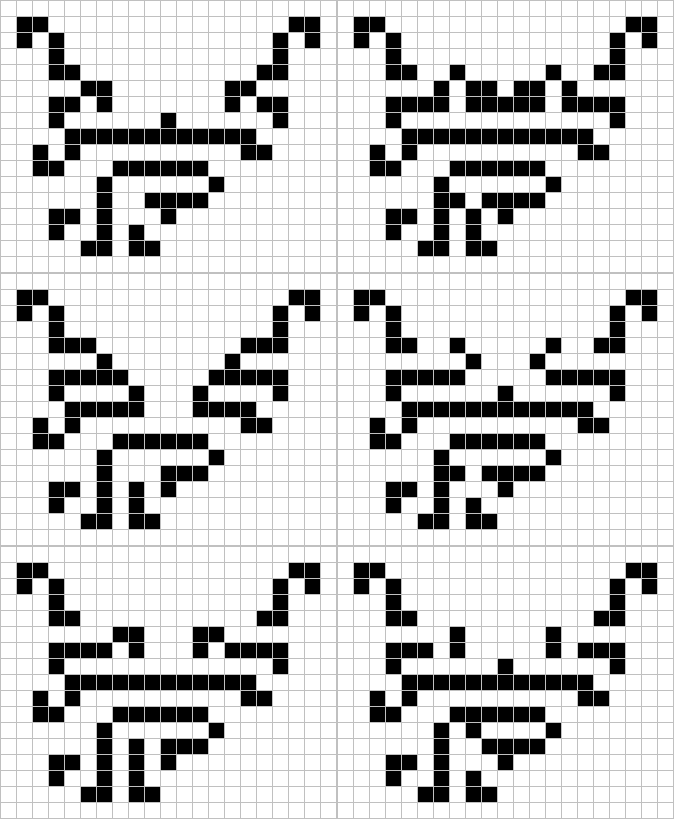

69P48 is an unnamed period-48 oscillator discovered by Noam Elkies on November 12, 2002.[1] It is composed of the rotors of both burloaferimeter and an unnamed 55P16 that interact in such a way so as to form a non-trivial period 48 oscillator (figure 1). In terms of its 69 cells, it had been the smallest known non-trivial period 48 oscillator before the discovery of 65P48 in 2014.
The oscillator works by having cells from the rotors of both oscillating parts converge in generation 20, causing the death of a single cell in the common stator of each oscillating part in generation 21 (figure 2). This has no effect on the progression of the period 16 rotor, but, in the succeeding two generations, it changes the phase of the burloaferimeter rotor (figure 3) so that it comes back to the state of generation 20 in only 6 generations. Since burloaferimeter oscillates at a period of 7, in the full oscillation of a period 48 oscillator it should oscillate six times and progress another six generations, leaving it just shy of its normal oscillation in 49 generations. The result of the phase change, however, compensates by removing one of the necessary generations required for the burloaferimeter rotor to return to its initial state, resulting in a period of 49 - 1 = 48.
Gallery
 |
 |
 |
See also
References
- ↑ Jason Summers' all-osc pattern collection. Retrieved on June 25, 2009.
External links
- 69P48.1 at Heinrich Koenig's Game of Life Object Catalogs
- Patterns
- Oscillators with 69 cells
- Periodic objects with minimum population 69
- Patterns with 69 cells
- Patterns found by Noam Elkies
- Patterns found in 2002
- Oscillators
- Oscillators with period 48
- Oscillators with mod 48
- Oscillators with heat 7
- Oscillators with volatility 0.42
- Oscillators with strict volatility 0.07
- Oscillators with n symmetry
- Unnamed periodic objects
- Least-common-multiple oscillators