L156: Difference between revisions
mNo edit summary |
Haycat2009 (talk | contribs) |
||
| (47 intermediate revisions by 9 users not shown) | |||
| Line 4: | Line 4: | ||
|type = composite | |type = composite | ||
|conduitfor = Herschel | |conduitfor = Herschel | ||
|bx = 29 | |||
|by = 29 | |||
|c = 56 | |c = 56 | ||
|m = L | |m = L | ||
| Line 14: | Line 16: | ||
|discoverer = David Buckingham | |discoverer = David Buckingham | ||
|discoveryear = 1996 | |discoveryear = 1996 | ||
|rulemin = B3/S23 | |||
|rulemax = B38/S23 | |||
|isorulemin = B3/S23 | |||
|isorulemax = B34c8/S234c5e | |||
|plaintext = true | |||
|rle = true | |rle = true | ||
|viewerconfig = #C [[ ZOOM 8 | |viewerconfig = #C [[ ZOOM 8 GPS 10 LOOP 157 PAUSE 2 T 69 PAUSE 2 T 97 PAUSE 2 T 156 PAUSE 2 WIDTH 480 HEIGHT 480 THUMBSIZE 2 ]] | ||
}} | }} | ||
'''L156''' is a [[composite conduit]], one of the original sixteen [[Herschel conduit]]s, discovered by [[Dave Buckingham]] | '''L156''' is a [[composite conduit]], one of the original sixteen [[Herschel conduit]]s, discovered by [[Dave Buckingham]] on August 7, {{year|1996}}. It is made up of three [[elementary conduit]]s: [[HLx69R]], [[RF28B]], and [[BFx59H]]. After 156 ticks, it produces a [[Herschel]] turned 90 degrees counterclockwise at (17, -41) relative to the input as well as an extra [[glider]] to southeast. | ||
The first is the one in the | Its [[recovery time]] is 62 ticks. It can be made [[Spartan]] by replacing the [[snake]] with an [[eater 1]] in one of two orientations. In the pattern shown in the infobox, a [[ghost Herschel]] marks the output location. | ||
The second uses an alternative | |||
The third uses | ==Variants== | ||
Three variants are shown below. The first is the one in the infobox. The second uses an alternative RF28B to emit a glider to northeast instead. The third uses a structure similar to [[RNE-19T84]] to produce two extra gliders. | |||
{{EmbedViewer | {{EmbedViewer | ||
|pname = l156variants | |||
|viewerconfig = #C [[ AUTOSTART THUMBSIZE 2 ZOOM 10 WIDTH 800 HEIGHT 1000 GPS 16 PAUSE 2 T 73 PAUSE 2 T 97 PAUSE 2 T 156 PAUSE 2 LOOP 157 ]] | |||
|position = center | |position = center | ||
| | |caption = Three L156 variants. The third one is shown following a [[Fx77]] | ||
|style = width:300px; | |||
}} | }} | ||
The third L156 variant is a [[period doubler]] because it produces an extra [[block]] that destroys the next Herschel. It can be deleted using either a [[reflector]] (such as the [[p8 bumper]] + [[dependent conduit]]) or a set of conduits (e.g. [[R64]] + [[F117]], at the cost of impractically high [[repeat time]]). In most cases where only the edge-shooting northeast glider is needed, it is better to suppress the output Herschel as in RNE-19T84. | |||
==L156_2== | |||
There is also a completely unrelated L156 conduit with the same step, repeat time and rotation, made out of the elementary conduits [[HL75P]], [[PF35W]] and [[WFx46H]]. After 156 ticks, it produces a [[Herschel]] turned 90 degrees counterclockwise at (4, -41) relative to the input. | |||
{{gallery top}} | |||
{{gallery item|{{EmbedViewer | |||
|pname = l156alternate | |||
|viewerconfig = #C [[ THEME 6 HEIGHT 600 WIDTH 600 GPS 30 ZOOM 8 AUTOSTART PAUSE 2 T 75 PAUSE 2 T 110 PAUSE 2 T 156 PAUSE 2 LOOP 157 ]] | |||
|position = center | |||
|caption = Alternate L156 (L156_2 in the H-to-H collection provided with Golly) | |||
|style = width:300px; | |||
}}}} | |||
{{gallery item|{{EmbedViewer | |||
|rle = x = 102, y = 38, rule = B3/S23 | |||
27b2o$28bo6b2o$28bobo4b2o45bo$22bo6b2o49b3o$20b3o2bo53bo$10b3o6bo5b3o | |||
51b2o$10bo8b2o7bo$9b3o15b2o$50bo$50bo$39b2o9b3ob2o$39b2o11bob2o26b2o | |||
15bo$82b2o15bo$99b3o$101bo5$2b2o48b2o$bobo49bo$bo48b3o24b2o$2o48bo26b | |||
2o2$18b2o$18b2o43b2o$10b2o52bo$10b2o6b2o41b3o$19bo41bo$16b3o54b2o$16bo | |||
56bo$22b2o50b3o$21bobo52bo$21bo$20b2o2$33b2o$33b2o! | |||
|viewerconfig = #C [[ HEIGHT 600 WIDTH 600 ZOOM 8 X -18 Y 0 ]] | |||
|position = center | |||
|caption = A Spartan variant of L156_2, followed by F166 | |||
|style = width:300px; | |||
}}}} | |||
{{gallery bottom}} | |||
==Lx138== | |||
On January 1, {{year|2012}}, [[Matthias Merzenich]] found Lx138, a composite conduit consisting of HL79B and BFx59H.<ref name="post5874" /> The HL79B stage evolves identically to HLx69R until generation 69, when a [[block]] and an [[eater 2]] absorb the southeast glider to transform the original R-pentomino to B-heptomino output. | |||
{{EmbedViewer | |||
|pname = lx138 | |||
|position = center | |||
|viewerconfig = #C [[ WIDTH 500 HEIGHT 500 ZOOM 12 AUTOSTART GPS 10 PAUSE 2 T 69 PAUSE 2 GPS 5 T 79 PAUSE 2 GPS 10 T 138 PAUSE 2 LOOP 139 ]] | |||
|caption = Lx138 Herschel conduit | |||
}} | |||
==Gallery== | |||
{|class="wikitable" style="text-align:center" | |||
|[[Image:hlx69r.png|128px]]<br/>HLx69R|| <b>+</b> || [[Image:rf28b.png|128px]]<br/>RF28B|| <b>+</b> || [[Image:conduit1.png|128px]]<br/>BFx59H | |||
|- | |||
| colspan="5" | The elementary conduits that form L156 | |||
|} | |||
==See also== | |||
* [[L112]] | |||
* [[L141]] | |||
==References== | |||
<references> | |||
<ref name="post5874">{{LinkForumThread | |||
|format = ref | |||
|p = 5874 | |||
|title = Re: Finally trying out stable Herschel tracks... | |||
|author = Matthias Merzenich | |||
|date = January 1, 2012 | |||
}}</ref> | |||
</references> | |||
==External links== | ==External links== | ||
{{LinkLexicon|lex_l.htm#l156}} | * {{LinkLexicon|lex_l.htm#l156}} | ||
* {{LinkCallahan|patterns/bhept/bhept.html|patternname=Buckingham on B-heptominos in oscillators}} | |||
__NOTOC__ | |||
Latest revision as of 07:21, 5 May 2024
| L156 | |||||||||
| View static image | |||||||||
| Pattern type | Conduit | ||||||||
|---|---|---|---|---|---|---|---|---|---|
| Conduit type | Composite | ||||||||
| Input | Herschel | ||||||||
| Number of cells | 56 | ||||||||
| Bounding box | 29 × 29 | ||||||||
| Output orientation | Turned left | ||||||||
| Output offset | (17, -41) | ||||||||
| Step | 156 ticks | ||||||||
| Recovery time (ignoring FNG if any) |
62 ticks | ||||||||
| Minimum overclock period (ignoring FNG if any) |
Unknown | ||||||||
| Spartan? | Yes | ||||||||
| Dependent? | No | ||||||||
| Discovered by | David Buckingham | ||||||||
| Year of discovery | 1996 | ||||||||
| |||||||||
| |||||||||
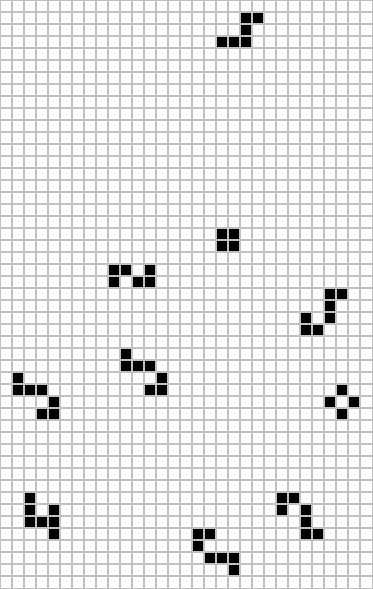
L156 is a composite conduit, one of the original sixteen Herschel conduits, discovered by Dave Buckingham on August 7, 1996. It is made up of three elementary conduits: HLx69R, RF28B, and BFx59H. After 156 ticks, it produces a Herschel turned 90 degrees counterclockwise at (17, -41) relative to the input as well as an extra glider to southeast.
Its recovery time is 62 ticks. It can be made Spartan by replacing the snake with an eater 1 in one of two orientations. In the pattern shown in the infobox, a ghost Herschel marks the output location.
Variants
Three variants are shown below. The first is the one in the infobox. The second uses an alternative RF28B to emit a glider to northeast instead. The third uses a structure similar to RNE-19T84 to produce two extra gliders.
| Three L156 variants. The third one is shown following a Fx77 (click above to open LifeViewer) RLE: here Plaintext: here |
The third L156 variant is a period doubler because it produces an extra block that destroys the next Herschel. It can be deleted using either a reflector (such as the p8 bumper + dependent conduit) or a set of conduits (e.g. R64 + F117, at the cost of impractically high repeat time). In most cases where only the edge-shooting northeast glider is needed, it is better to suppress the output Herschel as in RNE-19T84.
L156_2
There is also a completely unrelated L156 conduit with the same step, repeat time and rotation, made out of the elementary conduits HL75P, PF35W and WFx46H. After 156 ticks, it produces a Herschel turned 90 degrees counterclockwise at (4, -41) relative to the input.
| Alternate L156 (L156_2 in the H-to-H collection provided with Golly) (click above to open LifeViewer) RLE: here Plaintext: here |
| A Spartan variant of L156_2, followed by F166 (click above to open LifeViewer) |
Lx138
On January 1, 2012, Matthias Merzenich found Lx138, a composite conduit consisting of HL79B and BFx59H.[1] The HL79B stage evolves identically to HLx69R until generation 69, when a block and an eater 2 absorb the southeast glider to transform the original R-pentomino to B-heptomino output.
| Lx138 Herschel conduit (click above to open LifeViewer) RLE: here Plaintext: here |
Gallery
 HLx69R |
+ |  RF28B |
+ |  BFx59H |
| The elementary conduits that form L156 | ||||
See also
References
- ↑ Matthias Merzenich (January 1, 2012). Re: Finally trying out stable Herschel tracks... (discussion thread) at the ConwayLife.com forums
External links
- L156 at the Life Lexicon
- Buckingham on B-heptominos in oscillators at Paul Callahan's Page of Conway's Life Miscellany