Blockade: Difference between revisions
Jump to navigation
Jump to search
m S2 symmetry |
No edit summary |
||
| (22 intermediate revisions by 12 users not shown) | |||
| Line 1: | Line 1: | ||
{{ | {{Pattern | ||
The '''blockade''' | |name = Blockade | ||
|pname = blockade | |||
|type = Constellation | |||
|c = 16 | |||
|bx = 23 | |||
|by = 10 | |||
|symmetry = C2_2 | |||
|discoveryear = 1970 | |||
|rulemin = B/S3 | |||
|rulemax = B345678/S012345678 | |||
|rulespecial = [[Conway's Game of Life|Conway Life]] | |||
|isorulemin = B/S3a | |||
|isorulemax = B1e2-a345678/S012345678 | |||
|synthesis = 2 | |||
|synthesisRLE = true | |||
|plaintext = true | |||
|rle = true | |||
|apgcode = xs16_0ggydgj3zop1yd11 | |||
}} | |||
The '''blockade''' is a common formation of four [[block]]s and is one of the [[familiar fours]]. A common evolutionary sequence that leads to its formation is known as [[lumps of muck]], which can be seen by letting the [[stairstep hexomino]] evolve. | |||
= | A half-blockade is an {{cells|8|text=8-bit}} constellation consisting of two blocks with two empty rows separating them, offset by one cell. It most commonly forms as part of a blockade, but there are ways it can form by itself, such as the heptomino that is the orthogonally connected part of the [[MWSS]] in its less dense phase. | ||
== | {{EmbedViewer | ||
|pname = halfblockadeeatinglwss | |||
|viewerconfig = #C [[ GPS 8 THUMBSIZE 2 ]] | |||
|position = center | |||
|caption = A half-blockade can [[Eater|eat]] an [[LWSS]] via the [[double block reaction]]. | |||
|style = width:300px; | |||
}} | |||
==External links== | == See also == | ||
{{ | * [[Bricklayer]] | ||
{{ | * [[Four skewed blocks]] | ||
[[Category: | |||
== External links == | |||
* {{LinkLexicon|lex_b.htm#blockade}} | |||
* {{LinkCatagolue|xs16_0ggydgj3zop1yd11|format=pseudo-object}} | |||
* {{LinkCatagolue|xs8_33w66|format=pseudo-object|patternname=Half-blockade}} | |||
[[Category:Blockic constellations]] | |||
Latest revision as of 15:40, 21 August 2024
| Blockade | |||||||||
| View static image | |||||||||
| Pattern type | Constellation | ||||||||
|---|---|---|---|---|---|---|---|---|---|
| Number of cells | 16 | ||||||||
| Bounding box | 23 × 10 | ||||||||
| Static symmetry | C2_2 | ||||||||
| Discovered by | Unknown | ||||||||
| Year of discovery | 1970 | ||||||||
| |||||||||
| |||||||||
| |||||||||
| |||||||||
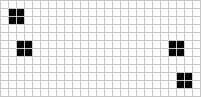
The blockade is a common formation of four blocks and is one of the familiar fours. A common evolutionary sequence that leads to its formation is known as lumps of muck, which can be seen by letting the stairstep hexomino evolve.
A half-blockade is an 8-bit constellation consisting of two blocks with two empty rows separating them, offset by one cell. It most commonly forms as part of a blockade, but there are ways it can form by itself, such as the heptomino that is the orthogonally connected part of the MWSS in its less dense phase.
| A half-blockade can eat an LWSS via the double block reaction. (click above to open LifeViewer) RLE: here Plaintext: here |
See also
External links
- Blockade at the Life Lexicon
- Blockade at Adam P. Goucher's Catagolue (pseudo-object)
- Half-blockade at Adam P. Goucher's Catagolue (pseudo-object)