20P4: Difference between revisions
No edit summary |
Neocaridina (talk | contribs) No edit summary |
||
| (15 intermediate revisions by 5 users not shown) | |||
| Line 10: | Line 10: | ||
|v = 0.95 | |v = 0.95 | ||
|sv = 0.95 | |sv = 0.95 | ||
|symmetry = .e | |||
|discoverer = Dean Hickerson | |discoverer = Dean Hickerson | ||
|discoveryear = 1992 | |discoveryear = 1992 | ||
|rulemin = B3/S23 | |rulemin = B3/S23 | ||
|rulemax = B378/S02378 | |rulemax = B378/S02378 | ||
|isorulemin = B3-cky/S2-n3-ceiy | |isorulemin = B3-cky/S2-n3-ceiy | ||
|isorulemax = B2i34-ajtyz5-kqr6-e78/S0234ceikny5-iq6-a78 | |isorulemax = B2i34-ajtyz5-kqr6-e78/S0234ceikny5-iq6-a78 | ||
| Line 24: | Line 24: | ||
|pentadecathlonid = 20P4.23 | |pentadecathlonid = 20P4.23 | ||
|viewerconfig = #C [[ HEIGHT 600 THUMBSIZE 3 ZOOM 36 GPS 2 LOOP 4 ]] | |viewerconfig = #C [[ HEIGHT 600 THUMBSIZE 3 ZOOM 36 GPS 2 LOOP 4 ]] | ||
}} | |||
'''20P4''' is an unnamed oscillator discovered by [[Dean Hickerson]] before April {{year|1992}}.<ref>{{CiteHickersonOscillators|accessdate=September 8, 2020}}</ref> It appears in [[Mark Niemiec]]'s [[Glider synthesis|synthesis]] collection as '''20-bit P4 #1'''. It gives off weak [[spark]]s. | '''20P4''' is an unnamed oscillator discovered by [[Dean Hickerson]] before April {{year|1992}}.<ref>{{CiteHickersonOscillators|accessdate=September 8, 2020}}</ref> It appears in [[Mark Niemiec]]'s [[Glider synthesis|synthesis]] collection as '''20-bit P4 #1'''. It gives off weak [[spark]]s. | ||
| Line 33: | Line 33: | ||
[[MathAndCode]] found an {{gliders|8}} [[synthesis]] of this oscillator on December 21, {{year|2021}}.<ref name="post139172" /> | [[MathAndCode]] found an {{gliders|8}} [[synthesis]] of this oscillator on December 21, {{year|2021}}.<ref name="post139172" /> | ||
Several phases of this oscillator have been analyzed as closely resembling that of [[inverted frutterfly]]. | Several phases of this oscillator have been analyzed as closely resembling that of [[inverted frutterfly]], one phase of it even being composed of the exact same "four Ls", arranged slightly differently; the phases then differ by one cell in the next generation, then three, then five. The connection in inverted frutterfly is two cells wide instead. | ||
== Other stabilisations == | == Other stabilisations == | ||
On 2022-10-13, an oscillator with two halves mutually supporting an unnamed object on a [[hat]] appeared in a D4_+1 symmetric soup submitted by the [[Open Science Grid]],<ref group=c name="xp4_aigo7zg88dj66z0hhrc66z5401e-occurrence" /> | On 2022-10-13, an oscillator with two halves mutually supporting an unnamed object on a [[hat]] appeared in a D4_+1 symmetric soup submitted by the [[Open Science Grid]],<ref group=c name="xp4_aigo7zg88dj66z0hhrc66z5401e-occurrence" /> | ||
There is another stabilisation, with two halves instead mutually supporting | There is another stabilisation, with two halves instead mutually supporting a [[longhorn]]. A stator variant<ref group=c>{{LinkCatagolue|code=xp4_orq2w8ozhxaaaaaarz3rb8w23|style=nobullet}}</ref> appeared in a soup submitted by [[Charity Engine]] on 2022-02-14,<ref group=c name="xp4_orq2w8ozhxaaaaaarz3rb8w23-occurrence" /> and the dimer form<ref group=c>{{LinkCatagolue|code=xp4_orq2w8o0o8w2qrozhxaaaaaaaaaxhz3rb8w23032w8br3|style=nobullet}}</ref> appeared in a soup submitted by the Open Science Grid on 2022-10-08.<ref group=c name="xp4_orq2w8o0o8w2qrozhxaaaaaaaaaxhz3rb8w23032w8br3-occurrence" /> | ||
{{gallery top}} | {{gallery top}} | ||
{{gallery item|{{EmbedViewer | {{gallery item|{{EmbedViewer | ||
| Line 60: | Line 60: | ||
== In other rules == | == In other rules == | ||
In the canonical phase, if one half is discarded and the L-tetromino has three cells added to make the remaining half rotationally symmetrical (with C2_2), forming two copies of the heptomino, it almost comprises an oscillator (that evolutionarily closely resembles 20P4), but on the fourth | In the canonical phase, if one half is discarded and the L-tetromino has three cells added to make the remaining half rotationally symmetrical (with C2_2 symmetry), forming two copies of the heptomino, it almost comprises an oscillator (that evolutionarily closely resembles 20P4), but on the fourth generation (T = 4) two cells in between the heptominoes will be born due to the B3q [[transition (rule definition)|transition]], cleanly destroying the pattern in two more generations. When the B3q transition is removed from the rule definition, resulting in a rule called qlife (B3-q/S23), the rotationally symmetric two-heptomino pattern works as an oscillator, though 20P4 itself is not an oscillator in qlife. | ||
{{EmbedViewer | {{EmbedViewer | ||
| Line 67: | Line 67: | ||
|viewerconfig = #C [[ HEIGHT 400 AUTOSTART GPS 2 LOOP 4 ]] | |viewerconfig = #C [[ HEIGHT 400 AUTOSTART GPS 2 LOOP 4 ]] | ||
|position = center | |position = center | ||
|caption = | |caption = qLife (B3-q/S23) 10P4 | ||
|apgcode = xp4_199iig/b3-qs23 | |apgcode = xp4_199iig/b3-qs23 | ||
}} | }} | ||
| Line 106: | Line 106: | ||
<ref name="xp4_orq2w8ozhxaaaaaarz3rb8w23-occurrence">{{cata|hashsoup/D4_+1/c_EDx6nFi8uhFi70201366/b3s23|the soup in question}}, {{cata|attribute/xp4_orq2w8ozhxaaaaaarz3rb8w23/b3s23/D4_+1|the attribution page}} (however, note that it has also occurred in {{cata|hashsoup/H4_+2/o_TvGqcYvTnXzb568870547/b38s23|a D4_+2 soup}} (in [[Pedestrian Life]] but {{cata|hashsoup/H4_+2/o_TvGqcYvTnXzb568870547/b3s23|working in Life also}}), with an {{cata|attribute/xp4_orq2w8ozhxaaaaaarz3rb8w23/b38s23/H4_+2|empty attribution page}} (so perhaps prior) but most likely by the [[Open Science Grid]] (so probably after August, when it began))</ref> | <ref name="xp4_orq2w8ozhxaaaaaarz3rb8w23-occurrence">{{cata|hashsoup/D4_+1/c_EDx6nFi8uhFi70201366/b3s23|the soup in question}}, {{cata|attribute/xp4_orq2w8ozhxaaaaaarz3rb8w23/b3s23/D4_+1|the attribution page}} (however, note that it has also occurred in {{cata|hashsoup/H4_+2/o_TvGqcYvTnXzb568870547/b38s23|a D4_+2 soup}} (in [[Pedestrian Life]] but {{cata|hashsoup/H4_+2/o_TvGqcYvTnXzb568870547/b3s23|working in Life also}}), with an {{cata|attribute/xp4_orq2w8ozhxaaaaaarz3rb8w23/b38s23/H4_+2|empty attribution page}} (so perhaps prior) but most likely by the [[Open Science Grid]] (so probably after August, when it began))</ref> | ||
<ref name="xp4_orq2w8o0o8w2qrozhxaaaaaaaaaxhz3rb8w23032w8br3-occurrence">{{cata|hashsoup/H4_+1/o_rL3Ge58aiqcb680858767/b3s23|the soup in question}}, {{cata|attribute/xp4_orq2w8o0o8w2qrozhxaaaaaaaaaxhz3rb8w23032w8br3/b3s23/H4_+1|the attribution page}}</ref> | <ref name="xp4_orq2w8o0o8w2qrozhxaaaaaaaaaxhz3rb8w23032w8br3-occurrence">{{cata|hashsoup/H4_+1/o_rL3Ge58aiqcb680858767/b3s23|the soup in question}}, {{cata|attribute/xp4_orq2w8o0o8w2qrozhxaaaaaaaaaxhz3rb8w23032w8br3/b3s23/H4_+1|the attribution page}}</ref> | ||
| Line 113: | Line 111: | ||
</references> | </references> | ||
==External links== | == External links == | ||
* {{LinkCatagolue|xp4_2e0771zw8ee074}} | * {{LinkCatagolue|xp4_2e0771zw8ee074}} | ||
* {{LinkPentadecathlonObject|20P4.23}} | * {{LinkPentadecathlonObject|20P4.23}} | ||
{{Sparker|p=4|type=domino|strength=moderate|strength2=weak}} | {{Sparker|p=4|type=domino|strength=moderate|strength2=weak}} | ||
{{Natural}} | {{Natural}} | ||
[[Category:Unnamed periodic objects]] | [[Category:Unnamed periodic objects]] | ||
__NOTOC__ | __NOTOC__ | ||
Latest revision as of 22:21, 15 January 2026
| 20P4 | |||||||||
| View animated image | |||||||||
| View static image | |||||||||
| Pattern type | Oscillator | ||||||||
|---|---|---|---|---|---|---|---|---|---|
| Number of cells | 20 | ||||||||
| Bounding box | 8 × 11 | ||||||||
| Period | 4 (mod: 4) | ||||||||
| Heat | 19 | ||||||||
| Volatility | 0.95 | 0.95 | ||||||||
| Kinetic symmetry | .e | ||||||||
| Discovered by | Dean Hickerson | ||||||||
| Year of discovery | 1992 | ||||||||
| |||||||||
| |||||||||
| |||||||||
| |||||||||
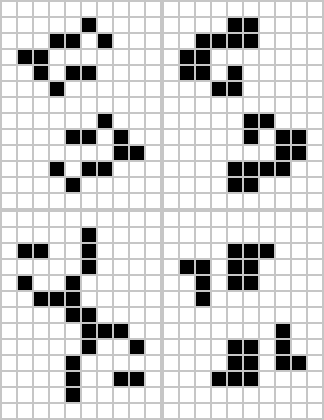

20P4 is an unnamed oscillator discovered by Dean Hickerson before April 1992.[1] It appears in Mark Niemiec's synthesis collection as 20-bit P4 #1. It gives off weak sparks.
Various names have been proposed for this oscillator, all along the lines of six Ls, including four Ls[2] due to generation 3 consisting of two L sparks and two L-tetrominoes.
It first appeared in an asymmetric soup submitted to Catagolue by Rob Liston on September 8, 2020.[3]
MathAndCode found an 8-glider synthesis of this oscillator on December 21, 2021.[4]
Several phases of this oscillator have been analyzed as closely resembling that of inverted frutterfly, one phase of it even being composed of the exact same "four Ls", arranged slightly differently; the phases then differ by one cell in the next generation, then three, then five. The connection in inverted frutterfly is two cells wide instead.
Other stabilisations
On 2022-10-13, an oscillator with two halves mutually supporting an unnamed object on a hat appeared in a D4_+1 symmetric soup submitted by the Open Science Grid,[c 1] There is another stabilisation, with two halves instead mutually supporting a longhorn. A stator variant[c 2] appeared in a soup submitted by Charity Engine on 2022-02-14,[c 3] and the dimer form[c 4] appeared in a soup submitted by the Open Science Grid on 2022-10-08.[c 5]
| The hat variant (click above to open LifeViewer) Catagolue: here |
| The Longhorn variant (click above to open LifeViewer) Catagolue: here |
In other rules
In the canonical phase, if one half is discarded and the L-tetromino has three cells added to make the remaining half rotationally symmetrical (with C2_2 symmetry), forming two copies of the heptomino, it almost comprises an oscillator (that evolutionarily closely resembles 20P4), but on the fourth generation (T = 4) two cells in between the heptominoes will be born due to the B3q transition, cleanly destroying the pattern in two more generations. When the B3q transition is removed from the rule definition, resulting in a rule called qlife (B3-q/S23), the rotationally symmetric two-heptomino pattern works as an oscillator, though 20P4 itself is not an oscillator in qlife.
| qLife (B3-q/S23) 10P4 (click above to open LifeViewer) Catagolue: here |
See also
References
- ↑ Dean Hickerson's oscillator stamp collection. Retrieved on September 8, 2020.
- ↑ Jeremy Tan (September 9, 2020). Re: Soup search results (discussion thread) at the ConwayLife.com forums
- ↑ praosylen (September 7, 2020). Re: Soup search results (discussion thread) at the ConwayLife.com forums
- ↑ MathAndCode (December 21, 2021). Re: Synthesising Oscillators (discussion thread) at the ConwayLife.com forums
- Catagolue
- ↑ the soup in question, the attribution page
- ↑ xp4_orq2w8ozhxaaaaaarz3rb8w23 at Adam P. Goucher's Catagolue
- ↑ the soup in question, the attribution page (however, note that it has also occurred in a D4_+2 soup (in Pedestrian Life but working in Life also), with an empty attribution page (so perhaps prior) but most likely by the Open Science Grid (so probably after August, when it began))
- ↑ xp4_orq2w8o0o8w2qrozhxaaaaaaaaaxhz3rb8w23032w8br3 at Adam P. Goucher's Catagolue
- ↑ the soup in question, the attribution page
External links
- 20P4 at Adam P. Goucher's Catagolue
- 20P4.23 at Heinrich Koenig's Game of Life Object Catalogs
- Patterns
- Oscillators with 20 cells
- Periodic objects with minimum population 20
- Patterns with 20 cells
- Patterns found by Dean Hickerson
- Patterns found in 1992
- Patterns that can be constructed with 8 gliders
- Oscillators
- Oscillators with period 4
- Oscillators with mod 4
- Oscillators with heat 19
- Oscillators with volatility 0.95
- Oscillators with strict volatility 0.95
- Oscillators with .e symmetry
- Sparkers
- Sparkers with period 4
- Domino sparkers
- Moderate sparkers
- Weak sparkers
- Natural periodic objects
- Unnamed periodic objects