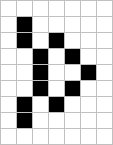
'''Queen bee''' is a pattern that lays two [[beehive]]s before exploding. Because of the way in which it lays those beehives, it is simple to stabilize into an [[oscillator]], as in the well-known [[queen bee shuttle]]. The term queen bee refers not just to the [[phase]] shown to the right, but also to any of the other phases of the pattern (excluding the beehives it creates) that occur before it explodes.
|name = Queen bee
|pname = queenbee
|type = Rotor
|c = 12
|bx = 7
|by = 5
|l = 191
|f = 30
|mcps = 12
|symmetry = D2_+1
|discoverer = Robert W. April
|discoveryear = 1970
|rulemin = B3/S23
|rulemax = B38/S238
|rulespecial = [[Conway's Game of Life|Conway Life]]
'''Queen bee''' is a somewhat commonly arising pattern that in 15 generations develops into a [[beehive]] and a reflected copy of itself. Left alone, after repeating this process another time, it crashes into the first beehive and explodes (splitting into two [[century|centuries]], which ultimately stabilize into six [[block]]s and two [[blinker]]s at generation 191). It was originally found by [[Robert W. April]] in {{year|1970}} by evolving two parallel lines of length 15 separated by a single empty column. It is simple to stabilize into an [[oscillator]] by deleting the beehives as they are formed, as in the well-known [[queen bee shuttle]]. The term queen bee refers not just to the [[phase]] shown to the right, but also to any of the other phases of the pattern (excluding the beehives it creates) that occur before it explodes.
==Turning reaction==
[[File:Queenbeegen21.png|thumb|center|Generation 21 of queen bee]]
One of the simplest reactions involves a queen bee involves colliding it with two [[glider]]s that come in from opposite directions in order to turn (reflect) it; this reaction was found by [[David Bell]] and was turned into a period 88 [[oscillator]] (shown below) on March 21, [[:Category:Patterns found in 1996|1996]]. The reaction itself turns the queen bee counterclockwise by 90 degrees in 22 [[generation]]s.<ref>{{CiteSummersPattern|name=jslife|accessdate=June 3, 2009}}</ref>
{| align="center" |
== Turning reaction ==
|-
One of the simplest reactions involves a queen bee involves colliding it with two [[glider]]s that come in from opposite directions in order to turn (reflect) it; this reaction was found by [[David Bell]] and was turned into a period 88 [[oscillator]] (shown below) on March 21, {{year|1996}}. The reaction itself turns the queen bee counterclockwise by 90 degrees in 22 [[generation]]s.<ref>{{CiteSummersPattern|name=jslife|accessdate=June 3, 2009}}</ref>
|caption = Queen bees often form along with a tub (Lifespan 1874). This can be seen in both the [[R-pentomino]] sequence around generation 770 and the [[p576 R-pentomino hassler]]
Queen bee is a somewhat commonly arising pattern that in 15 generations develops into a beehive and a reflected copy of itself. Left alone, after repeating this process another time, it crashes into the first beehive and explodes (splitting into two centuries, which ultimately stabilize into six blocks and two blinkers at generation 191). It was originally found by Robert W. April in 1970 by evolving two parallel lines of length 15 separated by a single empty column. It is simple to stabilize into an oscillator by deleting the beehives as they are formed, as in the well-known queen bee shuttle. The term queen bee refers not just to the phase shown to the right, but also to any of the other phases of the pattern (excluding the beehives it creates) that occur before it explodes.
Generation 21 of queen bee
Turning reaction
One of the simplest reactions involves a queen bee involves colliding it with two gliders that come in from opposite directions in order to turn (reflect) it; this reaction was found by David Bell and was turned into a period 88 oscillator (shown below) on March 21, 1996. The reaction itself turns the queen bee counterclockwise by 90 degrees in 22 generations.[1]
Queen bees often form along with a tub (Lifespan 1874). This can be seen in both the R-pentomino sequence around generation 770 and the p576 R-pentomino hassler (click above to open LifeViewer)