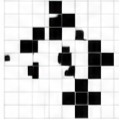
I’ve spent some time developing an "Adversarial Conway" framework called Hashwar, and I just launched the first tournament series, hoping to build it into a "computational sports" of sorts.
The goal was to move beyond passive observation and create a competitive environment for Conway’s Game of Life configurations. I’ve developed an adversarial meta-rule set where two glyphs are dropped into a shared "Arena" grid. Unlike standard Life, these patterns compete for territory—invading neutral cells and stealing space directly from their opponent.
The Tournament Format:
- Contenders: 32 unique configurations ("Glyphs") using S23/B3 on the 16x16 torus
Environment: A shared arena of cells.
Fairness: Each match consists of even rounds where contestants swap starting positions to account for any spatial bias.
Scoring: Based on cumulative point totals (territory control) over the final round.
I’d love to get your thoughts on the adversarial logic and which types of configurations you think will dominate this specific 16x16 ecosystem (which is a topic of active research on my part - I thought I knew the answer to that when I started but it turns out after a couple of matches, that I don't yet understand what makes certain Glyphs more successful than others).
Check out the Tournament Kickoff here:
https://youtu.be/WTwoMNvMx24
FAQ
■ What are the game pieces?
Called "Conway Glyphs", these are individual GOL configurations on the 16x16 torus following ruleset S23/B3. Additionally, they follow two more requirements.
■ Which additional requirements?
Firstly, we truncate their evolution at the first detected cycle, i.e. we do not allow repeating patterns.
Secondly, we calculate the SHA-256 hash value for a Glyph's initial configuration and subject it to requirements, e.g. they have to begin with a specific substring.
■ What is this hashing requirement about?
Hashing allows to uniquely identify individual Glyphs. Moreover, we use it as a "proof of work" method to level the playing field. Since we want Glyphs to compete against each other, anyone constructing particularly long lived patterns (or skimming them from the Internet) would have an advantage.
Moreover, hashing allows us to determine a Glyph's "intrinsic colour" when we interpret a particular substring of the hash value as hexadecimal RGB codes. This makes recognition of individual Glyphs much easier in a tournament.
Lastly, hashing allows us to effectively and quickly identify loops in the trajectory of a Life.
■ Is this a thinly-veiled crypto-project / scam?!
No, definitely not. Guarding myself against the "Cryptobros" has been close to my heart, so I set out to explain my opinion of them succinctly in this video: https://youtu.be/sl7AuIoElnA
In short, I HODL cyptoscammers in contempt.
■ Can anyone submit "Glyphs" to compete?
Yes! In fact, I would be delighted to find like-minded geeks who fret over finding the "ultimate" tournament champion "Glyph"!
I plan to publish the exact rules on how to generate a valid "Glyph" for a tournament soon. The computations needed require a modicum of technical Knowledge, but can be performed with, say, Excel, Python, Javascript etc.
■ How do we know your "Adversarial Conway" algorithm is fair?
I plan to publish the source code of my custom-built computational engine to GitHub soon and will gladly subject myself to public scrutiny. I'm just one dev (not a very good one) with a passion for CA, so I'm looking forward to the community poking holes in my 'Adversarial Conway' engine once the repo is live.