patterns where every cell has three ON neighbours

A forum for topics that don't fit elsewhere. Introduce yourselves to other members of the forums, discuss how your name evolves when written out in the Game of Life, or just tell us how you found it. Forum rules still apply.
Post Reply
User avatar
get_Snacked
Posts: 542
Joined: August 20th, 2022, 10:51 pm

patterns where every cell has three ON neighbours

Post by get_Snacked »

the block is the only known strict still life where every cell has three neighbours:

Code: Select all

x = 2, y = 2, rule = B3/S3
2o$2o!
however, with the usage of the T-tetromino, we can make a ton of infinitely extensible families which satisfy this condition:

Code: Select all

x = 6, y = 6, rule = B/S3
2b2o$bob2o$2o3bo$o3b2o$b2obo$2b2o!

Code: Select all

x = 2, y = 3, rule = B/S3:T0,3
bo$2o$o!

Code: Select all

x = 25, y = 21, rule = B/S3
4b2o10b2ob2o$3bob2o7b2ob2ob2o$2b2o3b2ob2ob2o7bo$2bo5b2ob2o8b2o$bo19bo
$2o20bo$o20b2o$bo19bo$2o20bo$o21b2o$bo21bo$b2o21bo$2bo20b2o$3bo19bo$2b
2o20bo$2bo20b2o$3bo19bo$2b2o8b2ob2o5bo$2bo7b2ob2ob2o3b2o$3b2ob2ob2o7b
2obo$4b2ob2o10b2o!

Code: Select all

x = 8, y = 10, rule = B/S3
2b4o$b2o2b2o$o6bo$2o4b2o$bo4bo$bo4bo$2o4b2o$o6bo$b2o2b2o$2b4o!
one can use double-sided crinkly heptominoes siamese other polyominoes to make more families of finite patterns:

Code: Select all

x = 10, y = 10, rule = B/S3
3b4o$2b2o2b2o$bo6bo$2o6b2o$o8bo$o8bo$2o6b2o$bo6bo$2b2o2b2o$3b4o!

Code: Select all

x = 24, y = 18, rule = B/S3
2b2o2b2ob2ob4o2b4o$bob4ob2ob2o2b4o2b2o$2o21bo$o21b2o$bo20bo$2o21bo$o21b
2o$o21bo$2o20bo$bo20b2o$bo21bo$2o21bo$o21b2o$bo20bo$2o21bo$o21b2o$b2o
2b4o2b2ob2ob4obo$2b4o2b4ob2ob2o2b2o!
another component using siamese tables:

Code: Select all

x = 13, y = 13, rule = B/S3
3bo2bo2bo$2b9o$bo9bo$2o9b2o$bo9bo$bo9bo$2o9b2o$bo9bo$bo9bo$2o9b2o$bo9b
o$2b9o$3bo2bo2bo!
this gives me hope for a second still life satisfying this condition: 2 born, 4 dead:

Code: Select all

x = 12, y = 6, rule = B3/S3
6b2o2b2o$b2o2bob4o$2b4o$6b4o$b4obo2b2o$2o2b2o!
questions:
  • can it be proven or disproven whether there exist other strict still lives where all cells have three ON neighbours?
  • is there a polyomino where every cell has three ON neighbours?
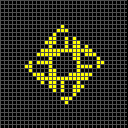
(i made this a topic because there are likely to be more polyomino components coming in the future that satisfy this condition, which i will post.)
User avatar
confocaloid
Posts: 6697
Joined: February 8th, 2022, 3:15 pm
Location: learn to protect yourself against stray gliders and sparks and self-destruct mechanisms

Re: patterns where every cell has three ON neighbours

Post by confocaloid »

get_Snacked wrote: October 4th, 2024, 1:13 pm the block is the only known strict still life where every cell has three neighbours:
[...]
can it be proven or disproven whether there exist other strict still lives where all cells have three ON neighbours?
[...]
confocaloid wrote: September 3rd, 2024, 4:27 am [...]
Crossposting a proof from another thread.
wiki/Block wrote: Block is [...] the only finite strict still life where all living cells have three neighbors. [...] Any such still life would remain a still life in B3/S3. A proof that there are no finite strict still lifes other than the block in B3/S3 was cross-posted from Discord in August 2023, settling an open problem.
LaundryPizza03 wrote: August 9th, 2023, 11:10 pm Here's a proof from rachel at Discord that there are no 3-cell spaceships in B2a that travel at a speed (X,Y)/P with X+Y = P and X,Y ≠ 0.
[...]
[...]
They also proved that there are no still lifes other than the block in B3/S3 (actually, B3aijnq/S3):
the trick is to ignore all blocks in the hypothetical SL. then we just look at an edge of the bounding diamond of the rest (for ease of writing, let's specify that it's the top right edge).
first, notice that we can't have o$2o on that edge, since that would make a B3a outside of the bounding diamond of the blockless part of the SL, so we could only prevent that with blocks, which would force an infinite amount of blocks via B3nq.
then notice that if there was a 2o$o on the edge, then (since we're not making a block) the top left cell could only be stabilized through S3k, and if the top left cell of that S3k didn't have a live cell above it, that would cause a B3j which once again can't be stopped by finitely many blocks. so the top left cell of the S3k must have a live cell c1 above it. now to stabilize c1 without overpopulating the cell below c1, we need a live cell c2 to the top left of c1, and then to prevent o$2o on the edge, we need a live cell to the bottom left of c1. but then to stabilize c2 without overpopulating c1, we either make another 2o$o further up the edge of the bounding diamond, or we have a live cell c3 to the top left of c2, and in the latter case, again to prevent o$2o, we need a live cell to the bottom left of c2. to stabilize c3 without overpopulating c2, we then need to either make another 2o$o further up the edge of the bounding diamond, or we have a live cell c4 to the top left of c3, and in the latter case, again to prevent o$2o, we need a live cell to the bottom left of c3. this continues on, and since our still life is finite, we're eventually forced to choose the first option and make another 2o$o further up the edge of the bounding diamond. so a 2o$o forces another one further up, but that will force yet another, etc. and our SL will be infinite. so we can't have a 2o$o on the edge at all.
now, since there can't be an o$2o or a 2o$o on the edge, this means that if any live cell on the edge had a live VN neighbor, then it could only have two neighbors, and that's a problem because we only have S3. but no VN neighbors leaves only S3c as a possibility, and each S3c on the edge forces another S3c further up on the edge, so we once again get an infinite SL.
so no matter what, the blockless part of the SL would have to be infinite or empty. and if it's empty, then... well the SL itself would just be a bunch of blocks, it doesn't count as a separate SL.

edit: i think i didn't explain well enough why the top left cell of the 2o$o must be stabilized with an S3k (and not with e.g. an S3j). it's because the 2o$o is forced to be part of a 2o$obo$bo, so the bottom left cell of the 2o$o already has 3 neighbors. this only works because we're on the edge of the bounding diamond, otherwise the 2o$obo$bo wouldn't be forced.
127:1 B3/S234c User:Confocal/R (isotropic CA, incomplete)
Unlikely events happen.
My silence does not imply agreement, nor indifference. If I disagreed with something in the past, then please do not construe my silence as something that could change that.
Post Reply