Pavgran wrote: January 28th, 2022, 8:55 pm
PaulKwiatkowski wrote: January 28th, 2022, 3:39 am
Does anyone recognize it?
I do.
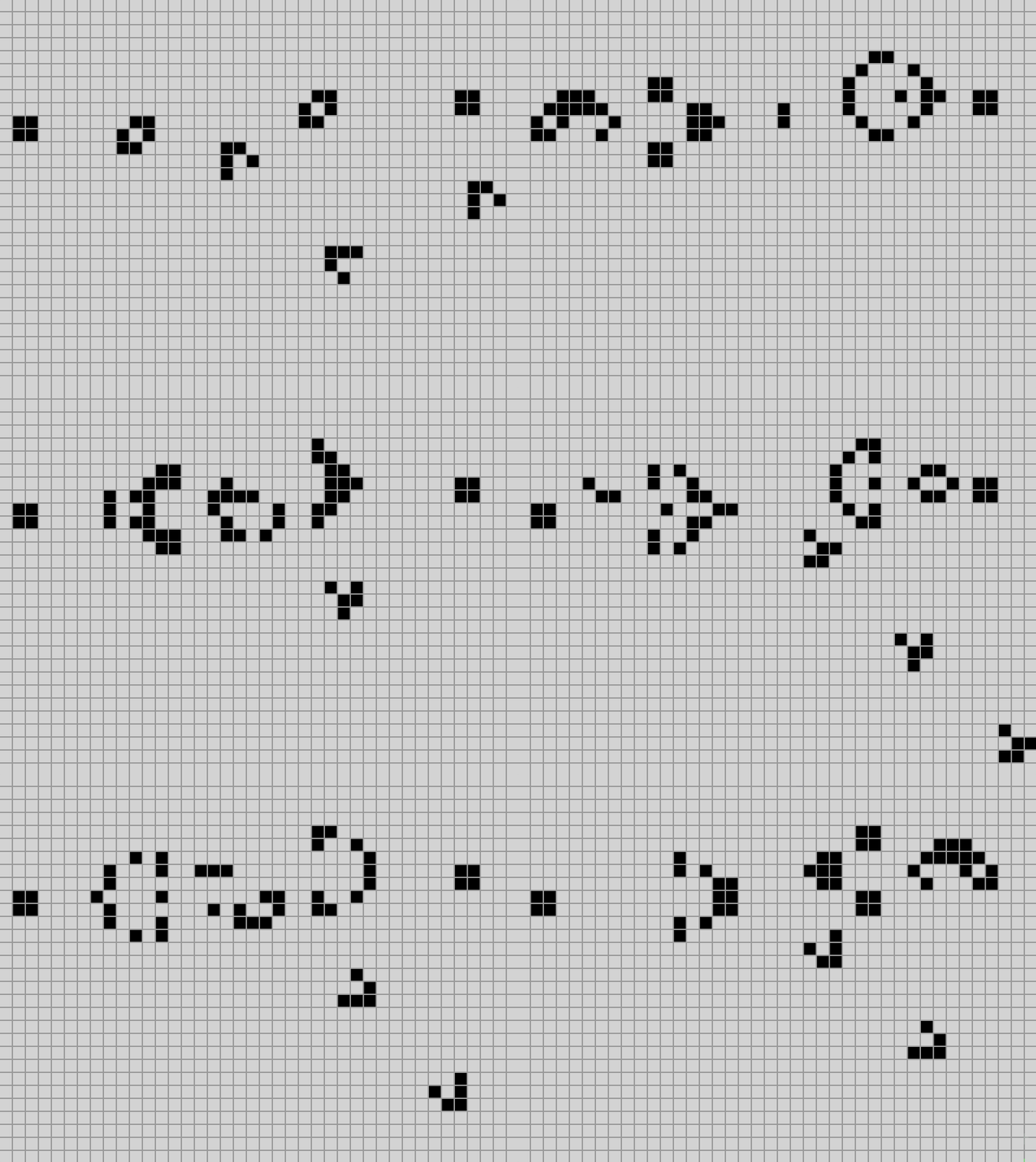
It's in Winning Ways for Your Mathematical Plays: Volume 4, Chapter 25: What is Life?, Figure 26. Thirteen Gliders Build Their Own Gun.
Screenshot 2022-01-29 035317.png
Aha, that's definitely the missing clue! It seems like that Winning Ways figure is a re-presentation of the MIT group's original recipe, which was thirteen gliders colliding
at right angles to produce a glider gun. The two-direction synthesis seems to have been intended to allow for building a breeder using thirteen backrakes. The full glider synthesis appeared in Martin Gardner's second column on Life, in the February 1971 issue of _Scientific American_, credited to the "MIT Group":
The glider gun led the M.I.T. group to many other amazing discoveries. A series of printouts (supplied by Robert T. Wainwright of Yorktown Heights, N.Y.) shows how 13 gliders crash to form a glider gun [see Figure 140].
Code: Select all
x = 42, y = 25, rule = B3/S23
34bo$34bobo$o21bobo9b2o$obo19b2o$2o6bobo12bo$8b2o$9bo2$36b3o$36bo$2b3o
18b2o12bo$2bo20bobo3bo$3bo5b2o12bo4b2o$9bobo3bo12bobo$9bo4b2o4b2o$14bo
bo3bobo$20bo$39b2o$39bobo$39bo3$28b3o$28bo$29bo!
(Bob Wainwright was not the inventor of the recipe, just the chronicler -- he was producing LIFELINE newsletters at the time. It's probably simplest to attribute the 13-glider recipe to either Bill Gosper specifically, or the M.I.T. group in general; I can't find a specific reference to the recipe in descriptions of who built which pieces of the breeder.)
I don't think that any actual breeder was ever constructed using that 13-glider recipe -- maybe that was the design that Michael Speciner tried that didn't quite work? It might have been a little tricky to get those last few gliders synchronized, since they had to show up on nearby lanes one right after another. Rake-based syntheses work better when only one glider at a time has to come in from each side, paired with one glider from the other side.
EDIT: Apparently there were other issues -- here's a small amount of detail from an email discussion between Dean Hickerson and Bill Gosper from August 16, 1994, and a description of the design and its flaws from LIFELINE.
Dean Hickerson wrote / Bill Gosper wrote:
***** Was that the first? LifeLine 3:7 says that Michael
***** Speciner tried to build a breeder, but it's not clear
***** if it worked.
It didn't...
LifeLine 3.7, September 1971:
The fastest growth possible in a two dimensional cellular automaton
(Life) is as a quadratic function of age, since any finite form will
stay inside a circumscribed square which expands at the speed of light
in all four directions. Speciner of the M.I.T. group designed and
attempted to construct and test such a quadratic device. It consisted
of two groups of twelve Glider Trains receding from each other along
the X axis, launching period 128 rearward gliders which assembled Guns
on the Y axis every 384 generations. Unfortunately, the population
exceeded 21,000 bits before it completed its first Gun! Also,
additional Glider Trains may have been needed to build eaters to
inhibit Gun outputs from provoking Train debris which would
counterattack the Guns.
Anyway, by the time the original breeder was done, it used only ten puffer/rakes instead of thirteen; it puffed two of the blocks directly instead of glider-constructing them, and also fixed the inefficiency I pointed out above -- it starts up the queen-bee shuttles in a way that doesn't need a quick cleanup of a too-early beehive. So the pattern displayed in the original post's GIF has been officially out of date for over half a century now (!).