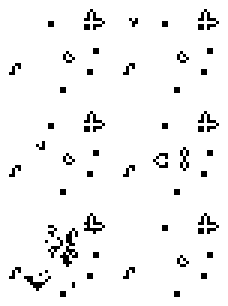
x = 10, y = 10, rule = greycells
3.B2.B3$B4.3A.B$5.A.A$5.A.A$B8.B3$3.B2.B!
I could have sworn this had a Life analog, but I guess I was wrong.
It's called Gourmet. The pattern also works on an 8x8 bounded grid, that might be where you recognised it from.
Apologies for bringing this thread back after a year but I have to link to my earlier oscillator collections from this rule as they're in unrelated threads. Namely the two posts here and my stamp collections here. I've attempted to "solve" some of these rotors with various search programs, especially the ones with few always-off cells required, but none of my attempts were successful. This pulsar-esque P19 can be polymerised to stabilise two sides, but I wasn't able to finish the job with stators or catalysts in regular Life:
Hello again! Sorry for this, it is a bit off-topic, I think there is a script for finding these oscillators and I’m missing it. Where can I find it?
It's in this post here. Note it's a horrible script I cobbled together when I had almost no prior coding experience (I work in data science now), it mostly relies on custom rules to do the work and it tends to create duplicate files with the same oscillators. I wouldn't recommend running my old scripts if you have any capability of creating a better one.
It would be interesting to have some sort of apgsearch-based script which would upload results to Catagolue but I doubt the apgcode format is compatible. Rather than a 16x16 random soup with all states you could generate soups of state 0 and 1 cells, with a sparse arrangement of state 2 cells around the border... or maybe common methuselae like T-tetrominoes and B-heptominoes surrounded by a random scattering of grey cells. I doubt the results would be particularly useful since the rule is already known to be omniperiodic and I've had no success replacing grey cells with Life catalysts, but who's to decide what's "useful" and who's to say there won't be a surprise really-close-to-Life P19 that can be solved with LLS...