Rotation but no reflection (C4) MAP rules

For discussion of other cellular automata.
Post Reply
User avatar
Rhombic
Posts: 1100
Joined: June 1st, 2013, 5:41 pm

Rotation but no reflection (C4) MAP rules

Post by Rhombic »

These rules always preserve the rotational symmetry (i.e. a given pattern evolves in the same way when rotated by 90º) but not reflection symmetries (i.e. a pattern with a mirror plane does not preserve the mirror plane).
A reflection of a pattern evolves differently. C4 symmetry is preserved throughout.

Example: B36a*/S23 (clockwise symmetry)

Code: Select all

x = 21, y = 12, rule = MAPARYXfhZofugWaH7oaIDogBZofuhogOiAaIHogIAAgAAWaH7oaIHogGiA6ICAAIAAaIDogIAAgACAAIAAAkAAAA
3o5bo3b2o4b3o$2bo3bobo3bo5bobo$b2o3b3o3b3o3bo7$3o4b2o3bo5b3o$obo5bo3bo
bo3bo$2bo3b3o3b3o3b2o!

Ironically, only C1-symmetric non-totalistic neighbourhoods can allow this kind of C4 MAP rules.
------Henceforth, a bit of a digression

Moore neighbourhood is D4 symmetry (because the corners are not equivalent to edges)
Each isotropic non-totalistic neighbourhood, due to the rotate4reflect, can be analysed with basic group theory.

Code: Select all

.....E.....2C4.....C2.....2σ(i).....2σ(n)
A1...1.....1.....1.....1.....1
A2...1.....1.....1.....-1.....-1
B1...1.....-1....1.....1.....-1
B2...1.....-1....1.....-1.....1
E....2.....0.....-2.....0.....0
NB. the (i) and (n) for σ are used because that is the way we tend to refer to the Hensel notation of neighbourhoods. I will consider them equivalent to v(vertical) and d(dihedral) respectively.

Assigning symmetry to each neighbourhood should be easy (I have somehow messed up though and I think I have the wrong approach). Considering the 8 neighbours, what I have done that probably is wrong is to check each transformation and count the number of unchanged cells within the neighbourhood.
E=8; 2C4=0; C2=0; 2σ(i)=2; 2σ(n)=2

which is a reducible representation equivalent to 2 A1 + B1 + B2 + 2 E.

How do I move on and get the symmetries of each neighbourhood within this representation? It's obvious that for this thread title you need "chiral" neighbourhoods to get any kind of rotate-but-not-reflect thing going on.
SoL : FreeElectronics : DeadlyEnemies : 6a-ite : Rule X3VI
what is “sesame oil”?
User avatar
Rhombic
Posts: 1100
Joined: June 1st, 2013, 5:41 pm

Re: Rotation but no reflection (C4) MAP rules

Post by Rhombic »

In B34z'/S234z* (where ' is anticlockwise and * clockwise), a knightship puffer that, obviously, works in the same way when rotated.

Code: Select all

x = 28, y = 25, rule = MAPARYXfhZofugWaH7oaIjogBZofuhogOiAaIDqgIAAgAAWaH7oaIDowGiA6ICAAIAAeIDogIAAgACAAIAAAAAAAA
19b3o$20b3o$16bob4o$16b4o$18b2o2$20b3o$20b2obo$18bo2bobo$16b3o3bo$17bo
2$16b2o$6bo$o20bo$2o19bo$4b3o6b2o6b3o$2b2o3bo4b4o6b3o$7bo4bob3o5bo2bo$
3bo4b3o9b3o$5b2o3bo7bobobo2bo$7bo2bo6bo2bob3obo$7bobo8b2o2b2ob3o$7b3o
14b3o$8b2o14bo!
B36k*/S23:

Code: Select all

x = 33, y = 9, rule = MAPARYXfhZofugWaH7oaIDogBZofuhogOiAaIDogIEAgAAWaH7oaIDogGiA6ICAEIAAaIDogIAEgACAAoAAAAAAAA
2ob6o15b6ob2o$2ob6o15b6ob2o$2o29b2o$2o5b2o15b2o5b2o$2o5b2o15b2o5b2o$2o
5b2o15b2o5b2o$7b2o15b2o$6ob2o15b2ob6o$6ob2o15b2ob6o!
SoL : FreeElectronics : DeadlyEnemies : 6a-ite : Rule X3VI
what is “sesame oil”?
User avatar
Rhombic
Posts: 1100
Joined: June 1st, 2013, 5:41 pm

Re: Rotation but no reflection (C4) MAP rules

Post by Rhombic »

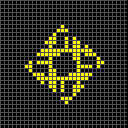
B3-q'/S23 shows a peculiarity of rotational symmetry where not only overall positioning but also relative rotation has an impact on frequency of constellations. Obviously, if you start with a C2 or C4 pattern, the symmetry is preserved, but any improper symmetries (reflections) are not carried on. This leads to a familiar four in B3-q'/S23 that is common as one exclusive enantiomer, whereas the opposite chirality enantiomer is the common familiar four in the -q* variant:

Code: Select all

x = 13, y = 13, rule = MAPARYXfhZofugUaH7oaIDogBZofuhogOiAYIDogIAAgAAWKH7oKIDogGiA6ICAAIAAaIDogIAAgACAAIAAAAAAAA
6bo$5bobo$5bo2bo$6b2o$2bo$bobo6b2o$o2bo5bo2bo$b2o6bobo$10bo$5b2o$4bo2b
o$5bobo$6bo!
Bear in mind that the lack of improper degeneracy means that all spaceships are equally common in all directions EXCEPT oblique spaceships, because orthogonal directions are equivalent in C4 symmetries (think 1e or 2i), as well as diagonal (think 1c or 2n) but not oblique (like 2k, for which you can't emulate every single 2k neighbourhood by using only rotation: you also need reflection).
Knightships of all kinds will have a certain favoured slope or even only one where they function, rotationally degenerate. To classify this, I have thought of the following idea: given the two possible oblique spaceships that go in the general directions between North, Northeast and East, if the favoured/allowed spaceship is the one between...
  • ... N and NE, the spaceship in this rule would have "steep" induction/specificity, because the favoured/allowed angle from the x axis is greater than 45º
  • ... NE and E, the spaceship in this rule would have "shallow" induction/specificity, because the favoured/allowed angle from the x axis is smaller than 45º
This can be extrapolated for naming knightships in isotropic rules: a NEsh Gemini in regular CGoL would be that that fulfils the former definition. A SEsh one is a 90º rotation (clockwise) of the NEsh Gemini, the SWsh is a 180º rotation of the NEsh one, and NWsh a 270º rotation. The steep ones (NEst, etc) can be defined in the same way starting from the NEst Gemini.

NB. C4 MAP rules have no rotamers. Rotations of any pattern are equally likely to occur.
SoL : FreeElectronics : DeadlyEnemies : 6a-ite : Rule X3VI
what is “sesame oil”?
User avatar
confocaloid
Posts: 6697
Joined: February 8th, 2022, 3:15 pm
Location: learn to protect yourself against stray gliders and sparks and self-destruct mechanisms

Re: Rotation but no reflection (C4)

Post by confocaloid »

At least some of these cellular automata can be defined using a notation other than MAP rulestrings.

I think a weighted definition is more illuminating in this case. I used the following neighbourhood weights:

Code: Select all

5 5 1
1 0 1
1 5 5

Code: Select all

x = 106, y = 104, rule = R1,C0,S2-3,6-7,10-11,15,B3,7,11,15,18,NW551101155
52b3o$51bo2bo$54bo$50bo3bo$50bo3bo$54bo$51bobo4$52b3o$51bo2bo$54bo$50b
o3bo$54bo$51bobo4$52b3o$51bo2bo$38b2o14bo$38bobo13bo$39b3o9bobo$39b2o$
34b2o7$79bo$79bo3$82b2o$38b3o24b3o12b2obo$38bo28bo12b3o$39bo26bo14bo4$
53bo$52bobo$52bobo$53bo3$92bo8b2o$6o4b5o4b4o23b2o5bo5b2o21bo2bo4bo3bo
4bo4bo$o5bo3bo4bo3bo3bo21bo2bo3b3o3bo2bo24bo8bo9bo$o9bo8bo26b2o5bo5b2o
21bo3bo3bo4bo3bo5bo$bo4bo4bo3bo4bo2bo59b4o4b5o4b6o$3b2o8bo2$53bo$52bob
o$52bobo$53bo$23bo$22b3o$21bob2o$21b2o$39bo26bo$38bo28bo$25bo12b3o24b
3o$25bo11$66b2o$61b2o$52bobo5b3o$51bo9bobo$51bo10b2o$51bo2bo$51b3o4$
52bobo$51bo$51bo3bo$51bo$51bo2bo$51b3o4$52bobo$51bo$51bo3bo$51bo3bo$
51bo$51bo2bo$51b3o!
Without the living condition B18, it would be plain Conway's Life:

Code: Select all

x = 3, y = 3, rule = R1,C2,S2-3,6-7,10-11,15,B3,7,11,15,NW551101155
b2o$2o$bo!
#C [[ ZOOM 4 STOP 1103 ]]
To preserve both 90-degree rotation symmetry of the rules and the four standard spaceships, each of the following sets of living conditions can either be completely included or completely excluded:

Code: Select all

B3,B15
B4,B20
B9,B21
B14,B22
B18
B24
S4,S20
S9,S21
127:1 B3/S234c User:Confocal/R (isotropic CA, incomplete)
Unlikely events happen.
My silence does not imply agreement, nor indifference. If I disagreed with something in the past, then please do not construe my silence as something that could change that.
Post Reply