WhiteHawk wrote: December 13th, 2024, 12:47 pm
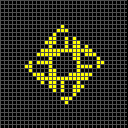
Does Eater 2 work (6x6)? Can take 4 gliders
...
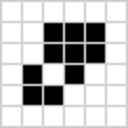
For 1 glider, maybe eater 1 on block?
"Any one glider" seems to imply that the protective layer needs to surround the block in all directions, and that the single glider can come from anywhere.
Also the question doesn't require that the protective layer has to survive the impact unchanged -- it depends on what "it" refers to.
If the protective layer _doesn't_ have to survive unchanged, then the old standard candidate for single-glider protection is a sparse field of blocks. Basically, start dropping these
Code:
Select all
x = 55, y = 44, rule = LifeHistory
.D10.D18.B$2.D10.D16.3B$3D8.3D16.3B$.15B13.5B$2.15B8.B3.5B3.B$3.15B5.
4B.7B.4B$4.15B4.17B$5.15B2.19B$6.15B.19B$16.26B.B$17.28B$15.B2.27B2.B
$14.35B$13.37B$13.37B$13.37B$12.39B$11.41B$11.41B$11.41B$11.41B$11.41B
$11.41B$9.45B$8.47B$9.21B2C22B$11.3B2.14B2C15B2.3B$11.3B2.31B2.3B$12.
B4.29B4.B$17.29B$18.13B.13B$18.12B3.12B$16.11B9.11B$15.12B9.12B$15.11B
11.11B$15.12B9.12B$13.15B7.15B$13.15B7.15B$14.14B7.14B$15.11B11.11B$16.
9B13.9B$18.7B13.7B$21.3B15.3B$22.2B15.2B!
-- or better yet, these
Code:
Select all
x = 62, y = 62, rule = LifeHistory
54.D$54.D.D$52.D.2D$51.2D$51.2D$.D10.D17.2B19.2D$2.D10.D15.4B18.2D$3D
8.3D15.4B18.2D$28.6B17.2D$2.15D7.2B2.6B2.2B13.2D$3.15D4.18B11.2D$21.20B
10.2D.D$18.26B7.2D.D.D$17.28B6.2D.2D$16.30B5.2D$16.30B5.2D$14.34B3.2D
$13.36B2.D$12.38B$12.38B$12.38B$11.40B$10.42B$10.42B$9.44B$9.44B$10.42B
$10.42B$8.46B$6.50B$5.25B2A25B$5.25B2A25B$6.50B$8.46B$10.42B$10.42B$9.
44B$9.44B$10.42B$10.42B$11.40B$12.38B$12.38B$12.38B$10.D2.36B$9.2D3.34B
$9.2D5.30B$9.2D5.30B$6.2D.2D6.28B$5.D.D.2D7.26B$7.D.2D10.20B$9.2D11.18B
4.15D$9.2D13.2B2.6B2.2B7.15D$9.2D17.6B$9.2D18.4B15.3D8.3D$9.2D18.4B15.
D10.D$9.2D19.2B17.D10.D$9.2D$9.2D$6.2D.D$5.D.D$7.D!
-- around the block at the safe distance prescribed by the blue envelope.
We're protecting a single block with blocks here, so the shadow of a block is just the right size to hide a block from any incoming glider. Four blocks is enough to provide a single-glider-stopping SafetyShield for the white block -- 38x38:
Code:
Select all
x = 38, y = 38, rule = LifeHistory
2A34.2A$2A34.2A17$18.2C$18.2C17$2A34.2A$2A34.2A!
The same idea works to protect arbitrarily large areas, not just block-sized ones -- just have to make sure to drop enough well-separated blocks that all incoming glider lanes are protected by the red marks.
There's probably something smaller than 38x38, but the analysis quickly gets a lot more complicated.
Dealing with more than one glider is an even more difficult project -- to the point where it would be quite painful to design even a two-glider-stopping SafetyShield, let alone a three-glider-stopping one.
Once you start dealing with multiple gliders, the other question that you have to answer is whether it's okay to assume that the previous collision settles before the next glider comes in -- or if all of the gliders are allowed to arrive at any time. For the second option, the number of cases to analyze quickly gets unmanageably large as the number of gliders increases.
With careful placement, it might work to add a bunch more blocks to protect against "any one [glider|LWSS|MWSS|HWSS]". But even that gets somewhat tricky due to cases like this:
Code:
Select all
x = 49, y = 39, rule = LifeHistory
.5C$C4.C5.2A34.2A$5.C5.2A34.2A$C3.C16$29.2C$29.2C17$11.2A34.2A$11.2A34.
2A!
You have to shield your diagonal shielding blocks from orthogonal attacks, by adding more blocks on the same diagonals, and more orthogonally off to the sides.
I think there aren't any really big ugly *WSS+block methuselahs, luckily. Anything that explodes with lots of gliders would be pretty tricky to deal with, but maybe the worst explosions are slightly offset pi explosions, which just means maybe expanding the "safe" envelope around the block a little bit.