A
structure is the pattern (arrangement of cells) that evolves in a specific way.
INT structure analysis is the study of requirements that two-state range-1 INT rules should meet to have specific structures.
The rule has the structure if it allows any configuration that structure's minimum allow and allows no configuration that structure's maximum doesn't allow.
Minimum of a structure is the rule that allows only configurations that are required to have that structure.
Maximum of a structure is the rule that allows all configurations that don't prevent it from having that structure.
For example, Life glider's minimum is B3aijr/S2ae3jnr and maximum is B2ink34-r5-n678/S234-k5678. Minimum and maximum together form the
scope of the structure.
Code:
Select all
x=15, y=4, rule=B2e3ei/S2cen3-a4a
7bo$3o3b3o$obo4b2o$obo5bo!
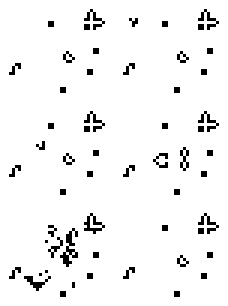
is the p2 c/2o pi-heptomino spaceship present on the left of the pattern. I discovered it when I realized that pi-heptomino in IceB (I didn't publish it because it turned out to be uninteresting) is a failed spaceship and I decided to construct by hand an INT rule in which it works. I ended up with the whole family of such rules - the
PSR (Pi Spaceship Rules). It has the scope B2e3i/S2ce3nq to B2-ac3-a4-i5-y67c8/S1c2-a3-a4-i5678.
A
wanderer is the p4 c/4d spaceship present on the right of the pattern. It's very common in pseudo-random soups in Class A and B
WR (Wanderer Rules). It has the scope B2e3ei/S2cn3i4a to B2-ac3-a45678/S1e2-a34-er5-a678. Due to striking similarities to Life glider (including speed, direction, period, p2 translation and frequency in random soups) it's an ideal counterpart of glider in rules with B2e but without B3a.
PS&WR are rules with both Pi Spaceship and wanderer. The compound structure corresponding to the pattern above has scope B2e3ei/S2cen3inq4a to B2-ac3-a4-i5-y67c8/S2-a3-a4-eir5-a678. Removing one of the spaceships from such rule is easy: add configuration S1e to remove Pi Spaceships and S1c to remove wanderers.
PSWR (Pi Spaceship or Wanderer Rules) are rules that have either Pi Spaceships, wanderers or both. Because Wolfram classification is too general for them, I decided to create
PSWR classification system (PSWRCS) based on how random soups evolve:
- In
Class A (Ash) rules, a random soup quickly evolves into an ash consisting of still lives, oscillators and spaceships (usually wanderers) regardless of their size. Rules that allow a sparse amount of configurations allowed often fall into this class. Life doesn't belong to this class because random soups in it tend to stabilize after a long time.
- In
Class B (Growing Chaos) rules, a random soup evolves into pool of chaos that (unlike the Class C chaos diamonds) has no stable border and slowly but inexorably grows. Still lives, oscillators and spaceships appear very often, but only the latter survive because the former two are quickly destroyed by a surrounding chaos.
-In
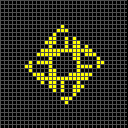
Class C (Expanding Chaos Diamond) rules, a random soup turns into a chaos diamond with borders quickly expanding with a constant speed (usually c or c/2). No stable structures appear in it.
-In
Class D (Space Battle) rules, a random soup turns into a mess consisting of semi-stable moving objects which create another moving objects which collide creating more mess. No stationary objects are found, but these rules are full of various moving objects, often replicating (spaceships, rakes, breeders, repliships (see below) etc.).
StellarRace is an excellent example of that class.
(it isn't finished; new classes will probably be added in the future.)
Code:
Select all
x=15, y=4, rule=B2e3-a4-ai/S2-a34-ai
6bo$2b6o$3o4bo$2b6o$6bo!
A
repliship (or replicating spaceship / Zergship) is a spaceship-like object that leave behind its own copy when moving and it copies often collide, creating a mess full of moving objects. An example is shown above. Repliships are a local pecularity of Class D rules, which are surrounded by replicator rules on one side and explosive spaceship rules (Class D2?) on the other side.
A
simple structure is a structure which doesn't create other structures, a
stationary structure is a structure which has a constant part which doesn't move and an
growing structure is a structure whose unmoving part increases over time.
A
moving object is an object which consists of
head which constantly shifts by a constant number of cells in a constant number of generations, and a
tail which can be anything, with one requirement - it cannot disrupt the head's motion.
A
spaceship is a moving object which has no tail.
A
puffer is a moving object whose tail consists of simple objects.
A
rake is a puffer whose tail consists of spaceships.
A
breeder is a stationary/moving object whose tail consists of objects which create simple objects.
A
moving replicator is a moving object whose tail consists of a copy/copies of the head.
A
repliship is a moving replicator which leave its copy behind it (possibly rotated and/or reflected), later inexorably causing its copies to interact and make chaos-like mess.
edit: fixed some typos