
3D.lua
Re: 3D.lua
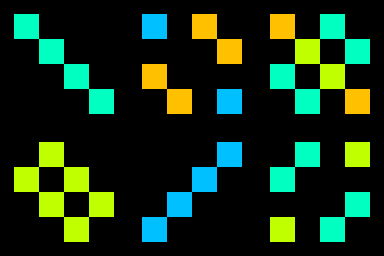
New neighbourhood suggestion: currently hexagonal rules are simulated using a square grid neighbourhood which resembles the intersection of two 2x2 squares. How about adding a new neighbourhood which comes about as the intersection of two 2x2x2 blocks (with the one intersecting cell being the center)? It probably wouldn't be as good an analogue as the hexahedral neighbourhoood but would be interesting to see.
Parity Replicator Collection v1.6 is now live - please send all relevant discoveries here.
-
Andrew

- Moderator
- Posts: 1048
- Joined: June 2nd, 2009, 2:08 am
- Location: Melbourne, Australia
- Contact:
Re: 3D.lua
Given the lack of interest in the currently supported neighborhoods I'd have to say the chances of me implementing a new one are zilch.muzik wrote:New neighbourhood suggestion: ...
Re: 3D.lua
Is 3D.lua tied to the currently set refresh rate? Patterns seem to whizz past compared to normal 2D Golly patterns, leading to the conclusion that it's using the 144hz monitor refresh rate rather than a fixed 60fps (which is preferable for some things, but not always others).
Parity Replicator Collection v1.6 is now live - please send all relevant discoveries here.

Re: 3D.lua
From my brief experiment on Windows 11: Golly uses the monitor refresh rate for the event loop. This is both for 3D.lua and if you're running B3/23 in QuickLife.muzik wrote: June 4th, 2024, 8:28 am Is 3D.lua tied to the currently set refresh rate? Patterns seem to whizz past compared to normal 2D Golly patterns, leading to the conclusion that it's using the 144hz monitor refresh rate rather than a fixed 60fps (which is preferable for some things, but not always others).
LifeViewer https://lazyslug.com/lifeviewer LifeViewer Pro https://lazyslug.com/lifeviewer/pro
-
Andrew
- Moderator
- Posts: 1048
- Joined: June 2nd, 2009, 2:08 am
- Location: Melbourne, Australia
- Contact:
Re: 3D.lua
Actually, Golly uses a 60 hertz timer to generate patterns, so if you run a small pattern like a blinker at a step size of 1 it should do about 600 generations in 10 seconds, regardless of the monitor's refresh rate (see StartGenTimer in wxcontrol.cpp). If you don't see that on Windows 11 then something is going wrong.rowett wrote: June 4th, 2024, 10:44 am From my brief experiment on Windows 11: Golly uses the monitor refresh rate for the event loop. This is both for 3D.lua and if you're running B3/23 in QuickLife.
Scripts that generate patterns (like 3D.lua) are a different matter. It is up to the script to decide if it wants to update patterns at a particular frame rate. If you look at the EventLoop routine in 3D.lua it calls NextGeneration as fast as it can go (g.sleep is only called when not generating a pattern). If I run the following small oscillator in 3D.lua on my Windows 10 VM it does about 170 gens per second. I'd be interested to see what speed you get on Windows 11.
Code: Select all
3D version=1 size=45 pos=21,21,21
x=3 y=3 z=4 rule=3D4,7/5,8
$bo/bo$bbo$obo/bo$bbo$obo/$bo!
Re: 3D.lua
I don't see that. My experiment was pretty much as you suggested. I ran a simple pattern in 3D.lua and measured 600 steps in 10 seconds (60 per second). I then ran a blinker in B3/S23 QuickLife and measured the same.Andrew wrote: June 5th, 2024, 5:18 amActually, Golly uses a 60 hertz timer to generate patterns, so if you run a small pattern like a blinker at a step size of 1 it should do about 600 generations in 10 seconds, regardless of the monitor's refresh rate (see StartGenTimer in wxcontrol.cpp). If you don't see that on Windows 11 then something is going wrong.rowett wrote: June 4th, 2024, 10:44 am From my brief experiment on Windows 11: Golly uses the monitor refresh rate for the event loop. This is both for 3D.lua and if you're running B3/23 in QuickLife.
I then changed my monitor refresh rate to 30Hz and repeated the experiment. In both cases I got 300 steps in 10 seconds (30 per second).
LifeViewer https://lazyslug.com/lifeviewer LifeViewer Pro https://lazyslug.com/lifeviewer/pro
-
Andrew
- Moderator
- Posts: 1048
- Joined: June 2nd, 2009, 2:08 am
- Location: Melbourne, Australia
- Contact:
Re: 3D.lua
That's odd. Maybe wxMSW is now doing the same throttling as wxMac (but only on Win 11?). Or maybe it's done automatically by the OS?rowett wrote: June 5th, 2024, 6:02 am I then changed my monitor refresh rate to 30Hz and repeated the experiment. In both cases I got 300 steps in 10 seconds (30 per second).
Can you bump the refresh rate above 60Hz? I'd be surprised if Golly then generates at that faster rate.
EDIT: Why is muzik seeing faster rates in 3D.lua on his Windows system? Is it because his monitor is doing refreshes at 144Hz?
Re: 3D.lua
I switched to 75Hz. I see 75 generations a second in 3D.lua (which probably answers the question about muzik and his 144Hz monitor).Andrew wrote: June 5th, 2024, 6:15 am Can you bump the refresh rate above 60Hz? I'd be surprised if Golly then generates at that faster rate.
EDIT: Why is muzik seeing faster rates in 3D.lua on his Windows system? Is it because his monitor is doing refreshes at 144Hz?
However, I see 64 generations per second in QuickLife.
LifeViewer https://lazyslug.com/lifeviewer LifeViewer Pro https://lazyslug.com/lifeviewer/pro
-
Andrew
- Moderator
- Posts: 1048
- Joined: June 2nd, 2009, 2:08 am
- Location: Melbourne, Australia
- Contact:
Re: 3D.lua
Ok, that makes sense. The timer firing rate is only approximately 60 gens per sec. On my Mac I typically see about 62 gens per sec -- this is because we set SIXTY_HERTZ = 16 for Mac/Linux in wxprefs.h (the wxTimer interval has to be an integer) and 1000/16 = 62.5. But for Windows we had to set SIXTY_HERTZ = 15 (see comments why) and 1000/15 = 66.7.
-
confocaloid
- Posts: 6697
- Joined: February 8th, 2022, 3:15 pm
- Location: learn to protect yourself against stray gliders and sparks and self-destruct mechanisms
Re: 3D.lua
I ran the same pattern in 3D.lua on Ubuntu 22.04.Andrew wrote: June 5th, 2024, 5:18 am [...] If I run the following small oscillator in 3D.lua on my Windows 10 VM it does about 170 gens per second. I'd be interested to see what speed you get on Windows 11.
[...]Code: Select all
3D version=1 size=45 pos=21,21,21
x=3 y=3 z=4 rule=3D4,7/5,8
$bo/bo$bbo$obo/bo$bbo$obo/$bo!
With display refresh rate set to 60 Hz, the pattern evolves for about 60 ticks per second.
With display refresh rate set to 48 Hz, the pattern evolves for about 48 ticks per second.
Then I ran the pentadecathlon in QuickLife (same system), with step 1. The results are the same (the number of ticks per second matches the display refresh rate).
In every case, I ran the pattern for about 20 seconds.
127:1 B3/S234c User:Confocal/R (isotropic CA, incomplete)
Unlikely events happen.
My silence does not imply agreement, nor indifference. If I disagreed with something in the past, then please do not construe my silence as something that could change that.
Unlikely events happen.
My silence does not imply agreement, nor indifference. If I disagreed with something in the past, then please do not construe my silence as something that could change that.
-
Andrew
- Moderator
- Posts: 1048
- Joined: June 2nd, 2009, 2:08 am
- Location: Melbourne, Australia
- Contact:
Re: 3D.lua
Ok, so the only anomaly seems to be when I run 3D.lua on my Windows VM. Not surprising really -- I've seen other cases where the VM doesn't behave the same as a real Windows machine.confocaloid wrote: June 5th, 2024, 7:06 am I ran the same pattern in 3D.lua on Ubuntu 22.04.
With display refresh rate set to 60 Hz, the pattern evolves for about 60 ticks per second.
With display refresh rate set to 48 Hz, the pattern evolves for about 48 ticks per second.
Re: 3D.lua
To clarify, I'm running Linux in this case; yet to see if Windows does anything different for either 3D.lua or 2D patterns. Monitor refresh rate is indeed set to 144.Andrew wrote: June 5th, 2024, 6:15 amEDIT: Why is muzik seeing faster rates in 3D.lua on his Windows system?
Parity Replicator Collection v1.6 is now live - please send all relevant discoveries here.
-
b-engine

- Posts: 3762
- Joined: October 26th, 2023, 4:11 am
- Location: Somewhere on where Earth At
- Contact:
Re: 3D.lua
I also met this problem in Windows 11.muzik wrote: June 5th, 2024, 2:25 pm To clarify, I'm running Linux in this case; yet to see if Windows does anything different for either 3D.lua or 2D patterns. Monitor refresh rate is indeed set to 144.
Try INT Minesweeper
Re: 3D.lua
The "hexahedral" neighbourhood is misnamed. It is actually a rhombic dodecahedral neighbourhood. It would be more accurately called something like "dodecahedral" rather than "hexahedral".
Ironically, it's actually cubes that are hexahedra! So the other neighbourhoods are the real hexahedral ones.
Ironically, it's actually cubes that are hexahedra! So the other neighbourhoods are the real hexahedral ones.
-
Andrew
- Moderator
- Posts: 1048
- Joined: June 2nd, 2009, 2:08 am
- Location: Melbourne, Australia
- Contact:
Re: 3D.lua
I was just following the nomenclature used by Carter Bays. From the help notes in 3D.lua:
The Hexahedral neighborhood simulates 12 spheres packed around a central sphere (also known as the face-centred cubic lattice, or the rhombic dodecahedral honeycomb). Because it is simulating a hexahedral tessellation in a cubic grid, this neighborhood is not orthogonally symmetric, so flipping or rotating a pattern can change the way it evolves.
Re: 3D.lua
Carter Bays made a mistake in using such ridiculous terminology. Another mistake he made was calling the cuboctahedron, which is the dual of the rhombic dodecahedron, a hexadecahedron, when in fact it has 14 faces not 16, making it a tetradecahedron, and indeed he even acknowledged this, calling it by the oxymoron "14-sided hexadecahedron"!Andrew wrote: September 4th, 2025, 8:16 pm I was just following the nomenclature used by Carter Bays.
It's possible that he meant to say "hexadecahedral" rather than "hexahedral", but even that would have been inaccurate.
In any case, I find it more intuitive to think of it in terms of the rhombic dodecahedron rather than the cuboctahedron. At the same time, the cuboctahedron has a shorter name, so maybe "cuboctahedral" could be a good name for the type of symmetry.
P.S. Come to think of it, it should be the "rhombic dodecahedral" neighbourhood.
Re: 3D.lua
Are the "edges-only" and "hexahedral" neighbourhood identical, in the sense that they both emulate the rhombic dodecahedral honeycomb, and the former just does it in a way that results in the grid being partitioned into two disconnected checkerboards?
Parity Replicator Collection v1.6 is now live - please send all relevant discoveries here.
-
Andrew
- Moderator
- Posts: 1048
- Joined: June 2nd, 2009, 2:08 am
- Location: Melbourne, Australia
- Contact:
Re: 3D.lua
Presumably not, given that the same pattern generates differently in the two neighborhoods. Try loading Three-Dimensional/p126-christmas-tree.rle3 and use Control > Set Rule to change the H in the rule to E. The pattern dies out instead of being periodic.muzik wrote: September 29th, 2025, 2:28 pm Are the "edges-only" and "hexahedral" neighbourhood identical ... ?
Re: 3D.lua
Well, that's true. But there does seem to be a correspondence that allows for any pattern operating on a H rule to be turned into a functionally equivalent pattern in an E rule.
For example, here's an oscillator predecessor (triangle with side length 27):
Code: Select all
3D version=1 size=50 pos=12,12,25
x=27 y=27 z=1 rule=3D3/3H
26bo$25boo$24b3o$23b4o$22b5o$21b6o$20b7o$19b8o$18b9o$17b10o$16b11o$
15b12o$14b13o$13b14o$12b15o$11b16o$10b17o$9b18o$8b19o$7b20o$6b21o$5b
22o$4b23o$3b24o$bb25o$b26o$27o!Code: Select all
3D version=1 size=50 pos=12,11,11
x=27 y=27 z=27 rule=3D3/3E
o$bo$bbo$3bo$4bo$5bo$6bo$7bo$8bo$9bo$10bo$11bo$12bo$13bo$14bo$15bo$
16bo$17bo$18bo$19bo$20bo$21bo$22bo$23bo$24bo$25bo$26bo/$o$bo$bbo$3b
o$4bo$5bo$6bo$7bo$8bo$9bo$10bo$11bo$12bo$13bo$14bo$15bo$16bo$17bo$18b
o$19bo$20bo$21bo$22bo$23bo$24bo$25bo/$$o$bo$bbo$3bo$4bo$5bo$6bo$7bo
$8bo$9bo$10bo$11bo$12bo$13bo$14bo$15bo$16bo$17bo$18bo$19bo$20bo$21b
o$22bo$23bo$24bo/3$o$bo$bbo$3bo$4bo$5bo$6bo$7bo$8bo$9bo$10bo$11bo$12b
o$13bo$14bo$15bo$16bo$17bo$18bo$19bo$20bo$21bo$22bo$23bo/4$o$bo$bbo
$3bo$4bo$5bo$6bo$7bo$8bo$9bo$10bo$11bo$12bo$13bo$14bo$15bo$16bo$17b
o$18bo$19bo$20bo$21bo$22bo/5$o$bo$bbo$3bo$4bo$5bo$6bo$7bo$8bo$9bo$10b
o$11bo$12bo$13bo$14bo$15bo$16bo$17bo$18bo$19bo$20bo$21bo/6$o$bo$bbo
$3bo$4bo$5bo$6bo$7bo$8bo$9bo$10bo$11bo$12bo$13bo$14bo$15bo$16bo$17b
o$18bo$19bo$20bo/7$o$bo$bbo$3bo$4bo$5bo$6bo$7bo$8bo$9bo$10bo$11bo$12b
o$13bo$14bo$15bo$16bo$17bo$18bo$19bo/8$o$bo$bbo$3bo$4bo$5bo$6bo$7bo
$8bo$9bo$10bo$11bo$12bo$13bo$14bo$15bo$16bo$17bo$18bo/9$o$bo$bbo$3b
o$4bo$5bo$6bo$7bo$8bo$9bo$10bo$11bo$12bo$13bo$14bo$15bo$16bo$17bo/10$
o$bo$bbo$3bo$4bo$5bo$6bo$7bo$8bo$9bo$10bo$11bo$12bo$13bo$14bo$15bo$
16bo/11$o$bo$bbo$3bo$4bo$5bo$6bo$7bo$8bo$9bo$10bo$11bo$12bo$13bo$14b
o$15bo/12$o$bo$bbo$3bo$4bo$5bo$6bo$7bo$8bo$9bo$10bo$11bo$12bo$13bo$
14bo/13$o$bo$bbo$3bo$4bo$5bo$6bo$7bo$8bo$9bo$10bo$11bo$12bo$13bo/14$
o$bo$bbo$3bo$4bo$5bo$6bo$7bo$8bo$9bo$10bo$11bo$12bo/15$o$bo$bbo$3bo
$4bo$5bo$6bo$7bo$8bo$9bo$10bo$11bo/16$o$bo$bbo$3bo$4bo$5bo$6bo$7bo$
8bo$9bo$10bo/17$o$bo$bbo$3bo$4bo$5bo$6bo$7bo$8bo$9bo/18$o$bo$bbo$3b
o$4bo$5bo$6bo$7bo$8bo/19$o$bo$bbo$3bo$4bo$5bo$6bo$7bo/20$o$bo$bbo$3b
o$4bo$5bo$6bo/21$o$bo$bbo$3bo$4bo$5bo/22$o$bo$bbo$3bo$4bo/23$o$bo$bb
o$3bo/24$o$bo$bbo/25$o$bo/26$o!Code: Select all
x = 7, y = 4, rule = B2/S34H
o5bo2$3bobo$3b4o!
[[ ZOOM 32 AUTOSTART GPS 32 ]]
Code: Select all
x = 14, y = 4, rule = B2/S34LO
bo11bo2$5bo3bo$4bobobobo!
[[ ZOOM 17 AUTOSTART GPS 32 ]]Code: Select all
x = 7, y = 4, rule = B2/S34LO
o5bo2$3bobo$3b4o!
[[ ZOOM 17 ]]
Code: Select all
x = 14, y = 4, rule = B2/S34H
bo11bo2$5bo3bo$4bobobobo!
[[ ZOOM 32 ]]Parity Replicator Collection v1.6 is now live - please send all relevant discoveries here.
-
Andrew
- Moderator
- Posts: 1048
- Joined: June 2nd, 2009, 2:08 am
- Location: Melbourne, Australia
- Contact:
Re: 3D.lua
Yep, I see what you mean. It would be a nice little exercise for someone to write a Lua script to convert a H pattern to a corresponding E pattern.muzik wrote: September 30th, 2025, 7:57 am My assumption is that the same thing is going on in 3D - the "edges" neighbourhood is functionally the same thing as two non-interacting "hexahedral" neighbourhoods, and there's a way to turn any "hexahedral" pattern into an equivalent "edges" pattern (and conversely, if we choose one of the two possible checkerboard-separated universes, any "edges" pattern into an equivalent "hexahedral" pattern).
Re: 3D.lua
Yes.muzik wrote: September 29th, 2025, 2:28 pm Are the "edges-only" and "hexahedral" neighbourhood identical, in the sense that they both emulate the rhombic dodecahedral honeycomb, and the former just does it in a way that results in the grid being partitioned into two disconnected checkerboards?
Re: 3D.lua
This neighbourhood is equivalent to the truncated octahedral tiling of space.muzik wrote: January 10th, 2019, 9:56 am New neighbourhood suggestion: currently hexagonal rules are simulated using a square grid neighbourhood which resembles the intersection of two 2x2 squares. How about adding a new neighbourhood which comes about as the intersection of two 2x2x2 blocks (with the one intersecting cell being the center)? It probably wouldn't be as good an analogue as the hexahedral neighbourhoood but would be interesting to see.
Re: 3D.lua
This is also what the 8-cell "vertices only" neighbourhood corresponds to, is it not (assuming we only consider cells adjacent to hexagonal faces, and there are eight non-interacting universes)?gzaytman wrote: October 27th, 2025, 5:55 pmThis neighbourhood is equivalent to the truncated octahedral tiling of space.
Is there a neighbourhood that implements it more efficiently (i.e. less non-interacting universes, such that we use more of the grid's available cells to represent the same pattern in a smaller way, much like how "hexahedral" is twice as efficient as "edges only" for representing the rhombic dodecahedral honeycomb)?
Parity Replicator Collection v1.6 is now live - please send all relevant discoveries here.
Re: 3D.lua
Correct. However, the neighborhood you described in the comment above is the 14-cell neighborhood corresponding to both hexagonal and square faces.muzik wrote: October 27th, 2025, 6:16 pmThis is also what the 8-cell "vertices only" neighbourhood corresponds to, is it not (assuming we only consider cells adjacent to hexagonal faces, and there are eight non-interacting universes)?gzaytman wrote: October 27th, 2025, 5:55 pmThis neighbourhood is equivalent to the truncated octahedral tiling of space.
Yes. The 8-cell "vertices only" neighborhood compresses to the 6-cell von Neumann neighborhood plus the points ±(1,1,1).muzik wrote: October 27th, 2025, 6:16 pm Is there a neighbourhood that implements it more efficiently (i.e. less non-interacting universes, such that we use more of the grid's available cells to represent the same pattern in a smaller way, much like how "hexahedral" is twice as efficient as "edges only" for representing the rhombic dodecahedral honeycomb)?
Re: 3D.lua
Certainly I'd be interested to see how this generalizes in higher dimensions.gzaytman wrote: October 27th, 2025, 7:16 pmCorrect.muzik wrote: October 27th, 2025, 6:16 pmThis is also what the 8-cell "vertices only" neighbourhood corresponds to, is it not (assuming we only consider cells adjacent to hexagonal faces, and there are eight non-interacting universes)?gzaytman wrote: October 27th, 2025, 5:55 pmThis neighbourhood is equivalent to the truncated octahedral tiling of space.
In 2D, the four edge-adjacent cells comprise the square tiling (effectively by definition), whereas considering only the four vertex-adjacent cells creates a different square tiling (scaled by sqrt(2) and rotated 45 degrees).
In 3D, the six face-adjacent cells also gets us the same cubic honeycomb again, the twelve edge-adjacent cells gives the rhombic dodecahedral honeycomb, and the eight vertex-adjacent cells gives the bitruncsted cubic honeycomb.
In 4D, the eight cell-adjacent cells once again just return the same tesseract honeycomb. I assume the 24 face-adjacent cells result in the 24-cell tiling? What do the 32 edge-adjacent cells and 16 vertex-adjacent cells result in?
In 5D, we can select from the 10 hypercell-adjacent cells (which just gets us the same penteractic honeycomb), 40 cell-adjacent cells, 80 face-adjacent cells, 80 edge-adjacent cells and 32 vertex-adjacent cells, but I don't know how one would even start to address these.
Parity Replicator Collection v1.6 is now live - please send all relevant discoveries here.