a review by Cosma Shalizi wrote:
[...]
There is one new result in this book which is genuinely impressive, though not so impressive as Wolfram makes it out to be. This is a proof that one of the elementary CAs, Rule 110, can support universal computation. To explain this needs a slight detour through the foundations of computer science.
[...]
[...]
[...]
The easiest way to show that something is a universal computer is to show that it can emulate something you already know is a universal computer, like a Turing machine. Now, it's been known since the work of Emil Post in the 1930s that something called a Post tag system (see
here or
here for more or less mathematical explanations) is Turing-equivalent.
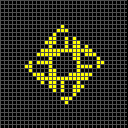
A New Kind of Science describes a new formal system, called a cyclic tag system (Wolfram drops "Post"), which is equivalent to a Post tag system, and so to a universal Turing machine. Finally, there is a sketch of how propagating structures ("gliders") in Rule 110 can be used to implement a cyclic tag system, assuming you had an infinite lattice to play with.
This is a genuinely new result. Rule 110 is the simplest CA (in terms of the number of states and the rule radius) which is known to support universal computation. (Indeed, in his 1985 book on cellular automata, Wolfram declared that universal computation in an elementary CA was obviously impossible.) However, lots of things are capable of universal computation — there's less interest in this kind of result than there was in, say, 1970. In 1990, for instance,
Cristopher Moore devised a
kind of idealized pin-ball machine which is capable of universal computation. This result, like the one about rule 110, is neat for people who care about dynamical models of universal computation — on the order of a thousand scientists and mathematicians world wide. What Wolfram wants to claim is that, since one universal computer is equivalent to another, by studying the behavior of one we learn things which are true of all others (true), therefore Rule 110 is as complex as anything in the universe, and all intelligent life, including, perhaps, the gods must have much in common. This, to put it mildly, does not follow. Wolfram even goes on to refute post-modernism on this basis; I won't touch that except to say that I'd have paid a lot to see Wolfram and Jacques Derrida go one-on-one.
The real problem with this result, however, is that it is not Wolfram's. He didn't invent cyclic tag systems, and he didn't come up with the incredibly intricate construction needed to implement them in Rule 110. This was done rather by one Matthew Cook, while working in Wolfram's employ under a contract with some truly remarkable provisions about intellectual property. In short, Wolfram got to control not only when and how the result was made public, but to claim it for himself. In fact, his position was that the
existence of the result was a trade secret. Cook, after a messy falling-out with Wolfram, made the result, and the proof, public at a 1998 conference on CAs. (I attended, and was lucky enough to read the paper where Cook goes through the construction, supplying the details missing from
A New Kind of Science.) Wolfram, for his part, responded by suing or threatening to sue Cook (now a penniless graduate student in neuroscience), the conference organizers, the publishers of the proceedings, etc. (The threat of legal action from Wolfram that I mentioned at the beginning of this review arose because we cited Cook as the person responsible for this result.)
Of course, lots of professors add their names to their students' papers, and many lab-chiefs owe their enviable publication records to the fact that they automatically add their names to the end of every manuscript prepared under their command. If Wolfram did that, he would merely be perpetuating one of the more common abuses of the current scientific community. But to deny Cook any authorship, and to threaten people with lawsuits to keep things quiet, is indeed very low. [...]
[...]
[...]
[...]
Let me try to sum up. On the one hand, we have a large number of true but commonplace ideas, especially about how simple rules can lead to complex outcomes, and about the virtues of toy models. On the other hand, we have a large mass of dubious speculations (many of them also unoriginal). We have, finally, a single new result of mathematical importance, which is not actually the author's. Everything is presented as the inspired fruit of a lonely genius, delivering startling insights in isolation from a blinkered and philistine scientific community. We have been this way before.
[...]
[...]
[...]
This brings me to the core of what I dislike about Wolfram's book. It is going to set the field back by years. On the one hand, scientists in other fields are going to think we're all crackpots like him. On the other hand, we're going to be deluged,
again, with people who fall for this kind of nonsense. I expect to have to waste a lot of time in the next few years de-programming students who'll have read
A New Kind of Science before knowing any better.
I don't object to speculation or radical proposals, even to radical, grandiose speculative proposals; I just want there to be arguments to back them up, reasons to take them seriously. I don't object to scientists displaying personality in their work, or staking out positions in vigorous opposition to much of the opinion in their field, and engaging in heated debate; I do object to ignoring criticism and claiming credit for commonplaces, especially before popular audiences who won't pick up on it. [...]
[...]