Oscillators and spaceships with extreme population changes

For discussion of other cellular automata.
Post Reply
User avatar
lukebradford
Posts: 101
Joined: October 11th, 2013, 8:07 pm
Location: Cambridge, MA
Contact:

Oscillators and spaceships with extreme population changes

Post by lukebradford »

Recently I've become intrigued by oscillators and spaceships whose populations undergo extreme changes. Specifically, I'm interested in any periodic pattern whose maximum population is very high in proportion to its minimum population.

Live Free or Die (s0/b2) seems particularly suited to patterns like this. Because birth is easy and survival is hard, relatively speaking, there are a lot of large sparks that are easy to produce, and most spaceships produce a large, dense "flame" which dies in one generation. The following small p4 c spaceship (the "R ship") has a minimum population of ten cells and a maximum population of 46 cells, for a ratio of 4.6, the highest of any known spaceship in Live Free or Die:

Code: Select all

x = 4, y = 11, rule = B2/S0
o$bo$3bo$o2bo4$o2bo$3bo$bo$o!
And the following small p19 oscillator (the "monster") has a minimum population of six cells and a maximum population of 40 cells, for a ratio of 6.666..., the highest of any known pattern in Live Free or Die.

Code: Select all

x = 4, y = 3, rule = B2/S0
o2bo$o2bo$o2bo!
I'd love to see patterns in other rules with extreme population changes, please post any here!

I'm also curious about the patterns with the highest proportional population changes in Conway's Life. From what I can see, most oscillators and spaceships in CGoL have very stable populations. On the other hand, there's a lot of potential for engineering in CGoL - would it be possible to build an oscillator or spaceship with an arbitrarily large proportional population change, or do additional engineered components add too much to the minimum population? (In Live Free or Die, arbitrarily large engineered flotillas are possible, but none of them have a mechanism that can beat the ratio of the R ship: every additional spaceship, tagalong, oscillator, or puffer adds too much to the minimum population to be worth it.)
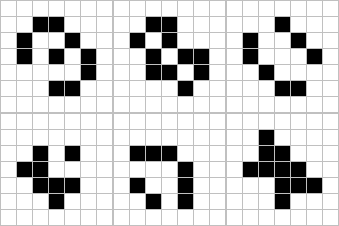
mniemiec
Posts: 1590
Joined: June 1st, 2013, 12:00 am

Re: Oscillators and spaceships with extreme population changes

Post by mniemiec »

lukebradford wrote:I'm also curious about the patterns with the highest proportional population changes in Conway's Life.
Lookup sawtooth on the Wiki. Sawtooths are patterns whose graph of period vs. time resemble a sawtooth pattern - typically growing to infinity repeatedly, but also resetting to a low population infinitely often. The wiki contains almost a dozen such patterns in Life.

There also exist simple sawtooth replicators in other rules, such as HighLife. These resemble successive lines in a Sierpinski Gasket.
User avatar
lukebradford
Posts: 101
Joined: October 11th, 2013, 8:07 pm
Location: Cambridge, MA
Contact:

Re: Oscillators and spaceships with extreme population changes

Post by lukebradford »

I'm familiar with sawtooths, but what about patterns with extreme population changes that are actually periodic? I haven't seen any oscillators or spaceships in CGoL with large changes in population relative to their minimum size.
bprentice
Posts: 920
Joined: September 10th, 2009, 6:20 pm
Location: Coos Bay, Oregon

Re: Oscillators and spaceships with extreme population changes

Post by bprentice »

Many rules support ships constructed from replicators. Here is a simple example:

Code: Select all

#Rule = Bit Counts
#States = 16
#NS 0,1,0,1,1,1,0,1,0
#NS 1,0,1,0,1,0,1,0,1
#NS 0,1,0,1,0,1,0,1,0
#NS 1,0,1,0,0,0,1,0,1
#RT 0,15,0,0,0,0,6,0,12,0,0,14,0,0,0,1,0,0,13,0,0,0,0,0,0,0,0,0,0,0,0,0,0,0,0,0,0
#Rows = 30
#Columns = 260
#L .O2.O$5.O$5.O$.O3.O2$6.3F.3F19$O2.O$4.O$4.O$O3.O2$5.3F.3F.3F.3F.3F.
#L 3F.3F.3F.3F.3F.3F.3F.3F.3F.3F.3F.3F.3F.3F.3F.3F.3F.3F.3F.3F.3F.3F.3F
#L .3F.3F.3F.3F.3F.3F.3F.3F.3F.3F.3F.3F.3F.3F.3F.3F.3F.3F.3F.3F.3F.3F.
#L 3F.3F.3F.3F.3F.3F.3F.3F.3F.3F.3F.3F.3F.3F
The pattern can be run on Square Cell which is here:

http://bprentice.webenet.net/Square%20C ... 20Cell.zip

There are two ships. The first of these has a minimum population of 9 and a maximum population of 12 with a period of 4. The second one has a minimum population of 9 and a maximum population of 198 with a period of 128. As you can see the population range can be made arbitrarily large.

Brian Prentice
Last edited by bprentice on November 9th, 2013, 11:46 pm, edited 1 time in total.
bprentice
Posts: 920
Joined: September 10th, 2009, 6:20 pm
Location: Coos Bay, Oregon

Re: Oscillators and spaceships with extreme population changes

Post by bprentice »

The same idea can also be applied to oscillators constructed from replicators. Here is an example from the same rule:

Code: Select all

#Rule = Bit Counts
#States = 16
#NS 0,1,0,1,1,1,0,1,0
#NS 1,0,1,0,1,0,1,0,1
#NS 0,1,0,1,0,1,0,1,0
#NS 1,0,1,0,0,0,1,0,1
#RT 0,15,0,0,0,0,6,0,12,0,0,14,0,0,0,1,0,0,13,0,0,0,0,0,0,0,0,0,0,0,0,0,0,0,0,0,0
#Rows = 6
#Columns = 145
#L 2.O2.O.3F.3F125.O2.O$2.O139.O$2O141.2O$4.2O133.2O$3.O137.O$O2.O137.
#L O2.O
It is a period 248 oscillator with a minimum population of 15 and a maximum population of 116. The population range can also be made arbitrarily large.

Brian Prentice
Last edited by bprentice on November 9th, 2013, 9:38 pm, edited 1 time in total.
bprentice
Posts: 920
Joined: September 10th, 2009, 6:20 pm
Location: Coos Bay, Oregon

Re: Oscillators and spaceships with extreme population changes

Post by bprentice »

Can't this same idea be applied to extensions of this simple Live Free or Die oscillator?

Code: Select all

x = 22, y = 5, rule = B2/S0
o3bo3bo3bo3bo3bo$21bo2$21bo$o3bo3bo3bo3bo3bo!
Brian Prentice
mniemiec
Posts: 1590
Joined: June 1st, 2013, 12:00 am

Re: Oscillators and spaceships with extreme population changes

Post by mniemiec »

lukebradford wrote:I'm familiar with sawtooths, but what about patterns with extreme population changes that are actually periodic? I haven't seen any oscillators or spaceships in CGoL with large changes in population relative to their minimum size.
If you have a sawtooth, it's possible to make an oscillator - just constrain it somehow. For example, with Life, with a sawtooth consisting of a stationary machine and a receding spaceship flotilla, you could make a catcher that eats the flotilla when it gets far enough ahead, then sends a glider back to the stationary machine to start it all up again. With simple sawtooth replicators like those in HighLife, it's even easier - just put eaters at both ends.
bprentice wrote:Can't this same idea be applied to extensions of this simple Live Free or Die oscillator?
Yes. It's even easier when you need a framework for the oscillator to live on - just limit the framework (like this one here). By the way, what format were the patterns in your previous two posts syooised to be in? Golly treats them as 0x0 patterns (whcih makes sense, since they're all entirely # comment lines).
bprentice
Posts: 920
Joined: September 10th, 2009, 6:20 pm
Location: Coos Bay, Oregon

Re: Oscillators and spaceships with extreme population changes

Post by bprentice »

mniemiec wrote:what format were the patterns in your previous two posts
As I mentioned above they are Square Cell patterns. They can be run on Square Cell which is here:

http://bprentice.webenet.net/Square%20C ... 20Cell.zip

A brief description telling how to run Square Cell is here:

http://bprentice.webenet.net/Square%20C ... 0Cell.html

Brian Prentice
User avatar
lukebradford
Posts: 101
Joined: October 11th, 2013, 8:07 pm
Location: Cambridge, MA
Contact:

Re: Oscillators and spaceships with extreme population changes

Post by lukebradford »

@bprentice - I will check out those SquareCell patterns when I get a chance. As for the Live Free or Die oscillator you posted (an "anchor track"), they do have a fairly large change in population, but the ratio approaches 3.5, not coming close to the ratio achieved by the p19 "monster."

@mniemiec - Aha! Good point about turning a sawtooth into an oscillator, I will have to try that out.
User avatar
Extrementhusiast
Posts: 1970
Joined: June 16th, 2009, 11:24 pm
Location: USA

Re: Oscillators and spaceships with extreme population changes

Post by Extrementhusiast »

This spaceship in my "9:43 at Knight" rule has a ratio of 11.75:

Code: Select all

x = 4, y = 3, rule = 237/34578/4
.2A$AC2A$.2A!
I Like My Heisenburps! (and others)
User avatar
velcrorex
Posts: 339
Joined: November 1st, 2009, 1:33 pm

Re: Oscillators and spaceships with extreme population changes

Post by velcrorex »

The spaceship described in this post has a ratio of ~10.08
-Josh Ball.
User avatar
Tropylium
Posts: 421
Joined: May 31st, 2011, 7:12 pm
Location: Finland

Re: Oscillators and spaceships with extreme population changes

Post by Tropylium »

For "natural" pulsating oscillators, ExtendedLife is a good rule to poke about. E.g. the p88 generated by a single on-forcer cell has a max:min population ratio of 247 : 13 ≈ 18.5:

Code: Select all

x = 5, y = 5, rule = extendedlife
.3A$A3.A$A.B.A$A3.A$.3A!
Ditto p1-alternating rules such as Pteriforever's "Aurora 19". E.g. this spaceship has a ratio 116 : 8 ≈ 14.5:

Code: Select all

x = 5, y = 5, rule = aurora19
2.2A2$A2.2A$A.A$2.A!
User avatar
Andrew
Moderator
Posts: 1066
Joined: June 2nd, 2009, 2:08 am
Location: Melbourne, Australia
Contact:

Re: Oscillators and spaceships with extreme population changes

Post by Andrew »

Tropylium wrote:E.g. the p88 generated by a single on-forcer cell has a max:min population ratio of 247 : 13 ...
265 : 13 according to pop-plot.py.
Use Glu or Glui to explore CA rules on non-periodic tilings: DominoLife and HatLife and SpectreLife
User avatar
lukebradford
Posts: 101
Joined: October 11th, 2013, 8:07 pm
Location: Cambridge, MA
Contact:

Re: Oscillators and spaceships with extreme population changes

Post by lukebradford »

I cannot for the life of me get any .rule file to work in Golly - I always get "File not found." Is there anything obvious I could be missing? I've put .rule files in my rule folder set in preferences (including the SlowLife file I found in the rule table repository on Google code, so I know it's well-formed) but to no avail.
User avatar
Andrew
Moderator
Posts: 1066
Joined: June 2nd, 2009, 2:08 am
Location: Melbourne, Australia
Contact:

Re: Oscillators and spaceships with extreme population changes

Post by Andrew »

lukebradford wrote:I cannot for the life of me get any .rule file to work in Golly - I always get "File not found."
I'll need more clues. When exactly do you get that error message? Are you sure you have read and write permission to the rule folder you chose? Perhaps you deleted that folder after telling Golly about it?
Use Glu or Glui to explore CA rules on non-periodic tilings: DominoLife and HatLife and SpectreLife
User avatar
Andrew
Moderator
Posts: 1066
Joined: June 2nd, 2009, 2:08 am
Location: Melbourne, Australia
Contact:

Re: Oscillators and spaceships with extreme population changes

Post by Andrew »

Luke, I think I might have found the problem. Does your rules folder, or the full path to it, contain any non-ASCII characters? If so, try avoiding such characters. (Golly is built with Unicode support so it *should* handle paths with non-ASCII chars but it looks like this is one case where it doesn't. I'll try to fix this in the upcoming 2.6 release.)
Use Glu or Glui to explore CA rules on non-periodic tilings: DominoLife and HatLife and SpectreLife
mniemiec
Posts: 1590
Joined: June 1st, 2013, 12:00 am

Re: Oscillators and spaceships with extreme population changes

Post by mniemiec »

lukebradford wrote:I cannot for the life of me get any .rule file to work in Golly - I always get "File not found." Is there anything obvious I could be missing? I've put .rule files in my rule folder set in preferences (including the SlowLife file I found in the rule table repository on Google code, so I know it's well-formed) but to no avail.
This may be a silly question, but are you running the latest version of Golly? Golly used to support rules via .table, .tree and .colors files; .rule files are a recent addition.
c0b0p0
Posts: 645
Joined: February 26th, 2014, 4:48 pm

Re: Oscillators and spaceships with extreme population changes

Post by c0b0p0 »

In two-state hexagonal rules, 22da seems to take second place for the ratio of max:min in a 20 by 20 bounding box with its p16, even though survival is about as easy as birth:

Code: Select all

x = 4, y = 4, rule = 22da
2bo$ob2o$bo$2bo!
B256/S346H takes first place, with a size 3 triangle having a ratio of 6:
x = 3, y = 3, rule = B256/S346H
o$2o$3o!

For B3 Moore-neighborhood rules, a ratio of 3.25 in a 20x20 bounding box:

Code: Select all

x = 7, y = 3, rule = B35678/S24
b5o$o2bo2bo$b5o!
Post Reply