
Hi all,
I'm a total amateur in this field so please excuse my ignorance.
As an exercise in improving my programming ability, I've made a program that assists in randomly generating and displaying different sets of cellular automata rules. The cells are dead or alive, and the alive count around each cell dictates what new state the cells transition to.
I did a writeup here on my project: https://lockwood.dev/automata/2020/03/2 ... olang.html
I'm interested in your general thoughts on the approach. I'm also trying to figure out if there are any heuristics I could use to prune game rulesets that look "uninteresting". Your advice and thoughts are appreciated!
Thanks for your time,
Tom
Personal project randomly generating different cellular automata rulesets
-
murderofescrows
- Posts: 9
- Joined: March 30th, 2020, 7:55 pm
Re: Personal project randomly generating different cellular automata rulesets
Very nice! Not all Lifenthusiast likes OCA. I will write a longer post later.
EDIT: Firstly, I still didn't quite understand what exactly are your "two-rule" rules. Are they cellular automaton that alternatively applies the first rule and the second rule?
Secondly, it's good to randomize rules and investigate (I sometimes get rulegolf ideas by randomizing too) but it will be also good to know about how the "transistions" in the rule affect the rule's behaviour. For example, as you probably already know, if there's no birth at 0 neighbours (that kind of rule is usually excluded), birth at 1 neighbours forces the rule to explode (because every pattern have to grow), birth at 2 neighbours forces the rule to explode (because the lightspeed chaotic puffer engine) too but not as explosive as B1, etc.
(to be continued)
Last edited by Hunting on March 30th, 2020, 9:42 pm, edited 1 time in total.
-
murderofescrows
- Posts: 9
- Joined: March 30th, 2020, 7:55 pm
Re: Personal project randomly generating different cellular automata rulesets
Hi! Thanks for your response!
Is there a good resource where I can learn more about the logical implications of transitions? For example is there some behaviour we always logically expect with a death on 8 neighbours?
Thanks for you time
I don't know if I quite understand, but if the game has two rules, its transitioning between the two? I assume conway's is an example of a two-rule game?Hunting wrote: March 30th, 2020, 8:08 pm EDIT: Firstly, I still didn't quite understand what exactly are your "two-rule" rules. Are they cellular automaton that alternatively applies the first rule and the second rule?
Interesting! I didn't think that a birth at 1 rule would always be explosive!!! Thank you!Hunting wrote: March 30th, 2020, 8:08 pm Secondly, it's good to randomize rules and investigate (I sometimes get rulegolf ideas by randomizing too) but it will be also good to know about how the "transistions" in the rule affect the rule's behaviour. For example, as you probably already know, if there's no birth at 0 neighbours (that kind of rule ), birth at 1 neighbours forces the rule to explode (because every pattern have to grow), birth at 2 neighbours forces the rule to explode (because the lightspeed chaotic puffer engine) too but not as explosive as B1, etc.
(to be continued)
Is there a good resource where I can learn more about the logical implications of transitions? For example is there some behaviour we always logically expect with a death on 8 neighbours?
Thanks for you time

Re: Personal project randomly generating different cellular automata rulesets
No, Conway's Game of Life has a single rule, B3/S23, which means if a dead cell has 3 neighbors it becomes alive and if a live cell has 2 or 3 neighbors it stays alive, otherwise it dies. I'm not sure how you're interpreting this as 2 rules.murderofescrows wrote: March 30th, 2020, 9:28 pm
I don't know if I quite understand, but if the game has two rules, its transitioning between the two? I assume conway's is an example of a two-rule game?
Not really, except B1 and B2 will always be explosive (If we exclude Non-Totalistic CA). But of course if you put S5678 you should expect a blobby "white-out" rule. Otherwise, not really.murderofescrows wrote: March 30th, 2020, 9:28 pmIs there a good resource where I can learn more about the logical implications of transitions? For example is there some behaviour we always logically expect with a death on 8 neighbours?
jarring cyan
-
murderofescrows
- Posts: 9
- Joined: March 30th, 2020, 7:55 pm
Re: Personal project randomly generating different cellular automata rulesets
My program might be considered to generate one-rule games then?Saka wrote: March 30th, 2020, 9:39 pmNo, Conway's Game of Life has a single rule, B3/S23, which means if a dead cell has 3 neighbors it becomes alive and if a live cell has 2 or 3 neighbors it stays alive, otherwise it dies. I'm not sure how you're interpreting this as 2 rules.murderofescrows wrote: March 30th, 2020, 9:28 pm
I don't know if I quite understand, but if the game has two rules, its transitioning between the two? I assume conway's is an example of a two-rule game?
However, it might transition to a different cell type if it has 2 alive neighbours versus 3. And that new cell type might transition differently on each of the 9 different alive neighbour counts. Each cell type is considered either alive or dead for the neighbour counts, but may transition to other cell types.
Interesting! Thanks!Saka wrote: March 30th, 2020, 9:39 pmNot really, except B1 and B2 will always be explosive (If we exclude Non-Totalistic CA). But of course if you put S5678 you should expect a blobby "white-out" rule. Otherwise, not really.murderofescrows wrote: March 30th, 2020, 9:28 pmIs there a good resource where I can learn more about the logical implications of transitions? For example is there some behaviour we always logically expect with a death on 8 neighbours?
Re: Personal project randomly generating different cellular automata rulesets
I'm not sure what you mean here, yes, each cell state turns into a different state based on it's neighbors, that's how CA works. However, the rules governing what states should turn into which states on what neighbors stay the same. In B3/S23, on every generation, the same transitions are applied:murderofescrows wrote: March 30th, 2020, 9:46 pm My program might be considered to generate one-rule games then?
However, it might transition to a different cell type if it has 2 alive neighbours versus 3. And that new cell type might transition differently on each of the 9 different alive neighbour counts. Each cell type is considered either alive or dead for the neighbour counts, but may transition to other cell types.
Code: Select all
Cell's State     | Number of Alive Neighbors                | Resulting state
0                | 0                                        | 0
0                | 1                                        | 0
0                | 2                                        | 0
0                | 3                                        | 1
0                | 4                                        | 0
0                | 5                                        | 0
0                | 6                                        | 0
0                | 7                                        | 0
0                | 8                                        | 0
1                | 0                                        | 0
1                | 1                                        | 0
1                | 2                                        | 1
1                | 3                                        | 1
1                | 4                                        | 0
1                | 5                                        | 0
1                | 6                                        | 0
1                | 7                                        | 0
1                | 8                                        | 0
jarring cyan
Re: Personal project randomly generating different cellular automata rulesets
I see, in your article, you refer to it as two rules. But that's not our usual definition. A rule is the combination of the birth condition and the survival condition. I mean, what does your program do when it have "four rules"?murderofescrows wrote: March 30th, 2020, 9:28 pmI don't know if I quite understand, but if the game has two rules, its transitioning between the two? I assume conway's is an example of a two-rule game?Hunting wrote: March 30th, 2020, 8:08 pm EDIT: Firstly, I still didn't quite understand what exactly are your "two-rule" rules. Are they cellular automaton that alternatively applies the first rule and the second rule?
Here you go. You might want to take a look at this too.Is there a good resource where I can learn more about the logical implications of transitions? For example is there some behaviour we always logically expect with a death on 8 neighbours?
Thanks for you time
I agree with Saka's statement, but as a (sort-of) experienced rulegolfer, I can provide more information about non-B8/S8 rules.
1. Like what Saka mentioned, S8 plays a role in the "blob" rules like Day&Night.
2. Adding B8/S8 may tame explosive rules that is explosive because of moderate-to-high period replicators.
3. I usually divide rules into categories, because in different categories the effect of the same transistion can be very different. Explain later.
EDIT: 4. Also, promoting my semi-totalistic rulespace. Having 25 birth condition and 25 survival condition, it's a super set of totalistic rules that can fit in two 32-bit integer. (One for birth and another for survival)
-
murderofescrows
- Posts: 9
- Joined: March 30th, 2020, 7:55 pm
Re: Personal project randomly generating different cellular automata rulesets
Here's an example:Hunting wrote: March 30th, 2020, 10:13 pmI see, in your article, you refer to it as two rules. But that's not our usual definition. A rule is the combination of the birth condition and the survival condition. I mean, what does your program do when it have "four rules"?murderofescrows wrote: March 30th, 2020, 9:28 pmI don't know if I quite understand, but if the game has two rules, its transitioning between the two? I assume conway's is an example of a two-rule game?Hunting wrote: March 30th, 2020, 8:08 pm EDIT: Firstly, I still didn't quite understand what exactly are your "two-rule" rules. Are they cellular automaton that alternatively applies the first rule and the second rule?
Code: Select all
var r0 = Rule{
  Alive:       true,
  Transitions: [9]uint8{0,3,0,1,2,2,2,1,0}}

var r1 = Rule{
  Alive:       true,
  Transitions: [9]uint8{1,0,1,0,3,1,1,3,3}}

var r2 = Rule{
  Alive:       false,
  Transitions: [9]uint8{3,1,1,2,1,3,1,2,3}}

var r3 = Rule{
  Alive:       true,
  Transitions: [9]uint8{3,3,0,1,1,3,0,0,0}}
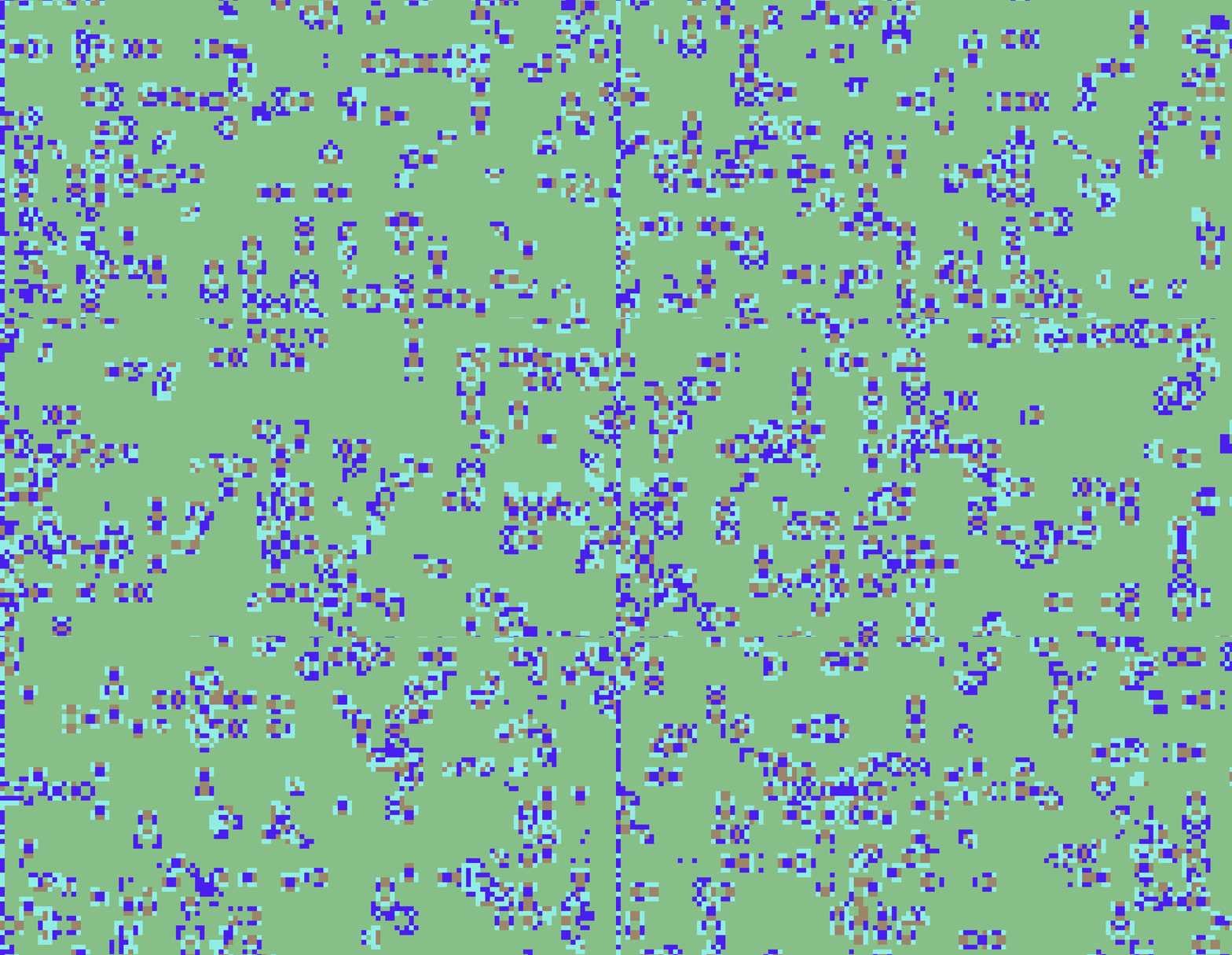
Edit: I think this may address Saka's post, too?
Re: Personal project randomly generating different cellular automata rulesets
Ohhh, you mean a 4-state totalistic rule. Wait a minute...murderofescrows wrote: March 30th, 2020, 10:34 pmHere's an example:Hunting wrote: March 30th, 2020, 10:13 pmI see, in your article, you refer to it as two rules. But that's not our usual definition. A rule is the combination of the birth condition and the survival condition. I mean, what does your program do when it have "four rules"?murderofescrows wrote: March 30th, 2020, 9:28 pm
I don't know if I quite understand, but if the game has two rules, its transitioning between the two? I assume conway's is an example of a two-rule game?
So, based on there being 0 alive neighbours, rule 0, 1 and 3 stay the same (survives?). However, rule 2 transitions to rule 3. The transitions are different for each different rule. Those 4 different sets of transitions leads to this:Code: Select all
var r0 = Rule{
  Alive:       true,
  Transitions: [9]uint8{0,3,0,1,2,2,2,1,0}}

var r1 = Rule{
  Alive:       true,
  Transitions: [9]uint8{1,0,1,0,3,1,1,3,3}}

var r2 = Rule{
  Alive:       false,
  Transitions: [9]uint8{3,1,1,2,1,3,1,2,3}}

var r3 = Rule{
  Alive:       true,
  Transitions: [9]uint8{3,3,0,1,1,3,0,0,0}}
(Sometimes, rules with 2-state is interesting enough.)
EDIT: Then what counts as "alive"? All of state 1, 2, and 3?
Last edited by Hunting on March 30th, 2020, 10:42 pm, edited 1 time in total.
-
murderofescrows
- Posts: 9
- Joined: March 30th, 2020, 7:55 pm
Re: Personal project randomly generating different cellular automata rulesets
Ah! Cool! My understanding of the terminology was lacking! Sorry!Hunting wrote: March 30th, 2020, 10:40 pm Ohhh, you mean a 4-state totalistic rule. Wait a minute...
(Sometimes, rules with 2-state is interesting enough.)
Re: Personal project randomly generating different cellular automata rulesets
Then what counts as "alive"? All of state 1, 2, and 3?murderofescrows wrote: March 30th, 2020, 10:42 pmAh! Cool! My understanding of the terminology was lacking! Sorry!Hunting wrote: March 30th, 2020, 10:40 pm Ohhh, you mean a 4-state totalistic rule. Wait a minute...
(Sometimes, rules with 2-state is interesting enough.)
-
murderofescrows
- Posts: 9
- Joined: March 30th, 2020, 7:55 pm
Re: Personal project randomly generating different cellular automata rulesets
0,1,3
In my code that's the Alive property of each Rule aka state.
In my code that's the Alive property of each Rule aka state.
Re: Personal project randomly generating different cellular automata rulesets
When we have a set of constant transitions (doesn't matter how many) that are applied every generation, that counts as one rule. One rule can have multiple cell states (what you call cell types).
jarring cyan
Re: Personal project randomly generating different cellular automata rulesets
Oh yeah. I'll make a Golly ruletable for it. I'm going to call it "Lockwood4s"murderofescrows wrote: March 30th, 2020, 10:52 pm 0,1,3
In my code that's the Alive property of each Rule aka state.
EDIT: Meanwhile I reproduced your Maze rule:
Code: Select all
x = 6, y = 4, rule = B3/S12356
bo$bo2bo$o2b3o$3o!
-
murderofescrows
- Posts: 9
- Joined: March 30th, 2020, 7:55 pm
Re: Personal project randomly generating different cellular automata rulesets
I might write some code that outputs a valid Golly file!Hunting wrote: March 30th, 2020, 10:53 pmOh yeah. I'll make a Golly ruletable for it. I'm going to call it "Lockwood4s"murderofescrows wrote: March 30th, 2020, 10:52 pm 0,1,3
In my code that's the Alive property of each Rule aka state.
Is this the right place to read if I want to generate that? https://github.com/GollyGang/ruletabler ... /TheFormat
-
murderofescrows
- Posts: 9
- Joined: March 30th, 2020, 7:55 pm
Re: Personal project randomly generating different cellular automata rulesets
Gotcha! Thanks.Saka wrote: March 30th, 2020, 10:52 pm When we have a set of constant transitions (doesn't matter how many) that are applied every generation, that counts as one rule. One rule can have multiple cell states (what you call cell types).
I'll attempt to alter my code to make it consistent with the correct terminology.
Re: Personal project randomly generating different cellular automata rulesets
Yesmurderofescrows wrote: March 30th, 2020, 10:58 pm I might write some code that outputs a valid Golly file!
Is this the right place to read if I want to generate that? https://github.com/GollyGang/ruletabler ... /TheFormat
jarring cyan
Re: Personal project randomly generating different cellular automata rulesets
Done.
(Unnecessary transistions for easy modification)
EDIT: Added into LifeViewer.
There's a lot of interesting things there. I noticed this wickstrecher plus wickeater:
This rule's glider is this photon:
Code: Select all
@RULE Lockwood4s
@TABLE
n_states:4
neighborhood:Moore
symmetries:permute
var a={0,1,3}
var b={0,1,3}
var c={0,1,3}
var d={0,1,3}
var e={0,1,3}
var f={0,1,3}
var g={0,1,3}
var h={0,1,3}

0,2,2,2,2,2,2,2,2,0
0,a,2,2,2,2,2,2,2,3
0,a,b,2,2,2,2,2,2,0
0,a,b,c,2,2,2,2,2,1
0,a,b,c,d,2,2,2,2,2
0,a,b,c,d,e,2,2,2,2
0,a,b,c,d,e,f,2,2,2
0,a,b,c,d,e,f,g,2,1
0,a,b,c,d,e,f,g,h,0

1,2,2,2,2,2,2,2,2,1
1,a,2,2,2,2,2,2,2,0
1,a,b,2,2,2,2,2,2,1
1,a,b,c,2,2,2,2,2,0
1,a,b,c,d,2,2,2,2,3
1,a,b,c,d,e,2,2,2,1
1,a,b,c,d,e,f,2,2,1
1,a,b,c,d,e,f,g,2,3
1,a,b,c,d,e,f,g,h,3

2,2,2,2,2,2,2,2,2,3
2,a,2,2,2,2,2,2,2,1
2,a,b,2,2,2,2,2,2,1
2,a,b,c,2,2,2,2,2,2
2,a,b,c,d,2,2,2,2,1
2,a,b,c,d,e,2,2,2,3
2,a,b,c,d,e,f,2,2,1
2,a,b,c,d,e,f,g,2,2
2,a,b,c,d,e,f,g,h,3

3,2,2,2,2,2,2,2,2,3
3,a,2,2,2,2,2,2,2,3
3,a,b,2,2,2,2,2,2,0
3,a,b,c,2,2,2,2,2,1
3,a,b,c,d,2,2,2,2,1
3,a,b,c,d,e,2,2,2,3
3,a,b,c,d,e,f,2,2,0
3,a,b,c,d,e,f,g,2,0
3,a,b,c,d,e,f,g,h,0EDIT: Added into LifeViewer.
Code: Select all
x = 89, y = 102, rule = Lockwood4s
B.ABA2BC6.BC2.C3.2CA.AB.C2.BAC6.A3.BA3.2A.2C.AB.B2.A3.CA.BA.AC.ABA2.C
B3.C.A$ACA2.2BC4.BC2.CAB2.CB4AB2CA.A.C.C2.2A4.2C.2C.C2.B.BA.C.B.B.B.B
4.2AB2.C.ABA3.A$.C8.A3.CBA.B.2C3.BA.C3.C3.B.2A5.CA2.C.2B2.2B2.C2.C2.C
B2.B.2A.C6.CB$B3.C5.2BA2.C.ABA.B.A3.C4.A2C2.B2.A3.B3.ABAB3.B3.2B3.2A.
BA.BABC2A4.CB2A2C2.C$2AB2C2.B.C2.C.AC.CB2.2A2.A.B.BAC.A.A8.BA4.ABC2.A
2.BCAB.3B.2CB.A5.BC.CB2.A.2C$.C2BC3B3.B.C.BAB3.2ACA.C2.A3.BCA.C4.C.BC
.B2.B.A2.2B2.2C.A.3C3.B.B4.AC3.BC.A.B$.B3.B4.BC2.ACAB2.C2.B.A2CB5.A2.
C.A2BAC3.C.BA2.A.2B6.B.C.C.C2.B2C.AC.C3.C.CA2C$2C2A2.2A.C2.BC.B2.B3.C
B.A2.AC2AB3.2C3B.A.2C3.A.2A2.A.B.C3.A.A2.AB.BC2.2C2.A.A2.A.C.C$3.BCAC
.C3.B.A2.B4.B2.C3.CA.BA4.BC.AB4.AC.B.CABC2.CBAC.CB2.CB2.3C3A2.2B2.C.
2B$C.ACB.ACABA4.ACA.A.2B.A3.2A.A.B3.C.B2.A.BA2.CA9.B.BAB2.A2.A2.A.2B
4.A5.2C$B.B3.B.BC2B2.2BC3.A.B.A.C2ABC.A2.A.B.CB.B2.B6.2CA3.BC.C2.B6.C
3.CAC3.2B2.2BAC$.C.2C2.BAC.CA3.C.AC.2BA.2C.C.B2.B4.B.C.C.AB.A.BAB4.2C
.C4.2C2.C3.3BC.AB2ABC.C.C.B$C.2C5.C2.2AC2.B4.A5.A2.ACA.C3.C2.ACA2.A2B
C5.A2.B4.C.BA.A.CAB6.BA2.C.AC$.B.B5.C2B2C.2C2.A2.C5B.C.2C.2C.CA3.2AC
2.2A.C3.A.B.A.A2.CB.B.AB2C3.BC3B.BAB3.BC$C2.B5.A.2CB.2BA.CA.2C5.A2.2C
AC.3A.CBA2.A.2AB.A3B.A3C4.ABCB2.2B4.CB.BACA3.C$2.CB.C.C2.CBA3.B.C.C.B
3.A.A2.B2.A.C4.2B4.C.AB3.A5.A.A.B.C4.2B2.A3.A.A2B.2C.B$.C4.2A.B.C2.2B
.2CA2.C.A2.AC2.AB2.B3.CB2.A2.A.A.C.A.A2.2B2.C.BA2C2A2.AB2CAC2.C.B.C4.
A$2ABA.BA2.2CB2A.A.C2BC5.B2.C2.C.CACB2.2B4.B.B.2C2.CB.A.3C.B.2BA.A.A.
A2B.C2.A4.AC.B$B.B.B2.C4.A2.AB4.C.CA.C2A.C.A.AC3ABC.C3.AB.BAB.2CA3.AB
CA3.A.BAB3.ACBAB5.BC$B2.AB3C.CB4.B7.A.2A.B4.2C3.2BACA.C2.5BA3.CB3.C4.
2B2.C2.A4.2AC5.C2B$.A.B5.2A.B2.C.BACABCA.CBA.2CA2.CABC.C2AB3A3.B2.B5.
A.C2A.AB.BCA.2B3.CA.AB2.C3.2C$.C.A.A2CB3.2B3.2A2.B2.A3.A.C.C.3A2.B.CA
CA.A3.A.A.2ABA.2CB2.C2.A4.A5.CA5.2A$2.B2.C.A.AC3.C.A5.C.C2B2.2B4.CB.
2B2C2.B.ACBC3.B2.C.2B.2A3B.BC.B2C.A3.AC.ABAC.ACA$CBC.CA2CB.CB.2C2.A3.
BAB3.B3.CA.CA2.2C2.A4.AB.C4.2A2.C3.AB.C5.A3.C2.C.2C2.2A.A$AB2C2.C2B2.
2C2.C.B2.A.B2.A.A.A.3B.A.CB2.B2.C2.BA2B.C3.A.C.B2.C2B.C.2B2C6.BA.ACAB
AB$AC.BA2B.C.B5.2A3.A4.A2.A2.2CB.CBA2.2ACA3.BC.B.C.A.A.BC4.B.AB6.CBC
3.CA2.AC.C$C2B3.B.C.B.BA.BC.B6.2AB2.B6.2B4.AB2.C5.A.B4.A.A.BC2A.BAC2.
CB.CAB6.A.C$C2.CAC2.A.BA.AB2C3.C.B.CA.C7.A2.A.C.A.2B2.C.A4.A4.C2.3A.B
.C.B.BC.2B.AB3A3.AC$B.A.B.BA.CB.2B.C.2B.C2.CA.B.B2.B.2B.ACB3.A2.B2.AC
.A3C2AB2.2C2.A2.A2.A.CB.B.2B3.ABCB2CB$CA3.BA8.BA2.B.CAB.A.B.2C2.B2.BA
BA2.C2B.CA.B4.2B2.ACA.B3.B4.A2.A2.C2.2BCACB.AB$B2.A.C.A2B2.A.CB.B.C3A
C2B.2B2C2.AB2.B.CAC.B.B.CA.A.AB2.C.C.AB.A2B2.AC6.BC.CB2.A4.B$AC.BC2.B
A.A.BC.AC.2C2.A.BC3.2BA2BA2.C.2A2.B.AB.A4.CAB.B.C.ACB.B3.2B.A3.C.BCAC
3.A$2.CABAC.AB3.B.ACA8.CB4.BAB.C3A.CA2.B.2A2.2BC.BC.C.A.A.B2AB.B4.2A
3.B2A.CB.B.A$.A.C2AB2.2CA2.B2.C.A2.B.A4.2B.B2A.B3.C.B2.2C2.2A.C3.AB2.
B.3CB2.C.2BC.B7.A.2C$.BA.C5.AC.2C3.C3.C.C5.C2.C2B.C2.A.A9.A3.A.C.B2.B
CBA2.ACA4.B2C4.AB.CAC$.2A2.B2.BA3.2C2.C.A.C2.C5.CA.A.ABC2.A2.C3.A.B3.
2CA.2B.BAB.A5.B2.2CA2.C.C.2B.2AC$CA.AB2.C.A.2B2.2B2.B2.BA.AB5.B3.B2CB
2.C3.B.AB2A4.B2.BCACAB4.B.A.BCA.BC2.BA3.C$4.B.ABA4.C2.2BC.A2.B2A.ABA
2.A2.C2.C.A2.A2.B.C4.C4.BA.BA4.CB2A2.B2.BC2.A2.B.2BA$.A.2A2.3C.2BA.B.
CAB4.C2.B2.2B.2C2.CA2B2.C2.C.2A.BC2.A2.2B2.2A.C2.2A2.2C.B.A2.C$2.CB.C
A.C3.C.CA.C2A.C2.A3.A.B4.2BC4.A.A.B.CB.BA.CB2.A.B.3AC.ABA.B.A.B2.2A.C
AB.A2CA$B2.A2.CB3ACABA2B3.BC4.C2.A4.B.A3.A2C.2C.C3.A.A3.C.A.A.ABCA.2B
.B2.ABA.BC2.2C2.2B$B.B.AC.C.C.BCA.B.B3.C4.A.B3.A2.B2.B2.A4.C.2ACA3.2A
3B.CA2.B2.A.CB.C2AB2.A.A.2B2.AB$.CA2.B4.A2.CBA2.B3.C4.CA.BCA3CB5.AB.C
A2C.C.BA7.A2.AB2.B.A3.2ABCB.2CBABA.2B$.C.CB.2C5.B2.C.3B.BA.C2.2C.C.C
2.2B.B.B.B.A2C4.C.AB.BA2.2CB.B.3C4.B.CA3.B4.A.C$B.ACBAC.2B2.B6.2CA.BA
3.A.B2.A.CA4.2AC5.A3.B11.BA.AB2A3.A.ABA.BC.2C.BA$3.C2.B2C.A2.2C5.2C.B
C.3B2.C.C.2A2.C3A.A.C.2A2.2A2.A2.2AC2.ACA4B.BC.2C.C.B2.C2.B.C$2.2ABA
5.CA.B.CB2.ABC.AC.AB3.A.C2AC3.C.B2CB.3C.2B.BC2.AC.3AB2ABAC.C.B3.2B4.
2B2.B$2A2BA.2BCA.A2.BA2.C2.C.A2.2AC3.A6.B.CB3.B.A.A2.AB.ACA2.BC2A3.A.
C.B4.A.C5.2CBA$2.2ABA2.AC2B.BA3.A.A2.CB7.C.B2.A.A.3B.BCACB.2A.B2C4.C.
CB.B.B.C2.B.C.B.3BC5.C$C.2A2.BA.C4.BC.A4.C.A5.BC.A2.BA2.B2.CAB.ABC.B.
BA3.B.AB6.B.2A.CB2CB.C.2A3.A$A.2AB2ABA.B.BA.BC.BAC.A.ABABA.B.CA.CB3.A
2B.A.B2C.CB2.A.A.AC.AB4.A.C2A.BA3.A.ACA2.CB2A$2B2.B.3B3.B3.AC.B.A5.C.
CA.2B.A3.A2.CA.BA3.A2.B3.B2.BA2CBCBA.AB3.BCA3.B3.B.3B$2.BA2B8.2A2.A2.
A4.BA2.A.A.A.CA4.B2.BABC2.2B4.AB.A3.A.2CBC4.A2.AC.AC.2A.C$.B2CABAB.C
2.C3.C.CBA.B3.AB.CA.2C.A3.A.C.C.BC.2CAB4.C.CBA4.B5.A.B.A2.BA2C2.3B$A.
C3BA2.C.A4.C4.C.CABC2.A6.B2.2BAB.BA.B2A2.C3.B.B.BC.A8.B.BC3.2B.2CB2.C
$CA.C.A2C6.2B2.C.A.B.3B.2CBACA9.C2.ACBC3.A.A2C2.AC2.C.B2.A2.A2.C2A.BC
2.CAC.BC$A.A3.CB2.C.B2.CB.BA2.2AB2.C2BABC2.CA3.C3.ABA.BAC3.CA2.A.C.B
3.AC.2A2B2A3.C2BA3.2A$.2A5.C2.B5.B.C2.BC.C.A5.B.A.2B.C.C.ACB4.2A.BCBC
2A.C.CB2.2A3.CBA2B.AC3.A.C.C$2.2AC3.A2.BAB2.C3.2B.C4.B5.AB3.3AB.2CBC.
2B2.ABCBC3.B3.AC6.ABC.C3.AB3C.C$CA.B5.2CACA2.3B2.C.BCB.3C2.AB.CAC2B.C
.CB.B4.A.AC2.A3.A.AC.B.2A3.AC.B.2B3.A.B2.A$4.C2.A.A.BA.A.B.ACABCB2.B
2.C2.ABCB2.AB.2A2.A3.2C.A.BA5.AB3.B.A.CB.A.A3.A.A3BCA$.2C.ACA2.BC2AC
4.AB.B2C3.CA5.BAB.C2A.BC2.A.C.A.2B.C2.C.B.3C.CBA.B4.CB.A.2AB.2A2.B$B.
ABC.2CA.B2A4.2A.2CB2.2BAB6.C.C.2A.C.AC.2C4B2ABA2B3.2A.A3.2C2.2C2.B.C
2.C.CBA$.C.AC.ABCBC.A2.2BC2.A3BC.C.B2.2C2.B2C.B3.AB.A5.2C2B2AB3.A4.A.
CBA.2C2.C.CAC4.ABC$2.A2BAB.BCAB.AB3.C.2CB2CBAC5.BC2AC.A.2C.C.2CB4.CAC
.B.C.C2.CA.CAC2.CB.C2.B.ABA.BC.C$3B.A2.2B2.C.A2BC2.B.2AB3.C4.CB2ABC.
2A3.BCB3.B.2CB3.CAB.B.C3.B.BA.A2.C7.AC2.B$BACA.A2.B2.B2C2.B7.C4.2CB6.
2B.BC.A.B7.ACA.A.C.2C.2CBA3.C2B2C.A.BA.A3.A$CB2CB.A2.C.A2.A.2AC2.C2.A
.C.BC3.BC.CB2.BC.A2B2.B5.2B3.BA.B3.A3.2BC2AB3.CACB3.A.B$2BA.B3.A.B.A.
B.2B2.2CBA.C.BC.BAC.B2.B.CBAB3.A2.B2.2B2C.BC2BCA.CA.A4.3B2.CB.ABA.A.C
.B$BAB.C.3A.C4.A.BA.A.A.A2.A3.ABA.BA2.A.BC2.ACB.ACA2B2.2C.A7.2B3.3BC
2.A2.B2.C.C2A$.A2BC.B.C2A3.2B.2C.AB2.CA2.A.B.B2.2BCBCA.B.CBC2A.2AC2.A
C2.CA.AC.2A.BA2B2.AB.B2C3.BA2.BA$2B2.AC2.BCA4.A.AB3.C.2ABA2.2AB.2B4.
3B.B2.A.CBAC.2B2.C2BA2CA.CBCB2.B.A.ABAC.B.A3.A$C2.B5.B2.B.CBCAC.ABC4.
BCAC.BA2.2C2.BA2.C.B.B2.2B2A.B2.C2B2A.A.BACBACA2.B.A3.A3BC.C$A.2BC.A
4.A2.BCB.A.C2.2B.B.B2.AB2.B2.B2AC.ACB.BC2A.C2.C2ABC2A2.2A.B.BA.A2.C.B
2.C.2B2.BC$B2.C3A2.C.2B.A.A2.C10.2B2.A.BAC.ABA.3A.CB2.B2.A.B.C2.AC.A
3.BC2.A3.CA2.B.B.C.A$.2C.CAC.2C.BA2.C.2CA2.A2B5.B.2A.3BCA2.CB.A.B.BA.
BCA.C.BC3.BA2.B2C4.A6.AC.2CBA$.BC7.A2.B.AB.CBC2.ABC2.B.AC2.AC5.A2C5.B
.3B.C2.C.C.C2BCB4.C2B.CB3.A2.2A2.2C$AC2.A.CABC2.A4.BC.B2.2A2.BA.A4B7.
B.CA3.2C3.A3.C4.BC4A2.3C.C2.2B2.ACB$.2C3.A.ACBC2B.B4.BA.CA.B.C2.CABCB
A2.CB3.ACBABAB.B.B2.C.BCABA.ACA2.A3.AB2C.B2.2C.A2.B$5.C2B3.B2A3.B2C2.
B.A.B.B2.A2BA.A.3A3.B.B2A2.A2.AB3A.C.C.BC.2B5.AC.2BA4.C3.B$7.2C2.2AC
3.AC.A2.CA3.ACB4.B3.C2.B.CB.2A.AC2B2.C.ACAC2.2CA.B.CA.A2.2CB2.AB$B.BA
.BCB2.BA3.BACB2A7.C2.3C.C.A.CA.C5.BA2CA4.A4.B.2A.2B.2C.C.B.C2AC.C.CAC
$4.2CBC2ACB6.BC.C.A2B3.AB.A.C5.B.C2.BA.B5.B5.2BC3.C2.C2.2C.C2.CB2.CBC
$.C.2C.C2.B.C.A2.ABA.C.AC.A2C4.C5.2B2.A.CB.B.2AC2.2A.A3.C.B.A.A4.B.AB
.C4.B2.A.B$.CBA4.C3.B.B2.C.CB2.A.BA.CB.A.B5.AB.B3.A3.C.B3.C.A2BCA.A6.
2A2.A.CB.A.B3.2BA$B.C.B2.A4.B2.C2.A.C.B4.B2.A.A3.C2.C2A.ABC3.C3.AC.CA
B3A3.3B5.B.A.CB2.ABA.AC$5.ABA3.3C.A2.C2.AC.B2.A4.2BAB2A.A3.C7.B3.CA3.
2AC.A.2A4.C.CB.2BCA4.C.2B$A2B.3AB2.C.CABCB2C.BA.BAB2.A.C.A.BC.C4.CBC.
AB.C.CBACB2.B.CA.AB4.C.A3.A.C.ACAB2.C$.C.B2.AB.C.C.BC.BC2ABCB.C.2C2.A
BC.B2.ACBA2BACAC.C.A3.C2BA.2A.BC.C2.C2.B.CA4.2A.B3.C2B$.A3.BA.BCA.A2.
AB2.C2B.A3.C4.C.A.ABA2.AB3A3.2C.C2B2.B2.C2.B2.2CB.C2.CA2B4.A.C.BA$BA
4.C.A2.B.A.A.CA.A.C.A.C2.A2.B2.A4.C.A.CACBC2.C2.C.ABA.A.CB.A2.2B.B2.A
.C5.2C.CB.A$A2.C2.A.C2.A2C.B2A.BA.ACA2.BCA3.B3.B2.C2A5.3A.2B4.A3.BCAB
.AB3.CA.2BC2.A2.2AC.BA$B.C4.CA2.A.2CA9.CB3.A3.A3.2B.2B5.2B2.B3AC.C3.B
.BA.AB2.BA2.BCA.BAC2.A2.A$.B.3B2.CB.2A.C.A3.CA.C2.B2C2.A.ABA.C2.A.C.A
2.B.C3.B.3B.C2.C3.CA.B2.A.AB2.ACB2AC.B2.B$A.C2A2B2CABCB4.B2CA2.CB.AC.
C.2BAC.A2.BA8.B2.A.BA6.B.B2.C2.B2.CACB2C2.CA3.B$2.2C3.A3.A.B.B.2AB.2A
C2.A.BA2.B2.B.A2.C2.A.BC.A5.A.B5.C.A4.A2.ACB4.CBCBA.BCBA$.C.B.BA3.2BA
C2.C.C.ABA.CA.A.A2C4.2ACB.A2BCB5.AC2.C.B2.A.A.BA.A.C3.B4.3A2BAB.CB$2B
ACA2.B.B.B.CB3.A2.BA2.CB2C.CBAC.C.C2.B.A2C.A2.B4.AC.A.C.A2B.B.B.B3.A.
B4.2C.A.B$5.B.B.B2.B2.A.B2.BCB3.2A2.A2.B.CA2.BCB.B2.C2BCA2.A3.AC5.A.B
C2.A.C.C.A.BC2.C$3.2CB4.CA2.A.BC2B5.BA2.B.A2.C2BA3CB.BAC.AC2.C2B2.B.
2A2.CA.B3.BC3.A2.BA4.BA$CB.A2C2A.C2.A.B2.BCA2.C.C3.AB2.2B6.4B.3C4.CA
2C3.BC2.B6.BCAC.BAC2ACB2.B.AB$B3.A2.2B.C3.C.ACABC.C.C.A2BABC.C2.AC2.B
5.CBCAB.C2A.C.3A3.2ABAC3.B.ABC.B5.AC.C!
Code: Select all
x = 13, y = 241, rule = Lockwood4s
4.C$C2.CABA$4.3A$3A3BA$C2B4A$C2BCABA2.2C$.2B.ABA.A2.A$.2C.A2.A.2A.A$A
2C3A.AB2CBA$A2B2AB2AC2ACA$4.ABA2.2B$5.2C2.2C$6.C.A2CA$4.ABA.A2BA$4.AB
A$4.C2A$4.2CA$4.ABA$4.ABA$4.A$4.2A$4.ABA$4.ABA$5.2C$6.C$4.ABA$4.ABA$
4.C2A$4.2CA$4.ABA$4.ABA$4.A$4.2A$4.ABA$4.ABA$5.2C$6.C$4.ABA$4.ABA$4.C
2A$4.2CA$4.ABA$4.ABA$4.A$4.2A$4.ABA$4.ABA$5.2C$6.C$4.ABA$4.ABA$4.C2A$
4.2CA$4.ABA$4.ABA$4.A$4.2A$4.ABA$4.ABA$5.2C$6.C$4.ABA$4.ABA$4.C2A$4.
2CA$4.ABA$4.ABA$4.A$4.2A$4.ABA$4.ABA$5.2C$6.C$4.ABA$4.ABA$4.C2A$4.2CA
$4.ABA$4.ABA$4.A$4.2A$4.ABA$4.ABA$5.2C$6.C$4.ABA$4.ABA$4.C2A$4.2CA$4.
ABA$4.ABA$4.A$4.2A$4.ABA$4.ABA$5.2C$6.C$4.ABA$4.ABA$4.C2A$4.2CA$4.ABA
$4.ABA$4.A$4.2A$4.ABA$4.ABA$5.2C$6.C$4.ABA$4.ABA$4.C2A$4.2CA$4.ABA$4.
ABA$4.A$4.2A$4.ABA$4.ABA$5.2C$6.C$4.ABA$4.ABA$4.C2A$4.2CA$4.ABA$4.ABA
$4.A$4.2A$4.ABA$4.ABA$5.2C$6.C$4.ABA$4.ABA$4.C2A$4.2CA$4.ABA$4.ABA$4.
A$4.2A$4.ABA$4.ABA$5.2C$6.C$4.ABA$4.ABA$4.C2A$4.2CA$4.ABA$4.ABA$4.A$
4.2A$4.ABA$4.ABA$5.2C$6.C$4.ABA$4.ABA$4.C2A$4.2CA$4.ABA$4.ABA$4.A$4.
2A$4.ABA$4.ABA$5.2C$6.C$4.ABA$4.ABA$4.C2A$4.2CA$4.ABA$4.ABA$4.A$4.2A$
4.ABA$4.ABA$5.2C$6.C$4.ABA$4.ABA$4.C2A$4.2CA$4.ABA$4.ABA$4.A$4.2A$4.A
BA$4.ABA$5.2C$6.C$4.ABA$4.ABA$4.C2A$4.2CA$4.ABA$4.ABA$4.A$4.2A$4.ABA$
4.ABA$5.2C$6.C$4.ABA$4.ABA$4.C2A$4.2CA$4.ABA$4.ABA$4.A$4.2A$4.ABA$4.A
BA$5.2C$6.C$4.ABA$4.ABA$4.C2A$4.2CA$4.ABA$4.ABA$4.A$4.2A$4.ABA$4.ABA$
5.2C$6.C$4.ABA$4.ABA$3.2C2A$2.4CA$3.2ABA$3.CABA$2.B2C$2.A2.C$2.C2.A3C
$2.C2B4AC$2.A2B2ACBC$5.A3BA!Code: Select all
x = 5, y = 5, rule = Lockwood4s
2.C$.C.C$C3AC$CBABC$A3BA!
Last edited by Hunting on March 30th, 2020, 11:24 pm, edited 1 time in total.
Re: Personal project randomly generating different cellular automata rulesets
What you refer to as two-rule and three-rule games are usually referred to by number of states, e.g. CGoL is a 2-state CA. A commonly explored family of multi-state CA is generations: https://conwaylife.com/wiki/Generations but there are many others.murderofescrows wrote: March 30th, 2020, 9:46 pmMy program might be considered to generate one-rule games then?Saka wrote: March 30th, 2020, 9:39 pmNo, Conway's Game of Life has a single rule, B3/S23, which means if a dead cell has 3 neighbors it becomes alive and if a live cell has 2 or 3 neighbors it stays alive, otherwise it dies. I'm not sure how you're interpreting this as 2 rules.murderofescrows wrote: March 30th, 2020, 9:28 pm
I don't know if I quite understand, but if the game has two rules, its transitioning between the two? I assume conway's is an example of a two-rule game?
However, it might transition to a different cell type if it has 2 alive neighbours versus 3. And that new cell type might transition differently on each of the 9 different alive neighbour counts. Each cell type is considered either alive or dead for the neighbour counts, but may transition to other cell types.
As for heuristics, this is a tricky field, I don't think there is any one heuristic that works well for understanding the behaviour of all rules. Langton's lambda parameter is probably the most widely used, there's a nice description here http://math.hws.edu/xJava/CA/EdgeOfChaos.html You can find other parameters which have been used if you explore the academic literature. Neural networks have also been trialed by many people, with varying success. The most accessible description of this idea - which showed some promising results - that I know of is here: https://softologyblog.wordpress.com/201 ... -automata/
Actually, that article also has a good overview of some alternative heuristics, so I think you might be interested. Jason, the author of Visions of Chaos, has been posting a lot of interesting articles on his blog recently, I recommend reading more of his articles to anyone interested in these topics.
Edit: a lot happened while I was typing this message on my phone, oh well - hopefully still something of interest here.
The 5S project (Smallest Spaceships Supporting Specific Speeds) is now maintained by speedydelete.
Semi-active here - recovering from a severe case of LWTDS.
Semi-active here - recovering from a severe case of LWTDS.
-
murderofescrows
- Posts: 9
- Joined: March 30th, 2020, 7:55 pm
Re: Personal project randomly generating different cellular automata rulesets
Thanks Hunting! So cool to see it in there!
Thanks wildmyron, I'll look into that after work!
Thanks wildmyron, I'll look into that after work!
Re: Personal project randomly generating different cellular automata rulesets
G backrake:
This can be attached to the rake:
EDIT: Head-on collisions:
G is somewhat edge-repairing. It also have a strong backspark.
Code: Select all
x = 11, y = 9, rule = Lockwood4s
.A2BA.A2BA$.C2BC.C2BC$.C2.C.C2.C$.A2.A.A2.A$.A3BA3BA$C.2ACAC2A.C$C.AB
3ABA.C$C.C2BA2BC.C$3.A3.A!
Code: Select all
x = 11, y = 72, rule = Lockwood4s
.A2BA.A2BA$.C2BC.C2BC$.C2.C.C2.C$.A2.A.A2.A$.A3BA3BA$C.2ACAC2A.C$C.AB
3ABA.C$C.C2BA2BC.C$3.A3.A3$5.C$4.C.C$3.C3AC$3.CBABC$3.A3BA4$5.C$4.C.C
$3.C3AC$3.CBABC$3.A3BA4$5.C$4.C.C$3.C3AC$3.CBABC$3.A3BA4$5.C$4.C.C$3.
C3AC$3.CBABC$3.A3BA4$5.C$4.C.C$3.C3AC$3.CBABC$3.A3BA4$5.C$4.C.C$3.C3A
C$3.CBABC$3.A3BA4$5.C$4.C.C$3.C3AC$A2BABABA2BA$C2BA3BA2BC$C2.C3.C2.C$
A2.C3.C2.A$BC3A.3ACB$.CBCACACBC$.A.CA.AC.A$3CA.A.A3C$.CA2CA2CAC$.A7BA
!
Code: Select all
x = 108, y = 68, rule = Lockwood4s
2.2CA10.A2C14.2CA9.A2C15.2CA10.2A15.2CA9.2A$.CA2B10.2BAC12.CA2B9.2BAC
13.CA2B10.B2AC12.CA2B9.B2AC$C.2AB10.B2A.C10.C.2AB9.B2A.C11.C.2AB10.BA
.A11.C.2AB9.BA.A$.CA2B10.2BAC12.CA2B9.2BAC13.CA2B10.B2AC12.CA2B9.B2AC
$2.2CA10.A2C14.2CA9.A2C15.2CA10.2A15.2CA9.2A16$2.2CA27.2CA27.2CA27.2C
A$.CA2B10.A2C13.CA2B9.A2C14.CA2B10.2A14.CA2B9.2A$C.2AB10.2BAC11.C.2AB
9.2BAC12.C.2AB10.B2AC11.C.2AB9.B2AC$.CA2B10.B2A.C11.CA2B9.B2A.C12.CA
2B10.BA.A12.CA2B9.BA.A$2.2CA10.2BAC13.2CA9.2BAC14.2CA10.B2AC13.2CA9.B
2AC$15.A2C26.A2C28.2A27.2A15$2.2CA27.2CA27.2CA27.2CA$.CA2B26.CA2B26.C
A2B26.CA2B$C.2AB10.A2C12.C.2AB9.A2C13.C.2AB10.2A13.C.2AB9.2A$.CA2B10.
2BAC12.CA2B9.2BAC13.CA2B10.B2AC12.CA2B9.B2AC$2.2CA10.B2A.C12.2CA9.B2A
.C13.2CA10.BA.A13.2CA9.BA.A$15.2BAC25.2BAC27.B2AC25.B2AC$15.A2C26.A2C
28.2A27.2A14$2.2CA27.2CA27.2CA27.2CA$.CA2B26.CA2B26.CA2B26.CA2B$C.2AB
25.C.2AB25.C.2AB25.C.2AB$.CA2B10.A2C13.CA2B9.A2C14.CA2B10.2A14.CA2B9.
2A$2.2CA10.2BAC13.2CA9.2BAC14.2CA10.B2AC13.2CA9.B2AC$15.B2A.C24.B2A.C
26.BA.A25.BA.A$15.2BAC25.2BAC27.B2AC25.B2AC$15.A2C26.A2C28.2A27.2A!
Code: Select all
x = 15, y = 22, rule = Lockwood4s
2.2CA$.CA2B$C.2AB$.CA2B$2.2CA13$10.A3BA$10.CBABC$10.C3AC$11.C.C$12.C!
-
yujh

- Posts: 3157
- Joined: February 27th, 2020, 11:23 pm
- Location: I'm not sure where I am, so please tell me if you know
- Contact:
Re: Personal project randomly generating different cellular automata rulesets
Cool rule!
I noticed this:
I noticed this:
Code: Select all
x = 17, y = 114, rule = Lockwood4s
3$4.A2BA$4.C2BC$4.C2.C$.A3B2.A$.C2B3CB$.C.2ABAC$.A.ABCA$.ACACA2C$2.2A
$4.2C2A$3.2CABA$3.2CB2A$4.3A$6.2C$5.ABC$5.BAC$4.3C$5.A$4.2AB$4.ABA2$
5.C2A$4.CABA$4.CB2A$4.3A$6.2C$5.ABC.A2BA$5.BAC.A2CA$4.3C3.2C$5.A4.2B$
4.2AB.AC2ACA$4.ABA.AB2CBA$8.A.2A.A$5.C2A.A2.A$4.CABA2.2C$4.CB2A$4.3A$
6.2C$5.ABC.A2BA$5.BAC.A2CA$4.3C3.2C$5.A4.2B$4.2AB2.C2BC$4.ABA2.C2BC$
9.4A$5.C2A$4.CABA.C2.C$4.CB2A$4.3A$6.2C$5.ABC.A2BA$5.BAC.A2CA$4.3C3.
2C$5.A4.2B$4.2AB.AC2ACA$4.ABA.AB2CBA$8.A.2A.A$5.C2A.A2.A$4.CABA2.2C$
4.CB2A$4.3A$6.2C$5.ABC$5.BAC$4.3C$5.A$4.2AB$4.ABA2$5.C2A$4.CABA$4.CB
2A$4.3A$6.2C$5.ABC$5.BAC$4.3C$5.A$4.2AB$4.ABA2$5.C2A$4.CABA$4.CB2A$4.
3A$6.2C$5.ABC$5.BAC$4.3C$5.A$4.2AB$4.ABA$7.A2BA$7.B2CA$8.2C$7.ABA2$7.
CA$5.3CB2A$5.2CACB$5.3CA$7.AB$6.A2CA$6.B2CA$6.C2AC2$6.C$6.C$6.C.C!
Rule modifier
B34kz5e7c8/S23-a4ityz5k
b2n3-q5y6cn7s23-k4c8
B3-kq6cn8/S2-i3-a4ciyz8
B3-kq4z5e7c8/S2-ci3-a4ciq5ek6eik7
Bored of Conway's Game of Life? Try Pedestrian Life -- not pedestrian at all!
B34kz5e7c8/S23-a4ityz5k
b2n3-q5y6cn7s23-k4c8
B3-kq6cn8/S2-i3-a4ciyz8
B3-kq4z5e7c8/S2-ci3-a4ciq5ek6eik7
Bored of Conway's Game of Life? Try Pedestrian Life -- not pedestrian at all!
Re: Personal project randomly generating different cellular automata rulesets
Neat! The ships on the side of the wick is unnecessary, though.yujh wrote: March 30th, 2020, 11:45 pm Cool rule!
I noticed this:Code: Select all
x = 17, y = 114, rule = Lockwood4s
3$4.A2BA$4.C2BC$4.C2.C$.A3B2.A$.C2B3CB$.C.2ABAC$.A.ABCA$.ACACA2C$2.2A
$4.2C2A$3.2CABA$3.2CB2A$4.3A$6.2C$5.ABC$5.BAC$4.3C$5.A$4.2AB$4.ABA2$
5.C2A$4.CABA$4.CB2A$4.3A$6.2C$5.ABC.A2BA$5.BAC.A2CA$4.3C3.2C$5.A4.2B$
4.2AB.AC2ACA$4.ABA.AB2CBA$8.A.2A.A$5.C2A.A2.A$4.CABA2.2C$4.CB2A$4.3A$
6.2C$5.ABC.A2BA$5.BAC.A2CA$4.3C3.2C$5.A4.2B$4.2AB2.C2BC$4.ABA2.C2BC$
9.4A$5.C2A$4.CABA.C2.C$4.CB2A$4.3A$6.2C$5.ABC.A2BA$5.BAC.A2CA$4.3C3.
2C$5.A4.2B$4.2AB.AC2ACA$4.ABA.AB2CBA$8.A.2A.A$5.C2A.A2.A$4.CABA2.2C$
4.CB2A$4.3A$6.2C$5.ABC$5.BAC$4.3C$5.A$4.2AB$4.ABA2$5.C2A$4.CABA$4.CB
2A$4.3A$6.2C$5.ABC$5.BAC$4.3C$5.A$4.2AB$4.ABA2$5.C2A$4.CABA$4.CB2A$4.
3A$6.2C$5.ABC$5.BAC$4.3C$5.A$4.2AB$4.ABA$7.A2BA$7.B2CA$8.2C$7.ABA2$7.
CA$5.3CB2A$5.2CACB$5.3CA$7.AB$6.A2CA$6.B2CA$6.C2AC2$6.C$6.C$6.C.C!
perpendicular 2G:
Code: Select all
x = 45, y = 141, rule = Lockwood4s
2.2CA27.2CA$.CA2B26.CA2B$C.2AB25.C.2AB$.CA2B26.CA2B$2.2CA27.2CA6$10.A
3BA25.A3BA$10.CBABC25.5A$10.C3AC26.A.A$11.C.C27.CAC$12.C6$2.2CA27.2CA
$.CA2B26.CA2B$C.2AB25.C.2AB$.CA2B26.CA2B$2.2CA27.2CA7$10.A3BA25.A3BA$
10.CBABC25.5A$10.C3AC26.A.A$11.C.C27.CAC$12.C5$2.2CA27.2CA$.CA2B26.CA
2B$C.2AB25.C.2AB$.CA2B26.CA2B$2.2CA27.2CA8$10.A3BA25.A3BA$10.CBABC25.
5A$10.C3AC26.A.A$11.C.C27.CAC$12.C4$2.2CA27.2CA$.CA2B26.CA2B$C.2AB25.
C.2AB$.CA2B26.CA2B$2.2CA27.2CA9$10.A3BA25.A3BA$10.CBABC25.5A$10.C3AC
26.A.A$11.C.C27.CAC$12.C3$2.2CA27.2CA$.CA2B26.CA2B$C.2AB25.C.2AB$.CA
2B26.CA2B$2.2CA27.2CA10$10.A3BA25.A3BA$10.CBABC25.5A$10.C3AC26.A.A$
11.C.C27.CAC$12.C2$2.2CA27.2CA$.CA2B26.CA2B$C.2AB25.C.2AB$.CA2B26.CA
2B$2.2CA27.2CA11$10.A3BA25.A3BA$10.CBABC25.5A$10.C3AC26.A.A$11.C.C27.
CAC$12.C$2.2CA27.2CA$.CA2B26.CA2B$C.2AB25.C.2AB$.CA2B26.CA2B$2.2CA27.
2CA12$10.A3BA25.A3BA$10.CBABC25.5A$10.C3AC26.A.A$11.C.C27.CAC$12.C!
Code: Select all
x = 33, y = 17, rule = Lockwood4s
2.2CA23.A2C$.CA2B23.2BAC$C.2AB23.B2A.C$.CA2B23.2BAC$2.2CA23.A2C9$10.A
3BA$10.5A$11.A.A$11.CAC!Code: Select all
-
yujh
- Posts: 3157
- Joined: February 27th, 2020, 11:23 pm
- Location: I'm not sure where I am, so please tell me if you know
- Contact:
Re: Personal project randomly generating different cellular automata rulesets
G to G2 to G to most common big ship
SIde rake:
Code: Select all
x = 17, y = 160, rule = Lockwood4s
.A2BA.A2BA$.C2BC.C2BC$.C2.C.C2.C$.A2.A.A2.A$.A3BA3BA$C.2ACAC2A.C$C.AB
3ABA.C$C.C2BA2BC.C$3.A3.A3$5.C$4.C.C$3.C3AC$3.CBABC$3.A3BA4$5.C$4.C.C
$3.C3AC$3.CBABC$3.A3BA4$5.C$4.C.C$3.C3AC$3.CBABC$3.A3BA4$5.C$4.C.C$3.
C3AC$3.CBABC$3.A3BA4$5.C$4.C.C$3.C3AC$3.CBABC$3.A3BA4$5.C$4.C.C$3.C3A
C$3.CBABC$3.A3BA4$5.C$4.C.C$3.C3AC$3.CBABC$3.A3BA2$8.A2BA$8.A2CA$5.C
3.2C$4.C.C2.2B2.A2BA$3.C3A2C2BC.A2CA$3.CBAB2C2BC2.2C$3.A3B.4A2.2B$9.A
3.C2BC$7.3C.C.C2BC$9.C3.4A$8.C$4.C.A6.C2.C$3.C4A$3.CBC2A$3.A3BA2$8.A
2BA$8.A2CA$9.2C$4.3C2.2B$3.C3A2C2AC2A2BA$3.CBC2AB2CBAC2BC$3.A4B.2A.AC
2.C$7.C.A.A.A2.A$7.C2.C2.B2CB$7.C2.C2.C2BC$6.C2.2C3.2C$4.C3.ACA2.C2AC
$3.C2A.2C$3.CBABC$3.A3BA4$5.C$4.C.C$3.C3AC$3.CBABC$3.A3BA4$5.C$4.C.C$
3.C3AC$3.CBABC$3.A3BA4$5.C$4.C.C$3.C3AC$3.CBABC$3.A3BA4$5.C$4.C.C$3.C
3AC$3.CBABA2BA$3.A3B4A$6.CACA$6.2C.A$6.A.A$4.2C$6.C$3.C2.C$3.A2CA$3.A
2CA$3.C2.C$3.C2.C$4.2C$3.B2CB$3.A2.A$3.C2.C$3.C2BC$3.A2BA9$3.C2AC$4.
2C$3.C2BC$3.B2CB$3.A2.A$3.C2.C$3.C2BC$3.A2BA!
Code: Select all
x = 22, y = 11, rule = Lockwood4s
18.A2BA$18.A2CA$19.2C$2A2.2CA.C10.2B$B2C3BA7.A2BAC2BC$B2C3BA7.A2CAC3A
$2A2.2CA.C6.2C.4A$9.A3.CB3A.3A$8.B2C3BA$8.B2C3BA$8.2A2.2CA.C!
Rule modifier
B34kz5e7c8/S23-a4ityz5k
b2n3-q5y6cn7s23-k4c8
B3-kq6cn8/S2-i3-a4ciyz8
B3-kq4z5e7c8/S2-ci3-a4ciq5ek6eik7
Bored of Conway's Game of Life? Try Pedestrian Life -- not pedestrian at all!
B34kz5e7c8/S23-a4ityz5k
b2n3-q5y6cn7s23-k4c8
B3-kq6cn8/S2-i3-a4ciyz8
B3-kq4z5e7c8/S2-ci3-a4ciq5ek6eik7
Bored of Conway's Game of Life? Try Pedestrian Life -- not pedestrian at all!
Re: Personal project randomly generating different cellular automata rulesets
I'm going to finish my previous posts.
(Funny how the latter rule wants to create blobs with B5678, but they cannot survive, creating big "bubbles".)
This behaviour means it's impossible to have ship or guns etc. So a good, non-explosive rule must have B3.
Rules without birth at 0, 1, 2 and 3 cannot escape its bounding box. For example:Hunting wrote: March 30th, 2020, 8:08 pm Very nice! Not all Lifenthusiast likes OCA. I will write a longer post later.
EDIT: Firstly, I still didn't quite understand what exactly are your "two-rule" rules. Are they cellular automaton that alternatively applies the first rule and the second rule?
Secondly, it's good to randomize rules and investigate (I sometimes get rulegolf ideas by randomizing too) but it will be also good to know about how the "transistions" in the rule affect the rule's behaviour. For example, as you probably already know, if there's no birth at 0 neighbours (that kind of rule is usually excluded), birth at 1 neighbours forces the rule to explode (because every pattern have to grow), birth at 2 neighbours forces the rule to explode (because the lightspeed chaotic puffer engine) too but not as explosive as B1, etc.
(to be continued)
Code: Select all
x = 20, y = 20, rule = B45678/S012345678
3o2bobo5bobo3bo$bob4ob2o2b2o2bob2o$4o2bob4obo2bobo$3o2b2o5b3obo$4o2b2o
b2obo2bob2o$3o4bob5o3bo$o4b3o3b2obo$3o3b5o2bob4o$2o4b2o2bob7o$2o2bob2o
b7o2b2o$2o2b3o3bobo4bobo$2bo2bo2b3obo2b5o$ob2ob6obo$4bo6b3ob3obo$obo3b
o3bo4bob3o$2bob2o2bobo2bobob3o$b6o2b3ob2obobo$o3b4obo6bobo$b2o2bo3b3ob
ob5o$o2b3o4b2obo2bob2o!
Code: Select all
x = 20, y = 20, rule = B45678/S23456
3o2bobo5bobo3bo$bob4ob2o2b2o2bob2o$4o2bob4obo2bobo$3o2b2o5b3obo$4o2b2o
b2obo2bob2o$3o4bob5o3bo$o4b3o3b2obo$3o3b5o2bob4o$2o4b2o2bob7o$2o2bob2o
b7o2b2o$2o2b3o3bobo4bobo$2bo2bo2b3obo2b5o$ob2ob6obo$4bo6b3ob3obo$obo3b
o3bo4bob3o$2bob2o2bobo2bobob3o$b6o2b3ob2obobo$o3b4obo6bobo$b2o2bo3b3ob
ob5o$2ob3o4b2obo2bob2o!
This behaviour means it's impossible to have ship or guns etc. So a good, non-explosive rule must have B3.