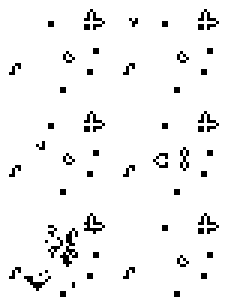
This cropped up (or rather, a close variant) while I was looking at the debris behind a line puffer (with various 'obstacles' placed). Not seen one of these before:
x = 10, y = 9, rule = B3/S23
4b2o$2o2bo3b2o$o8bo$b8o2$b8o$o8bo$2o2b2o2b2o$4b2o!
Interesting because it has a rotor of just 3 cells which I believe is the minimum for a p3. Can't find it on LifeWiki, closest relative seems to be the Cuphook. Has it got a name?
Actually I think a rotationally-symmetric variant is more attractive:
Moosey wrote:That IS cuphook, just with a different stator.
Stator variants aren’t new oscillators.
...does that mean the blinker and bipole are considered to be fundamentally the same oscillator? They both have the exact same rotor, just different stators.
Moosey wrote:That IS cuphook, just with a different stator.
Stator variants aren’t new oscillators.
...does that mean the blinker and bipole are considered to be fundamentally the same oscillator? They both have the exact same rotor, just different stators.
I think those two were probably named before we had those conventions, but yeah. Also, (of course) the latter is extensible, so that might have contributed to different names too. I suppose their small sizes and radically different stators also made them seem more different.
κ is measurable iff there is a nontrivial elementary embedding j:V→M (M transitive) with critical point κ
Entity Valkyrie 2 wrote:Stator variants aren't new oscillators, unless the period is 2.
They are "new oscillators", no matter what the period might be, but there appears to be little to no public interest in cataloging and trying to understand them.