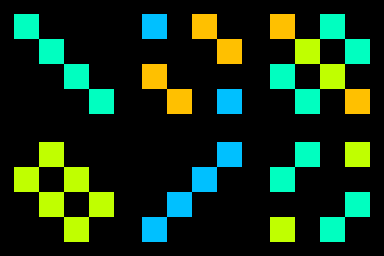
muzik wrote:There are still borders visible between triangular cells (forming a sort of rhombic tiling) even with cellborders disabled
True due to the vagaries of the browser's rendering. I'll have another go at some stage.
muzik wrote:Hexagons also seem to intersect each other slightly with cellborders turned off
Ditto.
muzik wrote:Just one more neighbourhood suggestion: how about a 15-cell neighbourhood that also includes these three cells at the very tips, giving a perfect triangle instead of a wonky hexagon?
Could the "Ctrl+C to copy pattern" thing be put in a more obvious spot, perhaps by "Click to control" when you hover over the viewer? It's such a useful command (especially on the wiki) that it probably shouldn't be buried so far down in the help menu; it took me several months before I even bothered to try it out.
An idea I've had for a while: for rules with aliases, when the T counter in the bottom left is clicked, could the alias text link to the rule's Catagolue page?
x = 10, y = 3, rule = B3-c/S234t
o8bo$b2o6bo$2o7bo!
One solution to this would be to change the triangular rule suffix to "TR", meaning only badly formatted rulestrings will be parsed this way.
Also the lower pattern seems to be shifted when I open it.
Any sufficiently advanced software is indistinguishable from malice.
x = 10, y = 3, rule = B3-c/S234t
o8bo$b2o6bo$2o7bo!
One solution to this would be to change the triangular rule suffix to "TR", meaning only badly formatted rulestrings will be parsed this way.
Good catch! Unfortunately "TR" won't work either since both "t" and "r" are valid non-totalistic modifiers. It also means that "TE" needs changing since "e" is also a valid non-totalistic modifier.
I'll probably change the "T" to "L" (which is available) and so the three neighbourhoods will become:
Triangular (postfix L) with 12 neighbours (touching triangle edges and vertices)
neighbourhood digits are 0123456789XYZ where X, Y and Z represent 10, 11 and 12 respectively
Triangular Edges (postfix LE) with 3 neighbours (touching triangle edges)
neighbourhood digits are 0123
Triangular Vertices (postfix LV) with 9 neighbours (touching triangle vertices)
neighbourhood digits are 0123456789
For alternating rules, capitalization of the rule name in the bottom-left menu seems to use the one provided in the rulename instead of what exists in the alias list:
muzik wrote:For alternating rules, capitalization of the rule name in the bottom-left menu seems to use the one provided in the rulename instead of what exists in the alias list
Instead of having defined aliases for Replicator-type rules of range n (e.g. Replicator R4, Fredkin R2), why not treat the rule names themselves as a form of rulestring?
A rulestring Replicator Rn would set both birth and survival transitions to all odd numbers 1 through (2n+1)²-2, and Fredkin Rn would set birth transitions to to all odd numbers 1 through (2n+1)² and survival transitions to all even numbers 0 through (2n+1)²-1.
This would be especially useful for higher-order replicator rules whose rulestrings may be too long to even fit into a forum post.
All of those are just instances of the general family where a cell is set to the XOR of all cells in a certain neighborhood. Replicator uses an 8-cell neighborhood, Fredkin uses a 9-cell neighborhood, etc.