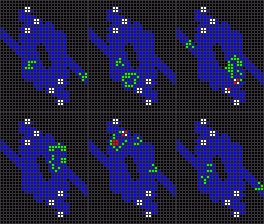
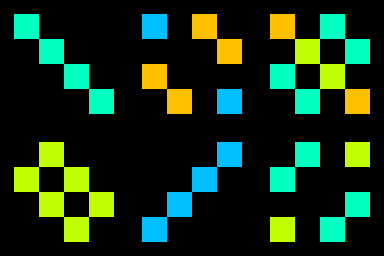
We've had an extremely fruitful year, with 24 impressive patterns nominated for the contest. This is going to be particularly enjoyable to watch.
#01 Record setting garden of eden (by Steven Eker): an orphan with 45 live cells and 43 dead cells, the fewest total number of specified cells among all known orphans.
#02 Fixed-length tail for a lightspeed bubble of arbitrary width in the 'stripes' agar (by wildmyron): Gabriel Nivasch showed that arbitrary-width lightspeed bubbles in the stripes agar are supportable, requiring a fixed-length head and variable-length tail. It was hitherto an open problem to replace the variable-length tail with a fixed-length counterpart.
#03 Three-glider synthesis of a switch engine (by Luka Okanishi): It was previously believed that 4 gliders were necessary and sufficient to synthesise a switch-engine.
#04 Tanner's p46 (by Tanner Jacobi): a new sparky p46 oscillator that various guns can be made
#05 gliderless unit cell (by Naszvadi): a cellular automata polyglot (pattern which runs in a range of rules) based on p46 technology, establishing Turing-completeness of B3[8]/S23[8] provided infinite patterns are permitted.
#06 Much smaller spiral-growth pattern (by Dave Greene and slmake): a tightly-coiled loop of data reflected in a double-spiral of snarks instructs a construction arm to encircle the construction indefinitely, gradually constructing an unbounded spiral of further snarks.
#07 Hydra (by Oscar Cunningham, Dave Greene and slmake): a single-channel quadratic-growth pattern which constructs an intricate mesh of splitting construction heads in all directions. Some well-positioned eaters prevent this behemoth from cannibalising itself. It uses similar technology to Dave's earlier triple wickstretcher (#25), but is more complex owing to the necessity of splitting signals.
#08 New Demonoid and Orthogonoid spaceships (by Dave Greene and slmake): Geminoid variants which travel diagonally and orthogonally, respectively, showcasing interesting developments such as MWSS-based signalling and syringe syntheses.
#09 Stable pulse-dividers (by Tanner Jacobi): the Snark and semi-snark have been joined by new exciting tremi-snarks, quadri-snarks, and semi-cenarks, which are particularly helpful for optimising glider and spaceship guns.
#10 Sparse Cordership (by David Bell): all previously-known Corderships required interactions between two or more adjacent switch-engines. This design, on the other hand, allows the individual switch-engines to be separated by arbitrary distances, relying instead on long-range interactions mediated by gliders and stable objects.
#12 The first c/6 orthogonal puffers (by Nico Brown and Matthias Merzenich): messy albeit elegant puffers where gliders collide with large sparky spaceships in perpetuity.
#13 The first 3c/7 orthogonal puffer (by Luka Okanishi): as above, but exclusively using 3c/7 spaghetti monsters (the only known spaceship of its velocity). Owing to its faster-than-c/4 speed, a c/2 spaceship is necessary to catch up with the front of the engine to continue the reaction.
#17 Runny nose (by 83bismuth38): a p3 oscillator which showed an unexpected gap in lists of small objects.
#18 2-engine cordership (by Aidan Pierce): a successful refutation of the common belief that 3 engines are required to build a Cordership.
#19 Completed Quest for Tetris challenge (by PhiNotPi, El'endia Starman, K Zhang, Muddyfish, Kritixi Lithos, Mego, Quartata, et al.): a game of Tetris simulated on a digital computer built out of logic gates formed from Brice Due's metacells.
#20 Synthesis of N-bit still lifes in 38 to 39 gliders (by Tanner Jacobi, Adam P. Goucher, and Chris Cain): syntheses of N-bit still lifes for all sufficiently large natural numbers N, using a bounded number of gliders (38 or 39, depending on the parity of N).
#21 p148 B29 gun (by Luka Okanishi, Dave Greene, and Adam P. Goucher): a compact gun for a c/4 diagonal spaceship.
#24 Life object having a bounded population with an unknown fate (by David Bell): a pattern which either becomes stable, oscillatory, or aperiodic, depending on the behaviour of 7 under the generalised Collatz iteration which maps a positive integer N to 5N+1 (if N odd) or N/2 (if N even).
#25 triple wickstretcher (by Dave Greene): a single-channel glider loop which extends zigzags of Snarks
.
By popular demand, the voting convention of this year's contest will mirror Alexey's system from 2016.
Vote only for the patterns you like, and give each of them 1, 2, or 3 stars depending on how much you like them. You can vote for your own patterns if you want.
The voting will end on 14th Feburary, at midnight UTC.
Last edited by apg on February 19th, 2018, 11:42 am, edited 2 times in total.
What do you do with ill crystallographers? Take them to the mono-clinic!
Macbi wrote:I think you're missing Dave Greene's triple wickstretcher, which he nominated himself, unless you meant to merge it with Hydra (good name by the way).
Thanks! I did merge them because they're quite similar in nature, but now I've separated the triple wickstretcher into #25. It is, after all, an independent discovery.
Note that there's still 36 hours before nominations close on Burns' Night, so this list isn't finalised (and therefore voting doesn't commence until then).
What do you do with ill crystallographers? Take them to the mono-clinic!
danny wrote:My vote is misinformed and igorant but I will provide some votes.
03 **
04 ***
09 ***
10 *
18 **
19 **
20 *
24 **
Did you not read the post directly above which says that voting won't commence for another day because the list isn't finalised yet?
calcyman wrote:Note that there's still 36 hours before nominations close on Burns' Night, so this list isn't finalised (and therefore voting doesn't commence until then).
former username: A for Awesome
praosylen#5847 (Discord)
The only decision I made was made
of flowers, to jump universes to one of springtime in
a land of former winter, where no invisible walls stood,
or could stand for more than a few hours at most...