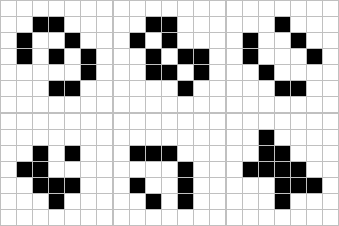
I have just finished programming a Cellular Automata simulator in Visual Basic. It allows you to write the rules you want the automata to follow. The first thing I tried was to put odd numbers of neighbours in the birth condition and even numbers (including 0) in the survival one. I suspected something especial could happen. It results in the automata copying the initial figure you draw 9 times in a few generations and then 9 again but more spaced. Later on, I think because the spacing keeps increasing, you get to see groups of 25 replicas...
I'm new here, ¿was this already discovered? (probably yes) ¿is there any mathematical explanation?
Welcome to the forums! I hope you have a good stay here. Get used to using RLE format, because you'll be seeing it a LOT here.
The answer to the original question: Yes, this has been discovered. Not only do all patterns replicate in B1357/S02468, all patterns also replicate in B1357/S1357.
Additionally, you don't need the "¿" symbols in English like you do en Español. Same thing holds true for the "¡" symbols before exclamations. (But I digress.)
Thank you for the welcome and sorry for the "¿" mistake, I used to have that rule in mind, but I wrote the post in a hurry (anyway you shoud give "¿" a try, it's very useful to know where a question starts xD).
For a moment I thought I had found something with the odd-even thing, I have a lot to learn about GOL.
I'll be around, looking for more information about RLE format. Thanks for answering. ¡Read you again!