
That one is the same as the 3-cell pattern I posted yesterday (rotated 180 degrees).ssaamm wrote:What about this 3-cell rake parent?
x = 3, y = 3, rule = serizawa
2.A2$B.B!
Serizawa
-
knightlife
- Posts: 566
- Joined: May 31st, 2009, 12:08 am
Re: Serizawa
Re: Serizawa
A slight modification of the best previous known quadratic growth pattern fits in the same bounding box (29 by 15) but has 4 fewer cells
I have thought of another way to compare pattern size: total cell value. The quadratic pattern I just posted is also the smallest known in total cell value.
For infinite linear growth, the smallest known is 5 (the 3x3 pattern with 3 cells).
Of course, we have arbitrarily selected one state to be "1" and the other to be "2", rendering this almost meaningless. It has slightly more meaning for totalistic rules, or any rule in which the numerical value of the cell is used in the step function.
Code: Select all
x = 29, y = 15, rule = Serizawa
5.A2.A$.B2.AB2ABA2.B$A.A8.A.A$4.B.2A.B8$20.A2.A$16.B2.AB2ABA2.B$15.A.
A8.A.A$19.B.2A.B!
For infinite linear growth, the smallest known is 5 (the 3x3 pattern with 3 cells).
Of course, we have arbitrarily selected one state to be "1" and the other to be "2", rendering this almost meaningless. It has slightly more meaning for totalistic rules, or any rule in which the numerical value of the cell is used in the step function.
-
knightlife
- Posts: 566
- Joined: May 31st, 2009, 12:08 am
Re: Serizawa
Further reduction of quadratic growth pattern:
It's only 12 cells in a 20x10 bounding box.
Code: Select all
x = 20, y = 10, rule = Serizawa
.B2.B$A.2B.A7$15.B2.B$14.A.2B.A!
-
knightlife
- Posts: 566
- Joined: May 31st, 2009, 12:08 am
Re: Serizawa
10-cell quadratic, 12 x 3 bounding box:
one cell wide quadratic is 12 cells, 19 x 1 bounding box:
Code: Select all
x = 12, y = 3, rule = Serizawa
9.2A$A2BA4.B2.B$9.2A!
Code: Select all
x = 19, y = 1, rule = Serizawa
A2BA3.A2BA4.A2BA!
Re: Serizawa
Some interesting results with a collision between a p3 oscillator and a glider:
Some patterns and syntheses:
EDIT: Spaceship collections:
Code: Select all
x = 27, y = 15, rule = Serizawa
A.A$.B22.A.A$25.B8$3.A18.A$2.A.A16.A.A$.A18.A$2.A.A16.A.A$3.A18.A!Code: Select all
x = 92, y = 38, rule = Serizawa
20.A$19.A.A$18.A3.A$3.A.A11.A.A.A.A13.A51.A$2.A.B.A9.A.A3.A.A11.3A16.
A2.A2.A2.A2.A2.A17.2AB$3.B.B9.A9.A12.2A14.AB2AB2AB2AB2AB2ABA17.A.B$2.
A.B.A9.A.A3.A.A11.3A14.A18.A17.B$3.A.A11.A.A.A.A13.A16.A.2A.8A.2A.A
18.B$18.A3.A68.B$19.A.A68.A$20.A3$89.A$19.A.A68.B$20.B15.A.A50.A$3.A.
A31.B$3.ABA$4.A14.A.A$A7.A5.A3.A.B.A3.A7.A$.B5.B7.B3.B.B3.B6.A2.A11.A
7.A2BA2.A2BA2.A2BA7.A$A7.A5.A3.A.B.A3.A$4.A14.A.A67.A$3.ABA82.2AB$3.A
.A83.A.B$20.B69.B$19.A.A68.B$89.A.B$90.B$90.B$91.B$90.B$90.B$91.B$90.
B$90.B$88.A2.B$89.2A!Code: Select all
x = 92, y = 5, rule = Serizawa
.B5.A8.B7.B3.B6.B2.B7.B2.B2.B7.B2.B2.B2.B7.B2.B2.B2.B2.B$A.A3.ABA5.AB
.BA4.A.B.B.A4.B.2B.B5.B.2B.2B.B5.B.2B.2B.2B.B5.B.2B.2B.2B.2B.B$6.A2.A
3.A5.A4.A.B.A4.3A2.3A3.3A5.3A3.3A8.3A3.3A11.3A$8.A5.A3.A6.A.A6.A4.A5.
A7.A5.A10.A5.A13.A$26.A!-
knightlife
- Posts: 566
- Joined: May 31st, 2009, 12:08 am
Re: Serizawa
Other spaceships including two that output "puffs of smoke":
EDIT:
A nice double backrake that produces clean big gliders:
Code: Select all
x = 72, y = 33, rule = Serizawa
10.A3.B13.B3.B3.B$9.ABA.A.A11.B.A.A.A.A.B$9.A.A.A12.3A2.A.A2.3A$13.A
13.A3.A.A3.A7$6.B3.A3.B15.A3.A3.B16.A5.B2.B5.A$5.A.A.ABA.A.A10.B2.ABA
.ABA.B.A14.ABA3.B.2B.B3.ABA$7.A.A.A.A11.A.A3.A.A.A2.A15.A2.A2.A4.A2.A
2.A$7.A5.A42.A12.A$61.A2.A9$.A15.A$ABA2.A10.ABA2.A$A.A.ABA9.A.A.ABA$
3.A3.A11.A2.A$6.A13.2BA12.B3.A3.B$34.A.A.ABA.A.A3$37.A.A.A$38.BAB!
A nice double backrake that produces clean big gliders:
Code: Select all
x = 18, y = 8, rule = Serizawa
.A5.A2.A5.A$ABA3.AB2ABA3.ABA$A2.A.A6.A.A2.A$2.A3.A.2A.A3.A$6.B4.B2$4.
A8.A$5.A6.A!

Re: Serizawa
p12 agar
Unit cell on torus
Code: Select all
x = 31, y = 31, rule = Serizawa
.B3.B3.B3.B3.B3.B3.B3.B$A.A.A.A.A.A.A.A.A.A.A.A.A.A.A.A$.B3.B3.B3.B3.
B3.B3.B3.B2$.B3.B3.B3.B3.B3.B3.B3.B$A.A.A.A.A.A.A.A.A.A.A.A.A.A.A.A$.
B3.B3.B3.B3.B3.B3.B3.B2$.B3.B3.B3.B3.B3.B3.B3.B$A.A.A.A.A.A.A.A.A.A.A
.A.A.A.A.A$.B3.B3.B3.B3.B3.B3.B3.B2$.B3.B3.B3.B3.B3.B3.B3.B$A.A.A.A.A
.A.A.A.A.A.A.A.A.A.A.A$.B3.B3.B3.B3.B3.B3.B3.B2$.B3.B3.B3.B3.B3.B3.B
3.B$A.A.A.A.A.A.A.A.A.A.A.A.A.A.A.A$.B3.B3.B3.B3.B3.B3.B3.B2$.B3.B3.B
3.B3.B3.B3.B3.B$A.A.A.A.A.A.A.A.A.A.A.A.A.A.A.A$.B3.B3.B3.B3.B3.B3.B
3.B2$.B3.B3.B3.B3.B3.B3.B3.B$A.A.A.A.A.A.A.A.A.A.A.A.A.A.A.A$.B3.B3.B
3.B3.B3.B3.B3.B2$.B3.B3.B3.B3.B3.B3.B3.B$A.A.A.A.A.A.A.A.A.A.A.A.A.A.
A.A$.B3.B3.B3.B3.B3.B3.B3.B!
Code: Select all
x = 4, y = 4, rule = Serizawa:T4,4
.B$A.A$.B!
First question ever. Often referred to as The Question. When this question is asked in right place in right time, no one can lie. No one can abstain. But when The Question is asked, silence will fall. Silence must fall. The Question is: Doctor Who?
-
knightlife
- Posts: 566
- Joined: May 31st, 2009, 12:08 am
Re: Serizawa
This quadratic is not chaotic, it is a nice triangular array of gliders.
Further optimization is possible, to clean up extra "dots".
EDIT:
This one has glider arrays moving both left and right:
Code: Select all
x = 34, y = 21, rule = Serizawa
16.A5.A2.A5.A$15.ABA3.AB2ABA3.ABA$15.A2.A.A6.A.A2.A$17.A3.A.2A.A3.A$
21.B4.B2$19.A8.A$20.A6.A6$32.B$31.A.A2$.A5.B2.B16.A$ABA3.B.2B.B$A2.A
2.A4.A$2.A$7.A2.A!
EDIT:
This one has glider arrays moving both left and right:
Code: Select all
x = 34, y = 17, rule = Serizawa
16.A5.A2.A5.A$15.ABA3.AB2ABA3.ABA$15.A2.A.A6.A.A2.A$17.A3.A.2A.A3.A$
21.B4.B2$19.A8.A$20.A6.A5$.A5.B2.B$ABA3.B.2B.B20.B$A2.A2.A4.A19.A.A$
2.A$7.A2.A16.A!
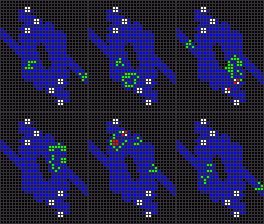
Re: Serizawa
Single Directional Side Rake:
A p24 side-rake taken from the double rake (by 137ben) and one side cleaned with glider.
A splitter that sits on rake
As mentioned before one can eliminate all the side tracks (or any specific by choise):
And finally two puffers that clean each other to create a side-rake
And here is large glider rake:
A p24 side-rake taken from the double rake (by 137ben) and one side cleaned with glider.
Code: Select all
x = 24, y = 30, rule = Serizawa
5$12.B3.B$11.A.3A.A$14.A$13.3A$8.B11.B$7.A.A9.A.A$14.A2$14.A$13.A.A$
14.A$13.A.A$13.A.A$12.A3.A$11.2A3.2A$6.B3.AB5.BA$5.A.A3.7A$13.3A$14.A!Code: Select all
x = 60, y = 64, rule = Serizawa
7$13.B3.B$12.A.3A.A$15.A$14.3A$9.B11.B$8.A.A.ABA.ABA.A.A$14.3A$15.B$
14.BAB$15.B3$15.A3$7.B$6.A.A4$11.A11.2A$10.ABA11.BA$9.ABA11.2A$10.A9$
35.2A$36.BA$35.2A10$47.2A$48.BA$47.2A2$53.B$52.A.A!
Code: Select all
x = 75, y = 73, rule = Serizawa
3$14.B3.B$13.A.A.A.A2$14.A3BA$10.B5.A5.B$9.A.A3.A.A3.A.A$15.ABA2$16.A
7$8.B$7.A.A.2A7.2A$11.B9.BA$11.2A7.2A10$32.2A$33.BA$32.2A10$44.2A$45.
BA$44.2A$49.B$48.A.A2$41.A$40.ABA$40.A.A6$55.A$56.B$43.A11.A6.A$42.B
18.ABA$36.A6.A17.A.A$35.ABA$35.A.A2$47.A.A$48.B!
Code: Select all
x = 112, y = 200, rule = Serizawa
23$45.B$41.B2.A.A$40.A.BA$41.B.A$40.A2.A$40.3A$39.ABA.A52.B$40.AB50.B
2.A.A$40.A.BA47.A.BA$41.ABA48.B.A$39.A2.A48.A2.A$38.A4.A47.3A$90.ABA.
A$91.AB$91.A.BA$39.A.A5.A44.ABA$40.A.A5.B41.A2.A$38.A2.A.A3.A41.A4.A$
40.A.A$41.A2$53.A36.A.A5.A$54.B36.A.A5.B$38.A14.A35.A2.A.A3.A$40.A50.
A.A$92.A2$59.A44.A$60.B44.B$38.A20.A29.A14.A$40.A50.A3$65.A44.A$66.B
44.B$38.A26.A23.A20.A$40.A50.A3$71.A$72.B$38.A32.A17.A$40.A50.A3$77.A
$78.B$38.A38.A11.A$40.A50.A3$83.A$84.B$38.A44.A5.A$40.A50.A4$87.2A$
38.A47.AB.A$40.A46.ABA.A$88.A3$81.2A$38.A41.AB$40.A40.2A8.A4$75.2A$
38.A35.AB11.A.A$40.A34.2A10.ABA.A$88.A3$69.2A$38.A29.AB$40.A28.2A20.A
4$63.2A$38.A23.AB23.A.A$40.A22.2A22.ABA.A$88.A3$57.2A$38.A17.AB$40.A
16.2A32.A4$51.2A$38.A11.AB35.A.A$40.A10.2A34.ABA.A$88.A3$45.2A$38.A5.
AB$40.A4.2A44.A5$38.A3.A44.A.A$43.B43.ABA.A$40.A.A45.A$41.B3$38.A9.A$
49.B41.A$48.A$89.B$88.A.A$91.B$38.A15.A35.A$55.B$40.A.A11.A$41.B$96.A
$97.B$38.A21.A35.A$61.B$60.A2$102.A$103.B$38.A27.A35.A6.A$67.B40.ABA$
40.A.A23.A41.A.A$41.B$105.A$104.A$38.A33.A32.A.A$73.B32.A$72.A4$38.A
39.A$79.B$40.A.A35.A$41.B3$38.A45.A$85.B$84.A4$38.A51.A$91.B$40.A.A
47.A6.A$41.B54.ABA$96.A.A$40.A$41.A51.A$41.A50.A$93.A.A$36.2A56.A$35.
AB$36.2A$29.B$28.A.A2$32.A$31.2AB$32.B2$33.A$33.2A$35.A!
Code: Select all
x = 24, y = 24, rule = Serizawa
3$10.B3.B$9.B.B.A.A$8.3A$9.A$12.A2.A$11.A2.ABA$11.2B.A.A$10.AB$11.ABA
$12.A2$11.A$17.A$10.3A3.A.A$18.BA$4.B3.A8.2A$3.A.A.B$8.A!
Re: Serizawa
Here is 5 cells quadratic:
Code: Select all
x = 0, y = 0, rule = Serizawa
B2$3.B2$B15$52.AB!
Re: Serizawa
And here is a collection of 3 cells infinite growth:
Code: Select all
x = 35, y = 1219, rule = Serizawa
B.B$7.B85$3.B$6.B$3.B75$5.B2$8.B2$5.B116$4.B$7.B$3.B113$9.B2$9.B.A
109$6.B$2.B3$6.A149$10.B$7.B7$9.A130$18.B$21.A2$17.B156$17.A3$17.B$
13.B123$32.B.A3$31.A124$34.A3$29.B2$29.A!

Re: Serizawa
I take it you've done some searching for 4-cell quadratic-growth patterns, without finding anything? It looks like there's some hope for such a search, but it isn't trivial to decide which patterns will end up with quadratic growth.simsim314 wrote:Here is 5 cells quadratic...
For example, here's a 4-cell infinite-growth pattern that doesn't stop producing novel reactions until about 2.185 million ticks:
Code: Select all
x = 30, y = 16, rule = Serizawa
B2$3.B2$B11$29.A!Code: Select all
x = 30, y = 28, rule = Serizawa
B2$3.B2$B23$29.A!Code: Select all
#C 4-cell Serizawa quadratic-growth candidate --
#C moving the key cell by (2,1) appears to have the same effect
x = 32, y = 24, rule = Serizawa
B2$3.B2$B19$31.A!
By 3.74 million ticks the rake-making region seems to be strictly bounded -- as many rakes are being destroyed as created, so no long-term quadratic growth after all. Of course it's quite possible that another quadratic-growth region will start up somewhere in this monster -- novelty clearly isn't exhausted yet -- but it may make sense to look for a simpler example of 4-cell quadratic growth...!
- Attachments
-
- Quadratic-growth region at 3.74M ticks, limited at orthogonal boundaries
- Almost-quadratic.png (48.94 KiB) Viewed 14728 times
Re: Serizawa
Found one, with a slightly-revised search script -- originally I was only looking 16K ticks ahead, not nearly far enough to catch late novelty appearances. Now I'm waiting to see if it looks quadratic at 2 million ticks. Even that may not be enough in a few cases, but for the most part Hashlife is happily running away with the pattern by T=2M.dvgrn wrote:... it may make sense to look for a simpler example of 4-cell quadratic growth.
Code: Select all
x = 35, y = 20, rule = Serizawa
B2$3.B2$B15$34.A!- Attachments
-
- Secondary puffer modifying original quadratic-growth puffer in 4-cell 35x20 initial seed
- Serizawa-4cell-quadratic-at-100352T.png (50.87 KiB) Viewed 14724 times
Re: Serizawa
WOW! Yes I was definitely searching for 4 cell quadratics in two waysdvgrn wrote:Found one
1. Randomized small box.
2. The way you did, adding single stable cell to the 3 cell infinite linear growth.
And yes I totally missed the 2M novelty case. I run up to 8K and suspected it to be enough...
Well every search has to make assumptions...
-----
For now I suspect it would be pretty hard to prove that the quadratic pattern you found is actually a quadratic one, due to the chaos introduced later (as you mentioned). My 5 cell pattern is a clear cut.
Well let's hope to find some more clear cut 4 cell quadratic.
Re: Serizawa
Found it! Very clear 4 cell quadratic:
Here is another one with late ignition (starts after 600K):
It has "twin" moving the static cell six units to the left.
Code: Select all
x = 125, y = 18, rule = Serizawa
A13$121.B2$124.B2$121.B!
Code: Select all
x = 373, y = 17, rule = Serizawa
372.A12$B2$3.B2$B!
Last edited by simsim314 on June 4th, 2014, 8:16 pm, edited 1 time in total.
Re: Serizawa
Ah, good -- congratulations! Now I won't be distracted by this search any longer.simsim314 wrote:Found it! Very clear 4 cell quadratic...
I looked at lots of false positives, mostly within 60 cells of the 3-cell. The odds of interesting novelty seemed to go down significantly, about 40 cells from the 3-cell, and cells to the right seemed to give better results on average than cells to the left, so I hadn't tried running a search that far out yet.
The complex maybe-quadratic "novelty generators" that I posted above remind me of some of Bill Gosper's experiments in Conway's Life from a few years ago. Different types of puffers and rakes have different large-scale signatures in a long-running pattern. It might be possible to find a few new rakes or puffers in Serizawa by looking for unfamiliar fingerprints in these patterns, in the same way that you can recognize switch engines in a zoomed-out Life pattern.
This seems to be a copy of the previous pattern.simsim314 wrote:Here is another one with late ignition (starts after 600K):...
Re: Serizawa
Oops copy-paste bug...now fixed.dvgrn wrote:This seems to be a copy of the previous pattern.
Re: Serizawa
Yes there is a lot of "quadratic mess". Here is an example of something which I couldn't even figure out if it quadratic or not, because it's so messy, and it's simply stuck golly before the growth rate is clear:
Anyway we also should prove that quadratic is impossible with 3. Probably some kind of brute force.
EDIT
I was thinking of GOL quadratic search, and the problem is that linear growth is so much rear in life unlike in Serizawa where it's pretty common. This makes the quadratic patterns in Life even more rear, so the current 26 cells record can't be so simply beaten. The current search in Serizawa with minor optimization took me an hour or two, in GOL it would probably take weeks even months.
Code: Select all
x = 464, y = 14, rule = Serizawa
463.A9$B2$3.B2$B!
Anyway we also should prove that quadratic is impossible with 3. Probably some kind of brute force.
EDIT
I was thinking of GOL quadratic search, and the problem is that linear growth is so much rear in life unlike in Serizawa where it's pretty common. This makes the quadratic patterns in Life even more rear, so the current 26 cells record can't be so simply beaten. The current search in Serizawa with minor optimization took me an hour or two, in GOL it would probably take weeks even months.
Re: Serizawa
Wow, that's an impressive one. By 1.5M ticks it seems to have decided to go quadratic in the first and third quadrants, anyway.simsim314 wrote:Yes there is a lot of "quadratic mess". Here is an example of something which I couldn't even figure out if it quadratic or not, because it's so messy, and it's simply stuck golly before the growth rate is clear...
The second quadrant is prolific enough that it will also contribute significantly to the population count. Probably the vertical bars will continue to appear irregularly, or they might settle into periodicity eventually... there's some fairly complicated recursive math happening there, with gliders from lower down bubbling up unpredictably to start new northward puffers. Anyway, it's certainly not clear that even an approximate growth rate can be calculated without running this one a lot farther.
Not bad for a four-cell starting pattern!
- Attachments
-
- "Quadratic mess" run to 1.63 million ticks
- Serizawa-quadratic-mess-1.63M.png (91.86 KiB) Viewed 14708 times
-
knightlife
- Posts: 566
- Joined: May 31st, 2009, 12:08 am
Re: Serizawa
I have been searching for a reaction to make a simple "big glider" gun.
This p64 "big glider" gun uses a 4-glider reaction I found:
I havn't found a good 3-glider reaction that doesn't require excessive cleanup.
Extraneous gliders tend to interfere with the next synthesis.
This p64 "big glider" gun uses a 4-glider reaction I found:
Code: Select all
x = 60, y = 120, rule = Serizawa
34.A$42.A3$34.B6.A.A$30.A2.B13.A$34.B7$43.A$29.A16.A$33.A.A7.A3$34.A
12$41.A.A$42.B8$5.A$14.A3$4.A8.A.A13.2A$.A28.BA$4.A24.2A6$4.A.A8.A$A
3.ABA11.A$4.3A8.A3$5.A40.B$14.A30.A.A6$36.A$35.ABA$35.A.A11$28.A3$27.
A.A7.A$23.A16.A$37.A7$27.3A16.B$24.A2.AB12.A3.A.A$27.3A5.A.A3$36.A$
28.A7$54.A3$45.A7.A.A$42.A16.A$45.A7$54.B$41.A13.B2.A$45.A.A6.B3$46.A
$54.A!
Extraneous gliders tend to interfere with the next synthesis.
Re: Serizawa
It's possible to reduce it to three "glider gun loops":knightlife wrote:This p64 "big glider" gun uses a 4-glider reaction I found:
Code: Select all
x = 109, y = 167, rule = Serizawa
11$60.A$88.A3$59.A11.A15.A.A$56.A13.B22.A$59.A11.A6$59.A.A$60.B28.A$
55.A36.A$59.A.A27.A3$60.A20$32.A$23.A63.A.A$87.ABA$88.A$22.A.A2.A5.A$
18.A9.B7.A$27.A5.A$23.A$22.ABA$23.A5$23.A$22.ABA$22.A.A3$31.A.A53.A.A
$31.ABA54.B$32.A7$83.A$92.A$85.A2$22.A35.A13.A$19.A39.B13.B$22.A8.A.A
24.A13.A3$32.A53.A$23.A24$92.A$91.ABA$91.A.A21$64.A3$63.A.A27.A$59.A
36.A$93.A7$63.A11.A$60.A13.B22.A$63.A11.A15.A.A3$92.A$64.A!
-
Antonin Duda
- Posts: 171
- Joined: October 19th, 2023, 10:23 am
- Location: 404 not found
Re: Serizawa
just casually posting this so the thread appears on top and maybe, more interesting things, like smaller self constructing spaceships, could be posted here much more easily
Like this small novelty generator, which stabilizes after ~3.2M generations
And this alternating puffer:
Like this small novelty generator, which stabilizes after ~3.2M generations
Code: Select all
x = 122, y = 70, rule = Serizawa
B2$3.B2$B62$119.B3$117.B3.B!
Code: Select all
x = 72, y = 111, rule = Serizawa
27.B3.B$26.A.B.B.A$27.A3.A2$27.A3.A$26.ABA.ABA$27.A.A.A$27.5A$28.B.B
2$28.B.B$27.B3.B$27.2A.2A$28.ABA$27.2B.2B2$17.A23.A$16.B5.A.2A7.2A.A
5.B$17.A6.4A3.4A6.A$23.3A2.B.B2.3A$25.A.A3.A.A$26.B2.A2.B2$29.A6$29.A
2$27.A3.A3$8.A20.A20.A$7.B43.B$8.A20.A20.A4$65.A$66.B$65.A2$24.2A7.2A
$25.BA5.AB$5.A19.A7.A19.A$4.B49.B$5.A23.A23.A3$27.A3.A2$15.A6.B.2B7.
2B.B6.A$14.B6.B2.B9.B2.B6.B$15.A8.3B5.3B8.A$23.B11.B2$21.B7.A$20.A.A$
29.A5$25.A.A3.A.A$23.A2.B5.B8$21.A8.A2$18.A21.A$26.A31.2A7.A$16.A22.A
19.BA7.B$2.2A54.2A7.A$.AB11.A7.A$2.2A20.A9.A$29.A2$29.A4$10.A.A$10.AB
A$11.A23.A8$37.A$21.A.A2.A$18.A2.ABA16.A$22.A9.A$19.A22.A2$36.A7.A$
24.A9.A$29.A2$29.A!
-
FWKnightship

- Posts: 1773
- Joined: June 23rd, 2019, 3:10 am
- Location: Hey,wait!! Where am I!? Help! Somebody help!I'm lost!!
Re: Serizawa
P15 gun:
Code: Select all
x = 27, y = 27, rule = Serizawa
5.A15.A4$4.A4.A7.A2.A.A$A7.B7.B$4.A4.A7.A2$21.B$4.A.A13.A.A$5.B6$21.B
$4.A.A13.A.A$5.B2$9.A7.A4.A$A9.B7.B7.A$4.A.A2.A7.A4.A4$5.A15.A!
How can I make so many wonderful patterns and rules?
Because I'm interested in them, and willing to devote a lot of time to them.
Because I'm interested in them, and willing to devote a lot of time to them.

Re: Serizawa
pure chaos
Edit: 8-cell novelty generator thing
Code: Select all
x = 33, y = 39, rule = Serizawa
3$16.B2.B$4.A2.A7.B.2B.A5.B2.B$3.AB2ABA5.3A3.A4.A.2B.B$2.A4.BA6.A3.A
9.3A$3.A.2A23.A$10.A$9.2AB$10.A.B$11.B$11.B$12.B$11.A5$11.2A$10.A2.B$
12.B$12.B$11.A.B$10.2AB$11.A6$10.2A$10.2BA$9.A.A$9.A.A$11.BA$9.A.A$
10.A!Code: Select all
x = 219, y = 246, rule = Serizawa
2$70.A13$191.B2$194.B2$191.B203$195.B2$198.B2$195.B13$74.A!
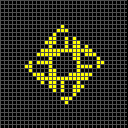
Code: Select all
x = 19, y = 37, rule = B3/S23
13b3o$12b4o$11b2obobo$13bobo$15bo12$10b2o$bobo7bobo$o7b2o3b2o$o3bo2b3o
3bo$o6b4obo$o2bo7bo$3o12bobo$18bo$14bo3bo$14bo3bo$18bo$9bo5bo2bo$8b3o
5b3o2$10bo$2bobo4b2o$5bo2b3o$5bo2b3o$2bo2bo2b2obo$3b3o3b3o$10bo!-
confocaloid
- Posts: 6697
- Joined: February 8th, 2022, 3:15 pm
- Location: learn to protect yourself against stray gliders and sparks and self-destruct mechanisms
Re: Serizawa
The supplied pattern "Delay27.rle" doesn't work with the supplied ruletable "Serizawa.rule" (the device is damaged after one use, and doesn't work second time):
I double-checked whether the supplied ruletable defines the exact same rules as Figure 1 in the paper in "Serizawa86.pdf". The ruletable appears to match the paper correctly.
Figure 8b in the same paper shows the delay device, and that looks roughly the same way as the above pattern, but there are no visible gridlines, so it is hard to tell whether all the cells are placed correctly.
One possible way to fix the device is to translate the rightmost 11 nonzero cells to the right:
Code: Select all
# A delay of 27 timesteps.
#
x = 30, y = 27, rule = Serizawa
8.A$15.A7.A4$7.A.A6.A7.A$3.A25.A$16.A7.A6$A8.A$.B13.A$A8.A12.A.A3$23.
A$8.A5$A$.B$A!
Figure 8b in the same paper shows the delay device, and that looks roughly the same way as the above pattern, but there are no visible gridlines, so it is hard to tell whether all the cells are placed correctly.
One possible way to fix the device is to translate the rightmost 11 nonzero cells to the right:
Code: Select all
x = 31, y = 27, rule = Serizawa
8.A$16.A7.A4$7.A.A7.A7.A$3.A26.A$17.A7.A6$A8.A$.B14.A$A8.A13.A.A3$24.
A$8.A5$A$.B$A!
- Figure 1 from "Serizawa86.pdf"
- serizawa-figure-1.png (98.78 KiB) Viewed 782 times
- Figure 8b from "Serizawa86.pdf"
- serizawa-figure-8b.png (37.82 KiB) Viewed 782 times
127:1 B3/S234c User:Confocal/R (isotropic CA, incomplete)
Unlikely events happen.
My silence does not imply agreement, nor indifference. If I disagreed with something in the past, then please do not construe my silence as something that could change that.
Unlikely events happen.
My silence does not imply agreement, nor indifference. If I disagreed with something in the past, then please do not construe my silence as something that could change that.