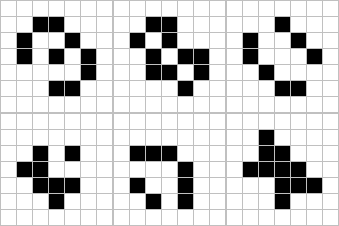
Extrementhusiast wrote:I was thinking of building a rule table, because of all of the rule tables posted on this board, but I don't know how to make any. Here is my objective:
State 0 and State 1 behave like Conway's Game of Life.
States 2 through n never change.
State 2 is the "birth-forcer" (will behave as described below).
State 3 is the "death-forcer" (equivalent to the "gray cells" in LifeHistory rule).
State 4 is the "birth-preventer" (no births are allowed in any of its eight neighbors).
State 5 is the "death-preventer" (once a cell is born into its neighborhood, it never dies).
State 6 is a combination of States 2 and 3.
State 7 is a combination of States 2 and 5.
This is how a lone State 2 cell behaves:
Code: Select all
000 111 101 010 111 101 010 111 101 010
020 121 020 121 121 020 121 121 020 121
000 111 101 010 111 101 010 111 101 010
To turn your ideas into a rule table, you first need to concentrate on the cell that is to change. Instead of: "a 2 changes all 0 neighbors to 1" you need to think: "a 0 with one or more 2 neighbors becomes 1". And then you can start writing the rule table:
n_states:8
neighborhood:Moore
symmetries:permute
var a={0,1,2}
var b={a}
var c={a}
var d={a}
var e={a}
var f={a}
var g={a}
0,2,a,b,c,d,e,f,g,1 # a 0 with one or more 2 neighbors (otherwise 0 or 1) becomes 1
Please note that this rule table takes advantage of some features due to arrive in Golly 2.2. With Golly 2.1 you can write:
n_states:8
neighborhood:Moore
symmetries:rotate8reflect
var a={0,1,2}
var b={0,1,2}
var c={0,1,2}
var d={0,1,2}
var e={0,1,2}
var f={0,1,2}
var g={0,1,2}
0,2,a,b,c,d,e,f,g,1 # a 0 with one or more 2 neighbors (otherwise 0 or 1) becomes 1
After that you'll need lots of experimentation and debugging to make sure it does what you expect.
I'm sure you've worked all this out by now but I thought it might be useful for others.
Tim