
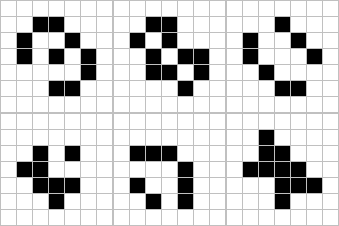
- Can any pattern be created by evolving a bent blinker (the smallest asymmetric shape) through a sequence of symmetric non-totalistic two-state rules?
- Can any pattern be differentiated from any other pattern by evolving them through the same sequence of symmetric non-totalistic rules (so that only one of the patterns survives)? (Obviously, rotations or reflections of a pattern are treated as identical.)
- Does adding multi-state rules change anything?
- What about asymmetric rules?
- What about copy/paste, given a set of acceptable paste modes?
- What about undo (to copy/paste "from the future")?
Repeatedly Changing Rules: Creating and Differentiating
-
Extrementhusiast
- Posts: 1970
- Joined: June 16th, 2009, 11:24 pm
- Location: USA
Repeatedly Changing Rules: Creating and Differentiating
When I'm gridding (i.e. exhaustively evaluating all ways to add another glider to a partial synthesis, to see if the results include certain cells), if there are too many false positives, I often resort to alternating changing rules and advancing the pattern by one step, in order to clear those false positives. This makes me wonder:
I Like My Heisenburps! (and others)

Re: Repeatedly Changing Rules: Creating and Differentiating
4. Almost certainly, I lack formal proof though.
1 and 2 are the most interesting questions. My first guess would be yes for one, but for 2 I'm less confident.
There probably are ways to tackle this problem efficiently with group theory and graph theory.
1 and 2 are the most interesting questions. My first guess would be yes for one, but for 2 I'm less confident.
There probably are ways to tackle this problem efficiently with group theory and graph theory.
-
praosylen

- Posts: 2449
- Joined: September 13th, 2014, 5:36 pm
- Location: Pembina University, Home of the Gliders
- Contact:
Re: Repeatedly Changing Rules: Creating and Differentiating
3 (both initial questions): Provably yes with an arbitrary amount of states. In Golly, I don't know.
Another interesting question: For any pattern fitting within a certain bounding area, is it possible to construct a sequence of rules of X type (isotropic non-totalistic, semi-totalistic, multi-state isotropic, etc.) so that after evolving the pattern one step sequentially in each successive rule, the population is nonzero, but evolving any other pattern fitting within the same bounding area through the same sequence of rules leads to zero population?
This is similar to 2, except it asks whether a particular sequence of rules can differentiate a certain pattern from any other pattern.
former username: A for Awesome
praosylen#5847 (Discord)
The only decision I made was made
of flowers, to jump universes to one of springtime in
a land of former winter, where no invisible walls stood,
or could stand for more than a few hours at most...
praosylen#5847 (Discord)
The only decision I made was made
of flowers, to jump universes to one of springtime in
a land of former winter, where no invisible walls stood,
or could stand for more than a few hours at most...