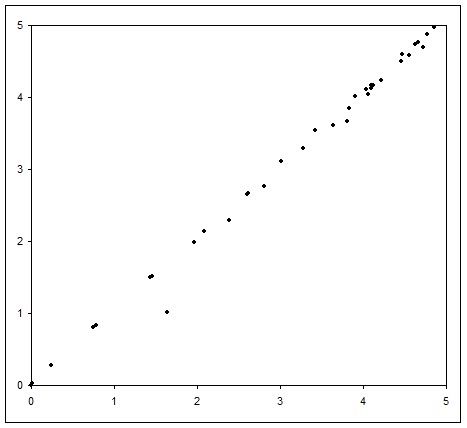
Comparing the frequencies of the 35 most common still lives and oscillators in each:
The anomaly is the ship. Why is it so much more common in the soup search? Maybe one of the reactions producing it takes a lot of space, and so can't happen in the dense toroidal universe Flammenkamp used, but can be formed on the edge of a cloud from the soup search.
Maybe one of the reactions producing it takes a lot of space
Ships appear almost exclusively in the debris of the B-heptomino, which flourishes in empty space. In toroidal universes, there is a uniform density, and not enough empty space for a B-heptomino to evolve.
What do you do with ill crystallographers? Take them to the mono-clinic!
I've noticed when running Day & Night in the Soup Search, occasionally infinite growth patterns (wickstretchers, I think) turn up. These seem to be undetected by the script, ie. the game isn't stopped and the pattern is seemingly grown forever.
Does the Soup Search ever detect these after a while? and if not, will it be fixed in a newer version of the script?
Lewis wrote:Does the Soup Search ever detect these after a while? and if not, will it be fixed in a newer version of the script?
I believe it does *eventually* stop, though it's been a while since I ran the script on Day & Night. As for the next version of the script, I've just about hit the limit of what I can do with the current script I think -- the next version of the script will likely be based on the WinLife census script, but that's still a while off.
Does the script detect pseudo-spaceships the same way it does with pseudo-still lifes/oscillators?
Andrzej Okrasinski's census counted around 20 or so 'LWSS on LWSS's: (I'm not sure why they're included though, because the census doesn't take pseudo-still lifes into account):
There's a new methuselah, in second place on the table for the standard Life rules (32,370 generations) which needs to be verified. I don't know if a low-population methuselah can be made from it.
There's a new methuselah, in second place on the table for the standard Life rules (32,370 generations)
I make it 31 319 generations. Interestingly, it collides two gliders to form a pond, then converts it to a block, then finally into a pi-heptomino. Similar to the Chapman-Greene slow salvo technology.
What do you do with ill crystallographers? Take them to the mono-clinic!
A pattern was found recently by Richard Wobus that lasts for over 32000 generations (currently second in the list of long-lived patterns). Amazingly, the pattern essentially becomes three blinkers and a B-heptomino, giving rise to this 15-cell 32829-generation methuselah:
#C 15-cell 32829-generation methuselah
#C found by Richard Wobus with Nathaniel Johnston's soup search (Oct. 7, 2010)
x = 23, y = 31, rule = B3/S23
3o20$3bo$3bo$3bo5$20b3o$9b3o10bo$22bo$21bo!
In terms of its initial population, this is currently the smallest known methuselah with a lifespan over 30000 (being only two cells larger than Lidka).
Edit: Here's a 16-cell 29937-generation methuselah based on a pattern by 'Kang Seonghoon aka senokay' (currently sixth in the list of long-lived patterns):
x = 8, y = 8, rule = B36/S125
5bo$4b3o$6b2o$6bo$5bo2$4bo$3bo!
Shouldn't the bounding box for B36/S125 for valid methuselahs be less that 8*8?
I don't see why. There are patterns in regular Life with bounding box 5x5 that grow indefinitely (see here). A methuselah, however, is a pattern that stays takes a long time to stabilize into predictable behaviour.
That definition has always been vague. A methuselah has to be "small", but it is unclear whether this should be done by bounding box or by initial population. It is also not entirely decided whether infinite growth patterns that take awhile to become predictable should be counted, since they never stabilize.
Now, if we want to define how small something has to be, it makes sense to require that a methuselah be smaller than the smallest pattern which can take an arbitrarily long time to stabilize. In B3/S23, this would mean allowing no more than 7 cells (at 8 cells a glider flying towards a blinker an arbitrary distance away can take an arbitrarily long time). Or, instead, we could require a specific sized bounding box, or we could use a combination of bounding box and initial population.
#C 15-cell 32829-generation methuselah
#C found by Richard Wobus with Nathaniel Johnston's soup search (Oct. 7, 2010)
x = 23, y = 31, rule = B3/S23
3o20$3bo$3bo$3bo5$20b3o$9b3o10bo$22bo$21bo!
#C 15-cell 32829-generation methuselah
#C found by Richard Wobus with Nathaniel Johnston's soup search (Oct. 7, 2010)
x = 23, y = 31, rule = B3/S23
3o20$3bo$3bo$3bo5$20b3o$9b3o10bo$22bo$21bo!
I was able to push it over the top by adding 3 cells:
#C 18-cell 37673-generation methuselah
#C based on Richard Wobus' 15-cell marvel
x = 75, y = 54, rule = B3/S23
73b2o$73bo22$3o20$3bo$3bo$3bo5$20b3o$9b3o10bo$22bo$21bo!
The bounding box is 75 x 54 but so far, 37673 may be a record for any methuselah of size 18 cells or less (even allowing a 100 x 100 bounding box).
The 15-cell pattern found by Richard Wobus is truly a standout methuselah.
I suppose the soup search will soon pass the 40000 generation barrier.
#C 15-cell 32829-generation methuselah
#C found by Richard Wobus with Nathaniel Johnston's soup search (Oct. 7, 2010)
x = 23, y = 31, rule = B3/S23
3o20$3bo$3bo$3bo5$20b3o$9b3o10bo$22bo$21bo!
If it's up to me, we can name it "Sedna" after the very distant minor planet, which is named after the Inuit sea goddess.
Since I've never really introduced myself here -- I was one of the loyal readers of Martin Gardner's "Mathematical Games" column 40 years ago when Conway's Life was introduced. I was about to be drafted into the army, with no computer access for the next two years, so I played with the "r-pentomino" and other patterns with pennies and nickels or paper and pencil. Even then I realized that this was more interesting than the average "Games" column, and that we would be reading about Life for many years. It was while learning about Golly and the Caterpillar, both of which go well beyond what most of us anticipated in 1970, that I found out about the soup search.
knightlife wrote:The bounding box is 75 x 54 but so far, 37673 may be a record for any methuselah of size 18 cells or less (even allowing a 100 x 100 bounding box).
This ark found by Nick Gotts and retreived from Stephen Silver's Life Lexicon is well within those limits. It stabilizes at generation 736692...
Well... A "normal" methuselah doesn't really stabilize eiter. It's bounding box for generation n is expanding forever. That's not really stable. So it's a matter of definition...