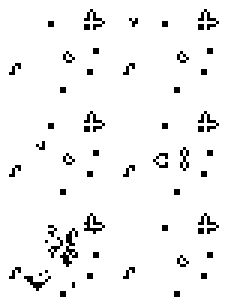
x = 32, y = 34, rule = B3/S23
22bo$20b2o$o3bo23bo$5o18bo3bobo$2bo4bobob2o5b2ob2obo3bo$bobo5bob3o3bo
2bo4bo$2bo4bobob2o5b2ob2obo$5o18bo$o3bo$25b4o$24bo4bo$24bo3bobo$25bo3b
obo$31bo$31bo$28bo2bo$29b2o$21b2o$21b2o$o3bo23bo$5o18bo3bobo$2bo4bobob
2o5b2ob2obo3bo$bobo5bob3o3bo2bo4bo$2bo4bobob2o5b2ob2obo$5o18bo$o3bo$
25b4o$24bo4bo$24bo3bobo$25bo3bobo$31bo$31bo$28bo2bo$29b2o!
I didn't see it in the sparker stamp collection.
I know that traffic light shuttles and beehive/loaf mechanisms can make more sparkers, like what I did with my newest p11 domino sparker, so what other low-period reactions or rephasable-looking mechanisms can be turned into useful sparkers? So far I know the beehive/loaf, interchange, sandwich, bi-block reaction, grin, pipsquirter catalyst, the reaction in the p16 beehive hassler, ship+eater, and two-blinkers-to-domino reaction are useful low-period reactions.
x = 26, y = 31, rule = B3/S23
6bo$5bobo$5bobo$ob2obob2o$2obobo2bo$5bobo$4bo2bo16b2o$4b2o8bo4bo3bobo$
7bo5bobo2bobobobo$4b4o6bo3bo$3bo13bob2obob2o$4b4o8bob3o4bo$7bo12bo4bo$
4b2o10bo4bo$4bo2bo6bo4b2o$5bobo4b4o$2obobo2bo4bob2o$ob2obob2o$5bobo$5b
obo$6b2ob2o3bo3b2o$8bo2bo2b2o3bo$8bob2o7bobo$7b2obo9b2o$7bo2bo$9b2obob
2o2bo$11bobob4o$11bobo$12bob3o$13bo2bo$14b2o!
I noticed that a B can turn into the same traffic light predecessor in my p10 pi hassler, and then noticed that a block that just got eaten can actually turn it back! The hassler is almost rephasable at p11. It just needs a good dot sparker or other reaction:
x = 74, y = 25, rule = B3/S23
12b2o24b2o24b2o$12bo25bo25bo$10bobo23bobo23bobo$4bo5b2o4bo13bo5b2o18b
o5b2o$3bobo9bo13bobo8bo3bo10bobo9bo2bo$3bobob2o6b3o11bobob2o6b3o11bob
ob2o6b3o$2obobob2o17b2obobob2o17b2obobob2o$ob2ob3o6bo11bob2ob3o6bo11b
ob2ob3o6bo$4bo5bob4o14bo5bob4o14bo5bob4o$4bob4o3bob2o13bob4o3bob2o13b
ob4o3bob2o$5bo25bo25bo$7bo25bo25bo$6b2o24b2o24b2o$14bo3b2o20bo3b2o20b
o3b2o$14b2o3bo20b2o3bo20b2o3bo$5bo13bobo9bo13bobo9bo13bobo$5b3o12b2o9b
3o12b2o9b3o12b2o$8bo2b3o20bo2b3o20bo2b3o$7bo2bo22bo2bo22bo2bo$7b3obo21b
3obo21b3obo$10bob2obo20bob2obo20bob2obo$9b2o3bobo18b2o3bobo18b2o3bobo
$9bo5bo19bo5bo19bo5bo$7bobo23bobo23bobo$7b2o24b2o24b2o!
However, because p11 doesn't allow for gliders, really, and even though this is a novel way to turn a traffic light sequence into itself, the eater doesn't give much room to turn it back, so I still like the way you discovered, 8than888.
Last edited by Timelord Missionary on October 25th, 2026, 9:36 pm, edited 1 time in total.
Helloshe, I like pentadecathlons and small-period motifs.
I may not be very skilled in search programs, but I have many ideas.
Soli Deo Gloria!
x = 24, y = 60, rule = B3/S23
20b2o$20bo$6b2o10bobo$5bobo6b2o2b2o$5bo8b2o6b2o$ob2ob2o14bobo$2obo17bo
$3bo16b2o$3b2o5bo$9b2o$9b2o$11bo2$7b3o$7b2o9b3o$4b2ob2o10b3o$3b3o2bo$
3b2o4bo$8b2o4b2o$7b2o5bo$15b3o$17bo5$2o$2o$7bo$6b2o$5b2obo$5bo$2o5bo$
2o2b2o5$17bo$15b3o$14bo$14b2o3$8b3o8b3o$7bo3bo6b3o2$8bobo$7bo2bo$6b2o
4b2o$9bo2bo$3b2o4bobo$3bo16b2o$2obo3b2o3bo8bo$ob2ob2o2b3o9bobo$5bo8b2o6b2o$5bobo6b2o2b2o$6b2o10bobo$20bo$20b2o!
I was trying to flip a pi again, but I accidentally put a block in the wrong place and it made the pi actually flip! I first found a 28-cell solution in LifeInvestigator:
x = 35, y = 60, rule = B3/S23
31b2o$31bo$17b2o10bobo$16bobo6b2o2b2o$16bo8b2o6b2o$11bob2ob2o14bobo$11b
2obo17bo$14bo16b2o$14b2o5bo$20b2o$20b2o$22bo2$18b3o$18b2o9b3o$15b2ob2o
10b3o$14b3o2bo$14b2o4bo$19b2o4b2o$18b2o5bo$26b3o$28bo5$11b2o$11b2o$16b
o$16b2o$15bob2o$18bo$16bo5b2o$18b2o2b2o5$6bo$6b3o$9bo$8b2o3$2b3o8b3o$
3b3o6bo3bo2$13bobo$13bo2bo$10b2o4b2o$11bo2bo$12bobo4b2o$2b2o16bo$2bo8b
o3b2o3bob2o$obo9b3o2b2ob2obo$2o6b2o8bo$4b2o2b2o6bobo$3bobo10b2o$3bo$2b
2o!
Serving currently as something of a stenographer within this community, mostly reducing the occasional gun, synthesis reduction, or providing discovery commentary. Will get software to begin searches eventually.
x = 10, y = 11, rule = B3/S23
b2o$2bo$bo$b2o$3bo$b3o3b2o$o6b2o$2o$7b2o$7b3o$7b2o!
And I tried making an oscillator using this reaction by turning the century into a pi predecessor and catalyzing the block to make the traffic light. I almost got a p16 oscillator, but I couldn't find anything that fit for the block:
x = 31, y = 21, rule = B3/S23
5b2o$6bo$5bo$5b2o9bo$7bo7bo$5b3o3b2o2bo$4bo6b2o2bo$4b2o2$20bo$10b3o6bo
bo6bo$5bo4bob2o6bo6b3o$4b3o7bo11bob3o$3bob3o4b2o3bo7bo3bo$2bo3bo5bo2b
2ob2o4bo3bo$bo3bo9bo4bo2b3obo$3obo19b3o$b3o12bo8bo$2bo$18bo2bo$18b2o!
Then I noticed that a grin in a different location can turn the century back into the traffic light at p17, which made me realize that it was actually completable!
Edit: I just found a p15 century/traffic light hassler!
x = 5, y = 9, rule = B3/S23
2o$obo$2b2o$b2o3$bo$b2o$3b2o!
At first, I didn't really make progress on it, but then I found that the century can still turn into the queen bee without an obo sparker by turning a blinker into a boat, which I knew can be easily eaten back! The current way that the queen bee turns back into the century looks hard to reduce, but there might be smaller ways to do it.
I'm revisiting my On-Off loops. I find this topic particularly interesting:
A Binary Transformation with Remarkable Periods
1. The transformation rule
Consider a binary sequence of length n >= 2, consisting of bits equal to either 0 or 1.
The initial state is: X0 = (1, 0, ..., 0)
At each iteration, a new state Y = (y_1, … ,y_n) is calculated from the current state X = (x_1, … , x_n), according to the following rule:
Y_i = x_n XOR x_1 XOR … XOR x_i, for i = 1, … , n.
XOR denotes addition modulo 2:
• 0 XOR 0 = 0
• 0 XOR 1 = 1
• 1 XOR 1 = 0
The rule is deterministic: each state always produces the same next state.
This transformation can be studied mathematically or physically implemented using a device based on loops and gliders.
2. The return period T(n)
The return period T(n) is defined as the minimum number of iterations required to return exactly to the initial state.
Example for n = 3:
100 -> 111 -> 010 -> 011 -> 101 -> 001 -> 110 -> 100
Thus, T(3) = 7.
Since the transformation is invertible, the evolution of the initial state forms a cycle. The maximum possible period for a nonzero initial state is:
T_max(n) = 2^n - 1
When T(n) = 2^n - 1, the period is said to be maximal:the cycle visits every nonzero state before returning to the initial state.
Examples of maximal periods:
• n = 2 : T(2) = 3
• n = 3: T(3) = 7
• n = 4 : T(4) = 15
• n = 7: T(7) = 127
• n = 15 : T(15) = 32,767
• n = 22: T(22) = 4,194,303
• n = 127: T(127) = 170,141,183,460,469,231,731,687,303,715,884,105,727
• n = 153: T(153) = 11,417,981,541,647,679,048,466,287,755,595,961,091,061,972,991
(The first six values were verified experimentally, while the last two were obtained through calculation.)
These examples show that the period does not increase regularly with n.
3. Three families of values of n
A. First family: powers of 2
n = 2^k: 2, 4, 8, 16, 32, 64, 128, …
Experiments and calculations carried out for several of these values indicate periods that are particularly short compared with the theoretical maximum period of 2^n - 1. Indeed, the following relationship is observed for these values of n:
T(n) = n^2 - 1
B. Second family: integers immediately below powers of 2
n = 2^k - 1: 3, 7, 15, 31, 63, 127, …
The values n = 3, n = 7 and n = 15 yield maximal periods. This does not mean that every value in this family necessarily has a maximal period.
This family contains both maximal and non-maximal periods. For example, n = 22 achieves the maximum period without belonging to either of the first two families.
Therefore, neither the parity nor the primality of n, on its own, is sufficient to predict the period.
4. Repetitions in the concatenated binary stream
The successive states of a cycle can be concatenated to form a single binary stream.
The cycle contains T(n) states, each consisting of n bits. The complete stream therefore contains n T(n) bits.
Three quantities must be distinguished:
• The logical period T(n): the number of iterations required to return to the initial state.
• The repeating block length: the number of bits in the pattern that repeats.
• The number of repetitions: the number of copies of that block in the complete stream.
Reported observations:
• n = 5: logical period of 21, a 21-bit block repeated 5 times.
• n = 6: logical period of 21, a 63-bit block repeated 2 times.
• n = 7: logical period of 127, a 127-bit block repeated 7 times.
For n = 5, the 21-bit block repeats five times even though the period is not maximal. For n = 7, the period is maximal and the 127-bit block repeats seven times.
These observations suggest a relationship between the logical period and the structure of the binary stream, but they are not sufficient to establish a general rule.
5. Conjectures to be investigated
Conjecture 1
For powers of 2, the return period appears to follow the relationship:
T(2^k) = (2^k)^2 - 1, with k >= 1
The values n = 2, 4, 8, 16, 32, 64 and 128 are consistent with this hypothesis:
This conjecture remains to be proved for all values of n = 2^k.
Conjecture 2
A particular structure in the concatenated stream.
For certain values of n, the complete stream appears to consist of several identical copies of the same binary block.
The conditions under which the block length is exactly T(n), and whether a maximal period guarantees this property, remain to be determined.
Conjecture 3
There are infinitely many values of n for which the transformation achieves the maximal period:
T(n) = 2^n - 1.
In other words, for every integer N >= 2, there exists an integer n >= N such that:
T(n) = 2^n - 1.
6. The algebraic framework
The transformation can be studied using the polynomial:
P_n(x) = (x + 1)^n + x^(n - 1) over the finite field with two elements, denoted by F_2.
This polynomial is the characteristic polynomial of the matrix associated with the linear transformation.
The algebraic properties of this polynomial make it possible to study the period of the transformation. In particular, its factorization and multiplicative order play a decisive role.
A polynomial of degree n is said to be primitive over F_2 if it is irreducible and its roots have multiplicative order equal to 2^n - 1.
When P_n(x) is primitive, the transformation achieves a maximal period:
T(n) = 2^n - 1.
In this case, the cycle visits every nonzero binary state before returning to the initial state.
This property provides an algebraic criterion for identifying certain values of n for which the period is maximal.
When the characteristic polynomial is not primitive, the transformation cannot achieve a maximal period. Determining the period then requires a more detailed study of its factorization and the associated multiplicative orders.
This approach makes it possible to go beyond numerical observations and seek general mathematical criteria, as well as to investigate the conditions under which maximal periods occur.
Conclusion
A simple binary rule can produce cycles of very different lengths and repetitive patterns at several scales.
The study of this transformation raises several questions concerning:
• the relationship between the logical period T(n) and the dimension n, particularly the behaviour observed for powers of 2;
• the conditions required to obtain a maximal period;
• the conjectured existence of infinitely many values of n for which the transformation achieves the maximal period;
• the structure of repetitions in the concatenated binary stream.
The observed relationships provide research directions that remain to be explored and mathematically demonstrated.
Neither the parity nor the primality of n, on its own, constitutes a sufficient criterion for maximality.
The objective is to turn experimental observations into demonstrable mathematical properties, particularly through the algebraic study of the polynomial associated with the transformation.
(The numerical values should also be independently recalculated before being accepted as established results.)
Last edited by GilGil on October 30th, 2026, 2:08 pm, edited 1 time in total.
x = 16, y = 33, rule = B3/S23
5b2o$6bo$6bob2o$b2o4bobo$2bo$2bobo$3b2o2$7b3o$6bo2bo2$11bo$6bo$2o5bo3b
o$obo5b3o$2bo$2b2o8b2o$13bo$5b3o5bobo$4bo3bo5b2o$9bo$4bo2$6bo2bo$6b3o
2$11b2o$11bobo$13bo$6bobo4b2o$6b2obo$9bo$9b2o!
I wanted to make a p13 traffic light hassler, because there aren't many p13 traffic light hasslers. I noticed that turning an r-pentomino to a traffic light and back again would give me a p13 hassler. The first problem was solved by dimerizing it, but the second problem looked difficult. Then I found that when the traffic light hits a block predecessor, the second problem would've been solved, and the block turns into a pi, which I knew I can eat back:
I was trying to make an oscillator using this reaction, and my searcher kept showing me where a pi-to-angel reaction made the angel look like the traffic light it came from, and I was able to search a way to actually turn the angel back at p16! I thought there weren't any known p16s that can turn it back, so I found a dependent pi/traffic light/beehive hassler solution instead:
I was trying to make an oscillator using this reaction, and my searcher kept showing me where a pi-to-angel reaction made the angel look like the traffic light it came from, and I was able to search a way to actually turn the angel back at p16! I thought there weren't any known p16s that can turn it back, so I found a dependent pi/traffic light/beehive hassler solution instead:
You know, 8than, you are all I wish I could be in the Game of Life, except you have more free time, a steadier will, and an eagerness to use search programs.
They will serve you well.
By the way, I know this is more on-topic for the Scripts forum, but what search program do you use? I would be interested to know if it's something common or if it's a bit more home-brew.
Helloshe, I like pentadecathlons and small-period motifs.
I may not be very skilled in search programs, but I have many ideas.
Soli Deo Gloria!
Timelord Missionary wrote: Yesterday, 10:52 pm
You know, 8than, you are all I wish I could be in the Game of Life, except you have more free time, a steadier will, and an eagerness to use search programs.
They will serve you well.
By the way, I know this is more on-topic for the Scripts forum, but what search program do you use? I would be interested to know if it's something common or if it's a bit more home-brew.
I use a simple searcher that I vibe-coded with Claude. I usually use it when an oscillator looks difficult to complete, though. Most of my ideas come from other people's posts, accidental mistakes, and sometimes just messing around in Golly.