
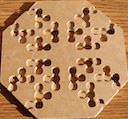
I used Claude to generate a Javascript page that does the same thing. It seemed to have no trouble porting my code. You can try it out here: https://html-preview.github.io/?url=htt ... rator.html
If for some reason the preview doesn't work, here's the regular github link: https://github.com/PaulBC/misc_scripts/ ... rator.html
Flexagon sheets look like this (since they sometimes need to be split).
- Screenshot 2026-10-13 185212.png (22.28 KiB) Viewed 104 times
- Screenshot 2026-10-13 185222.png (13.65 KiB) Viewed 104 times
Code: Select all
# This is a shell archive. Mainly of historical interest. Don't run this or any other
# unknown code as a shell script. Yikes, we were nuts back in the 90s.
#
# Wrapped by biffvm!callahan on Sat Jan  7 15:30:23 EST 1995
# Contents:  FOLDING_INSTRUCTIONS README flex flex2ps.c flextree.c flx0.rpn
#	flx1.rpn flx2.rpn flx3.rpn flx4.rpn flx5.rpn flx6.rpn flx7.rpn makefile
#	polytree.c

echo x - FOLDING_INSTRUCTIONS
sed 's/^@//' > "FOLDING_INSTRUCTIONS" <<'@//E*O*F FOLDING_INSTRUCTIONS//'
First, you must cut out and paste the strip together.  To do this, look
at the order of the numbers given in the file with the .table suffix.  Two
numbered triangles are adjacent when they correspond to two adjacent table
entries (the table is repeated three times, so the first entry follows the
last).  Sometimes the printed strip will wrap back on itself, in which case
two triangles will be adjacent on a sheet even though they are not adjacent
in the table.  In this case, separate them with scissors along that edge.
Note that the orientation of triangles does not change between separate
printed sheets.

You may need to consult the table to make sure of the appropriate way to join
strips between separate pages. This will depend on whether the entry for the
current triangle is "+" or "-".  Consider the sequence of three triangles
including the current triangle along with the one that precedes it and the one
that follows it, with their order denoted by the numbers 1, 2 and 3.  The
following sequences are consistent with "+":

                    /\                /\
    ----           / 3\              / 1\
   /\ 2/\          ----              ----
  / 1\/ 3\         \ 2/\            /\ 2/
  --------          \/ 1\          / 3\/
                     ----          ---


                     ----          ---
  --------          /\ 1/          \ 3/\
  \ 1/\ 3/         / 2\/            \/ 2\
   \/ 2\/          ----              ----
    ----           \ 3/              \ 1/
                    \/                \/


Reverse the numbers in each, and you get the sequences consistent with "-".
Note that given the position of triangles 1 and 2, there is a unique triangle 3
that is consistent with a given sign.  For more explanation, see
_Madachy's Mathematical Recreations_.

The final step is to fold the strip.  This is where it helps to write the
bottom labels on the reverse side of the strip explicitly.  In case you don't
have a copy of _Madachy's Mathematical Recreations_, the instructions given
on p. 72 are:

     The rule for folding is this: Find a symbol that occurs on pairs of
     adjacent triangles, but does not occur on the first one.   Eliminate
     that symbol by folding together each such pair.  Repeat this operation
     on the reduced strip thus obtained.  Repeat on the now reduced strip,
     and so on until only [two of the symbols] remain.  Paste together
     these two end triangles, which have come together into the correct
     position, so that they become one triangle.  The result is a
     flexagon showing [one symbol] 6 times on one side and [the other
     symbol] 6 times on the other side.

@//E*O*F FOLDING_INSTRUCTIONS//
chmod u=rw,g=r,o=r FOLDING_INSTRUCTIONS

echo x - README
sed 's/^@//' > "README" <<'@//E*O*F README//'
To install:

   Just type "make".  This will produce three executables. (one per source)
   These each do separate things on their own but the shell script "flex"
   uses them in the standard way.

To use:

   You must have a file with the suffix ".rpn" (an example of such a
   file is "flx1.rpn," supplied with this shar file).  It should contain
   one line with a valid RPN string signifying a binary tree structure.
   The following CFG defines all valid strings:

             S --> TTt
             T --> . | S

   If you are unfamiliar with CFGs but familiar with RPN, think of an HP
   calculator with one constant "." the empty tree, and one operator "t"
   meaning: construct a new tree with the two operands as left and right
   children, respectively.

   If the above does not make sense, consider the following examples.

   The string "..t" corresponds to the tree:

                       t
                      / \
                      . .

   The string "..t..tt.t" corresponds to the tree:

                       t
                      / \
                      t  .
                     / \
                     t  t
                    /\  /\
                    ..  ..


   Now, assuming such a string is in a ".rpn" file named <file>.rpn,
   just type:

      flex <file>

   This will produce all the appropriate output.

Example:

   Type:
      flex flx1

   (Note that flx1.rpn is supplied as an example)

   When the prompt returns, you will find the following new files:

      flx1.table
      flx1.struct.ps
      flx1.strip.ps

   The first is "human readable," and the next two are meant to be output
   on a PostScript printer.  If you read the exposition on flexagons in
   "Madachy's Mathematical Recreations," you should be able to figure
   out what to do with the above. (only the last file is necessary for the
   construction of the flexagon)

Note about the strips:

   The strips appear in the same format as in Madachy.  Numbers to
   be placed on reverse side of the strip are the bottom numbers in
   each triangle (actually writing these on the reverse side will make folding
   easier).

   Many pages may be printed to form a single strip.  The file containing
   the table will indicate how these are to be pasted together.  The
   orientation of triangles is the same on all pages.

   (Extra pages need to be printed when either (a) one triangle is
    about to be placed on top of another or (b) strip is about to
    leave the page)
@//E*O*F README//
chmod u=rw,g=r,o=r README

echo x - flex
sed 's/^@//' > "flex" <<'@//E*O*F flex//'
#!/bin/sh

flextree <$1.rpn | tee $1.table | flex2ps >$1.strip.ps
polytree <$1.rpn >$1.struct.ps

@//E*O*F flex//
chmod u=rwx,g=rx,o=rx flex

echo x - flex2ps.c
sed 's/^@//' > "flex2ps.c" <<'@//E*O*F flex2ps.c//'
/* Copyright Paul Callahan (call...@crabcake.cs.jhu.edu), 1990.
   Permission to copy and modify is granted, as
   long as you leave this header comment.
   [If you come up with a nicer way to output the strips, or
    any other improvements, please send me a copy] */
#include <stdio.h>
#define MAXLINE 255
#define MAXFLEX 100
#define SCALE 120

struct flextabtype {int row[2]; char movesym;};
struct tritabtype {int x,y,cell,top,bottom;};
struct centertype {int x,y;};

main()
{
  char s[MAXLINE],junk;
  struct flextabtype flextab[MAXFLEX];
  struct tritabtype tritab[3*MAXFLEX+1];
  int flexnum;

  flexnum=0;
  while(gets(s)) {
     sscanf(s,"%c %d %d %c\n",&junk,&(flextab[flexnum].row[0]),
                                    &(flextab[flexnum].row[1]),
                                    &(flextab[flexnum].movesym));
     flexnum++;
  }
  maketri(tritab,flextab,flexnum);
  psouttab(tritab,flexnum);
}

maketri(tritab,flextab,flexnum)
struct tritabtype tritab[];
struct flextabtype flextab[];
int flexnum;
{

  int x,y,cell,triind,oddeven;
  struct tritabtype pos;

  oddeven=flexnum%2;
  pos.x=0; pos.y=0; pos.cell=0;

  for (triind=0; triind<3*flexnum+1; triind++) {
    tritab[triind]=pos;
    tritab[triind].top
       =flextab[triind%flexnum].row[(triind/flexnum)%2*oddeven];
    tritab[triind].bottom
       =flextab[triind%flexnum].row[1-(triind/flexnum)%2*oddeven];
    move(&pos,flextab[triind%flexnum].movesym);
  }
}

#define charsign(x) (((x)=='+')?1: -1)
move(pos,movesym)
struct tritabtype *pos;
char movesym;
{
 static int direction=0, sense[2]={1,-1},
                         dx[6]={1,0,0,-1,0, 0},
                         dy[6]={0,0,1, 0,0,-1};

    direction=(direction+charsign(movesym)*sense[pos->cell]+6)%6;
    pos->cell=1-(pos->cell);
    (pos->x)=(pos->x)+dx[direction];
    (pos->y)=(pos->y)+dy[direction];
}


psprologue()
{
printf("%%!\n");
printf("100 dict begin\n");
printf("/clean true def\n");
printf("/csixty 60 cos def /ssixty 60 sin def\n");
printf("/tricoor {/y1 exch def /x1 exch def\n");
printf("          x1 y1 csixty mul add y1 ssixty mul} def\n");
printf("/maketri {/tritype exch def /y exch def /x exch def\n");
printf("           tritype 0 eq\n");
printf("x y tricoor\n");
printf("dup\n");
printf("uy gt {0 dy neg translate /uy uy dy add def /ly ly dy add def spitout} if\n");
printf("ly lt {0 dy translate /uy uy dy sub def /ly ly dy sub def spitout} if\n");
printf("dup\n");
printf("ux gt {dx neg 0 translate /ux ux dx add def /lx lx dx add def spitout} if\n");
printf("lx lt {dx 0 translate /ux ux dx sub def /lx lx dx sub def spitout} if\n");
printf("           {gsave newpath\n");
printf("            x y tricoor moveto\n");
printf("            x 1 add y tricoor lineto\n");
printf("            x y 1 add tricoor lineto\n");
printf("            closepath stroke grestore}\n");
printf("           {gsave newpath\n");
printf("            x 1 add y 1 add tricoor moveto\n");
printf("            x 1 add y tricoor lineto\n");
printf("            x y 1 add tricoor lineto\n");
printf("            closepath stroke grestore}\n");
printf("            ifelse /clean false def} def\n");
printf("/tricenter {/tritype exch def /y exch def /x exch def\n");
printf("            tritype 0 eq\n");
printf("            {x 0.3333 add y 0.3333 add}\n");
printf("            {x 0.6667 add y 0.6667 add}\n");
printf("            ifelse tricoor} def\n");
printf("/trilabel {tricenter moveto gsave\n");
printf("           -0.05 0.02 rmoveto show grestore\n");
printf("           gsave -0.05 -0.1 rmoveto show grestore} def\n");
printf("/spitout {clean not {copypage gsave 1 setgray clippath fill\n");
printf("          grestore /clean true def}\n");
printf("          if } def\n");
printf("612 0 translate\n");
printf("90 rotate\n");
printf("396 306 translate\n");
printf("/Helvetica findfont 8 60 div scalefont setfont\n");
printf("%d %d scale\n",SCALE,SCALE);
printf("currentlinewidth 100 div setlinewidth\n");
}

psouttab(tritab,flexnum)
struct tritabtype tritab[];
int flexnum;
{
#define XBOUND 30
#define YBOUND 30

struct centertype center();
struct centertype centerval;
int i,j,page;
int conflictarray[XBOUND*2+1][YBOUND*2+1][2];

   psprologue();

   /* initially, no conflicts */
   for (i=0; i<XBOUND*2+1; i++)
      for (j=0; j<YBOUND*2+1; j++)  {
         conflictarray[i][j][0]=0;
         conflictarray[i][j][1]=0;
      }

   page=1;
   centerval=center(tritab,flexnum);
   printf("%d %d tricoor\n",centerval.x,centerval.y);
   printf("neg 2 1 roll neg 2 1 roll translate\n");
   printf("clippath pathbbox newpath\n");
   printf("/uy exch 1 sub def /ux exch 1.5 sub def\n");
   printf("/ly exch def /lx exch def\n");
   printf("/dy uy ly sub 3 mul 4 div def\n");
   printf("/dx ux lx sub 3 mul 4 div def\n");
   for (i=0; i<flexnum*3+1; i++) {
      pageconflict(tritab[i].x,tritab[i].y,tritab[i].cell,
               &page,conflictarray);
      printf("%d %d %d maketri ",
                  tritab[i].x,
                  tritab[i].y,
                  tritab[i].cell);
      printf("(%d) (%d) %d %d %d trilabel\n",
                  tritab[i].bottom,
                  tritab[i].top,
                  tritab[i].x,
                  tritab[i].y,
                  tritab[i].cell);
   }
   printf("end showpage\n");
}

struct centertype center(tritab,flexnum)
struct tritabtype tritab[];
int flexnum;
{
int xmini,ymini,xmaxi,ymaxi,i;
struct centertype centerval;

   /* returns center of bounding box of triangle sequence */

#define COS60 0.5
#define SIN60 0.86603
#define tricartx(i) (int)((float)(tritab[i].x)+((float)(tritab[i].y)*COS60))
#define tricarty(i) (int)((float)(tritab[i].y)*SIN60)

   xmini=0; ymini=0; xmaxi=0; ymaxi=0;
   for(i=1; i<flexnum*3+1; i++) {
      if (tricartx(i)<tricartx(xmini)) xmini=i;
      if (tricarty(i)<tricarty(ymini)) ymini=i;
      if (tricartx(i)>tricartx(xmaxi)) xmaxi=i;
      if (tricarty(i)>tricarty(ymaxi)) ymaxi=i;
   }

   centerval.x=(tritab[xmini].x+tritab[xmaxi].x)/2;
   centerval.y=(tritab[ymini].y+tritab[ymaxi].y)/2;
   return(centerval);
}

pageconflict(x,y,cell,page,conflictarray)
int x,y,cell,*page,conflictarray[XBOUND*2+1][YBOUND*2+1][2];
{
  if (conflictarray[XBOUND+x][YBOUND+y][cell]==(*page)) {
        (*page)++;
        printf("spitout\n");
  }
  conflictarray[XBOUND+x][YBOUND+y][cell]=(*page);
}
@//E*O*F flex2ps.c//
chmod u=rw,g=r,o=r flex2ps.c

echo x - flextree.c
sed 's/^@//' > "flextree.c" <<'@//E*O*F flextree.c//'
/* Copyright Paul Callahan (call...@crabcake.cs.jhu.edu), 1990.
   Permission to copy and modify is granted, as
   long as you leave this header comment.
   [If you come up with a nicer way to output the strips, or
    any other improvements, please send me a copy] */
#include <stdio.h>
#define MAXARRAY 100

/* flextree.c:
   Generates specification array for a flexagon, given a
   binary tree structure which corresponds to a polygon
   triangulation. (See Madachy's Mathematical Recreations,
   by Joseph Madachy pp.64-72).

   Tree structure is specified in RPN.
       "." is the empty tree.
       "t" is an operation which forms a new tree from the
           two trees which precede it.
*/

struct edge {int first,last,child[2],listindex;};

main()
{
int vertnum,polysize,stacktop,listtail,inputnode;
struct edge stack[MAXARRAY], edgelist[MAXARRAY], treebound;

/* Postfix evaluation is done in standard manner, using a stack.
   As polygon edges are generated, they are appended to a list.
   Cursor values maintain the tree relationships between edges.
*/

   stacktop=0;
   listtail=0;
   vertnum=0;

   while (((inputnode=getchar())!=EOF)&&(inputnode!=(int)'\n')) {
     switch((char)inputnode) {
         case '.':

          /* empty tree is just an outside edge on the polygon */

           treebound.first=vertnum;
           treebound.last= ++vertnum;
           /* corresponds to a leaf in the overall tree structure */
           treebound.child[0]= -1;
           treebound.child[1]= -1;
           treebound.listindex=listtail;

           edgelist[listtail++]=treebound;
           stack[stacktop++]=treebound;
         break;

         case 't':
           if (stacktop<2) printf("Stack Underflow\n");
           else {

           /* new polygon is formed by connecting first and
              last vertices of two preceding polygons */

               treebound.child[1]=stack[--stacktop].listindex;
               treebound.last=stack[stacktop].last;

               treebound.child[0]=stack[--stacktop].listindex;
               treebound.first=stack[stacktop].first;

               treebound.listindex=listtail;

               stack[stacktop++]=treebound;
               edgelist[listtail++]=treebound;
           }
         break;

         default:
            printf("\'%c\' ignored\n",(char)inputnode);
     }
   }
   if (stacktop>1) printf("Invalid Tree\n");
   else genflex(stack[0].listindex,edgelist);

}

genflex(root,edgelist)
int root;
struct edge edgelist[];
{
int travrank,traversesense;

#define pmchar(x) (((x)==0)?'-':'+')
#define alternate(x) ((x)%2==1)

    travrank=0;
    traversesense=1;

    /* root edge gets printed in reverse order */
    if (!alternate(travrank))
        printf("%c %3d %3d %c\n",65+ travrank,
                             edgelist[root].last,
                             edgelist[root].first,
                             pmchar(traversesense));
    else
        printf("%c %3d %3d %c\n",65+ travrank,
                               edgelist[root].first,
                               edgelist[root].last,
                               pmchar(traversesense));

    travrank++;

    genflexrecur(root,&travrank,1-traversesense,edgelist);
}


genflexrecur(root,travrank,traversesense,edgelist)
int root,*travrank,traversesense;
struct edge edgelist[];
{
   if (edgelist[root].child[0]!=(-1)) {
       genflexrecur(edgelist[root].child[traversesense],
                    travrank,1-traversesense,edgelist);
       genflexrecur(edgelist[root].child[1-traversesense],
                    travrank,1-traversesense,edgelist);
   }
   else {

      if (alternate(*travrank))
          printf("%c %3d %3d %c\n",65+ *travrank,
                               edgelist[root].last,
                               edgelist[root].first,
                               pmchar(traversesense));
      else
          printf("%c %3d %3d %c\n",65+ *travrank,
                               edgelist[root].first,
                               edgelist[root].last,
                               pmchar(traversesense));

      (*travrank)++;
   }
}
@//E*O*F flextree.c//
chmod u=rw,g=r,o=r flextree.c

echo x - flx0.rpn
sed 's/^@//' > "flx0.rpn" <<'@//E*O*F flx0.rpn//'
@..t
@//E*O*F flx0.rpn//
chmod u=rw,g=r,o=r flx0.rpn

echo x - flx1.rpn
sed 's/^@//' > "flx1.rpn" <<'@//E*O*F flx1.rpn//'
@.....t.tt.tt.tt
@//E*O*F flx1.rpn//
chmod u=rw,g=r,o=r flx1.rpn

echo x - flx2.rpn
sed 's/^@//' > "flx2.rpn" <<'@//E*O*F flx2.rpn//'
@...t..ttt
@//E*O*F flx2.rpn//
chmod u=rw,g=r,o=r flx2.rpn

echo x - flx3.rpn
sed 's/^@//' > "flx3.rpn" <<'@//E*O*F flx3.rpn//'
@......t.tt.tt.tt.tt.t
@//E*O*F flx3.rpn//
chmod u=rw,g=r,o=r flx3.rpn

echo x - flx4.rpn
sed 's/^@//' > "flx4.rpn" <<'@//E*O*F flx4.rpn//'
@..t..tt..t..ttt..t..tt..t..tttt
@//E*O*F flx4.rpn//
chmod u=rw,g=r,o=r flx4.rpn

echo x - flx5.rpn
sed 's/^@//' > "flx5.rpn" <<'@//E*O*F flx5.rpn//'
@....t..tt.t..t..tt.ttt..ttt
@//E*O*F flx5.rpn//
chmod u=rw,g=r,o=r flx5.rpn

echo x - flx6.rpn
sed 's/^@//' > "flx6.rpn" <<'@//E*O*F flx6.rpn//'
@....tt..tt...ttt..tt...t...tttt..ttt..t...ttt..t..tt.....tttttttt
@//E*O*F flx6.rpn//
chmod u=rw,g=r,o=r flx6.rpn

echo x - flx7.rpn
sed 's/^@//' > "flx7.rpn" <<'@//E*O*F flx7.rpn//'
@..t..tt...t..ttt...t..ttttt
@//E*O*F flx7.rpn//
chmod u=rw,g=r,o=r flx7.rpn

echo x - makefile
sed 's/^@//' > "makefile" <<'@//E*O*F makefile//'
CC = cc

all: flextree flex2ps polytree

flextree: flextree.c
	$(CC) flextree.c -o flextree

flex2ps: flex2ps.c
	$(CC) flex2ps.c -o flex2ps

polytree: polytree.c
	$(CC) polytree.c -o polytree


@//E*O*F makefile//
chmod u=rw,g=r,o=r makefile

echo x - polytree.c
sed 's/^@//' > "polytree.c" <<'@//E*O*F polytree.c//'
/* Copyright Paul Callahan (call...@crabcake.cs.jhu.edu), 1990.
   Permission to copy and modify is granted, as
   long as you leave this header comment.
   [If you come up with a nicer way to output the strips, or
    any other improvements, please send me a copy] */
#include <stdio.h>
#define MAXARRAY 100
#define polyr 270
#define disp 30
#define pageheight 750
#define pagewidth 560

/* polytree.c: generates PostScript picture of the polygon
   triangulation corresponding to a binary tree structure.

        (and draws the tree structure inside, comments
         on how this is done are omitted)

   Tree structure is specified in RPN.
       "." is the empty tree.
       "t" is an operation which forms a new tree from the
           two trees which precede it.

   Accepts an arbitrarily long sequence of tree descriptions,
   each on a separate line.
*/

main()
{
int done,vertnum,polysize,stacktop,listtail,inputnode;
struct {int first,middle,last,lchildmid,rchildmid;}
                        stack[MAXARRAY],
                        edgelist[MAXARRAY],
                        treebound;
int i,px,py,maxpx,maxpy;

/* Postfix evaluation is done in standard manner, using a stack.
   As edges are generated, they are appended to a list.
   (Note that we can't draw an edge till we know the size of the
    polygon).
*/
/* output is supposed to be PostScript */

   printf("%%!\n");

   /* Now do some PostScript magic */
   printf("0.5 setlinewidth\n");
   printf("/Helvetica findfont 8 scalefont setfont\n");
   printf("/polygon {/n exch def /rad exch def /y exch def /x exch def} def\n");
   printf("/makeedge {gsave newpath findvert moveto findvert lineto\n");
   printf("           0.25 setlinewidth [1 1.2] 0 setdash\n");
   printf("           stroke grestore} def\n");
   printf("/findvert {0.5 add n div 360 mul 90 add /theta exch def\n");
   printf("           theta cos rad mul x add\n");
   printf("           theta sin rad mul y add} def\n");
   printf("/labvert {/rad rad 10 add def findvert /rad rad 10 sub def\n");
   printf("          moveto show} def\n");
   printf("/maketreearc {/D exch def /C exch def /B exch def /A exch def\n");
   printf("              A B C midpt 2 copy dot moveto\n");
   printf("              B C D midpt 2 copy dot lineto stroke} def\n");
   printf("/midpt {findvert /y3 exch def /x3 exch def\n");
   printf("        findvert /y2 exch def /x2 exch def\n");
   printf("        findvert /y1 exch def /x1 exch def\n");
   printf("        x1 x2 add x3 add 3 div\n");
   printf("        y1 y2 add y3 add 3 div\n");
   printf("       } def\n");
   printf("/dot {gsave newpath currentlinewidth 3 mul\n");
   printf("      0 360 arc fill grestore} def\n");

 maxpx=(pagewidth/polyr)/2-1;
 maxpy=(pageheight/polyr)/2-1;

 px=0; py=0;
 done=0;
 while (!done) {
   stacktop=0;
   listtail=0;
   vertnum=0;

   while (((inputnode=getchar())!=EOF)&&(inputnode!=(int)'\n')) {
     switch((char)inputnode) {
         case '.':

          /* empty tree is just an outside edge on the polygon */

           treebound.first=vertnum;
           treebound.last= ++vertnum;
           treebound.middle= -1; /* no middle vertex */
           stack[stacktop++]=treebound;
           edgelist[listtail++]=treebound;
         break;

         case 't':
           if (stacktop<2) printf("%% Stack Underflow\n");
           else {

           /* new polygon is formed by connecting first and
              last vertices of two preceding polygons */

               treebound.last      = stack[--stacktop].last;
               treebound.rchildmid = stack[stacktop].middle;
               treebound.middle    = stack[stacktop].first;

               treebound.lchildmid = stack[--stacktop].middle;
               treebound.first     = stack[stacktop].first;

               stack[stacktop++]=treebound;
               edgelist[listtail++]=treebound;
           }
         break;

         default:
            printf("%%\'%c\' ignored\n",(char)inputnode);
     }
   }
   if (inputnode==EOF) done=1;
   else {
     /* stack should now have exactly one element */
     if (stacktop>1) printf("%% Incomplete tree string\n");

     /* Size of polygon is maximum vertex number + 1 */
     polysize=vertnum+1;

     printf("%d %d %d %d polygon\n",px*2*polyr+polyr+disp,
                                    py*2*polyr+polyr+disp,polyr*92/100,
                                    polysize);

     for (i=0; i<polysize; i++) printf("(%d) %d labvert\n",i,i);

     while(listtail>0) {
       --listtail;
       printf("%d %d makeedge\n",edgelist[listtail].first,
                                 edgelist[listtail].last);

       if (edgelist[listtail].middle!= -1)  {
          if (edgelist[listtail].lchildmid!= -1)
                printf("%d %d %d %d maketreearc\n",
                       edgelist[listtail].last,
                       edgelist[listtail].middle,
                       edgelist[listtail].first,
                       edgelist[listtail].lchildmid);

          if (edgelist[listtail].rchildmid!= -1)
                printf("%d %d %d %d maketreearc\n",
                       edgelist[listtail].first,
                       edgelist[listtail].middle,
                       edgelist[listtail].last,
                       edgelist[listtail].rchildmid);
       }

     }
     px++;
     if (px>maxpx) {
        px=0;
        py++;
        if (py>maxpy) {
          printf("gsave\nshowpage\ngrestore\n");
          py=0;
        }
     }
   }
 }
 if ((px!=0) || (py!=0)) printf("showpage\n");
}
@//E*O*F polytree.c//
chmod u=rw,g=r,o=r polytree.c

exit 0