This is mainly a copied post from my sandbox thread.
TheWayOfTheCon wrote: September 6th, 2026, 3:35 pm
I had a half-baked idea regarding measuring the frequency of evolutionary sequences.
The measuring process goes as follows:
- Take all n-plets with a certain number of cells
- See how many eventually evolve into the sequence of interest
- Divide the number of n-plets that evolved into the sequence by the total number of possible n-plets
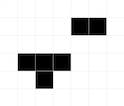
Take this traffic light predecessor for example:
Code:
Select all
x = 5, y = 3, rule = B3/S23
2bo$2ob2o$2bo!
Let's figure out its frequency among tetraplets. There are 22 tetraplets.
Code:
Select all
x = 54, y = 31, rule = B3/S23
4o6b3o7b3o7b2obo6b2o8b2o$13bo8bo9bo9b2o8bo$53bo7$2o8b2o8b2o8b2o8b2o8b
2o$2bo9bo8b2o8bo9bo8b2o$2bo8bo20bo7bo7$obo7bo9bo9bo9bo9bo$bobo7b2o8b2o
8bobo7bo9bo$13bo7bo10bo9bo8bo$43bo6bo7$bo8bo9bobo7bo$obo7b2o9bo9b2o$b
o8bo11bo7bo!
And we see that two of them evolve into that specific predecessor.
So 2 out of 22 (or 1/11) of all tetraplets evolve into the sequence.
Thus, the sequence's frequency among tetraplets is 1/11, or 9.1%. You could scale this up for pentaplets, hexaplets, etc. or do it with different sequences. This method almost certainly isn't perfect, because I'm assuming that all n-plets have about the same rarity. Additionally, this method could undermine the perceived frequency of some sequences. But it could lead to something more strict regarding calculating how frequent certain sequences are.
EDIT: Remembered that all polymonioes are also polyplets, a lot of corrections.