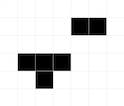
Ok, this is probably the best I'll be able to find regarding an INT improvement of LowLife under my criteria.
Code:
Select all
x = 64, y = 64, rule = B36-ai78/S12n34n
!
#C [[ RANDOMIZE2 ]]
I, two posts ago wrote: May 26th, 2026, 8:14 pm
I've been exploring INT alternatives to LowLife, a "HighLowLife" if you will. My end goal is to find the best balance of
- Retention of most common oscillators, still lifes, Sidewinder and Creeper
- Increased commonness of the elementary spaceships
that I can with at most several new transitions.
How does it do with my four criteria?
Interesting cosmology:
In this rule, the average soup stabilization time seems to be in the high 40s, whereas in LowLife its in the low 30s. Not a huge improvement, but its better than none, and soups seem to spurt out a bit more too.
Retention of most common oscillators, still lifes, Sidewinder and Creeper:
In this rule, it looks like pretty much all of the common patterns, plus the three elementary spaceships, work. Some basic reactions are carried over too, like the T-fuse and a heptomino that spawns two bananas.
Increased commonness of the elementary spaceships:
Not only do the Sidewinder and Creeper work in this rule, but their commonness is increased. Specifically, the occurrence of Sidewinders increased 119%, with Creepers and 97%. So they nearly doubled in commonness. Still makes them pretty rare sights in large soups, but once again, better than nothing.
Number of transitions:
The number of added transitions is 8, which is still pretty close to "several". I put this limit on transition numbers as to not "distance" the rule from regular LowLife, and to make apgsearching still easly. Turns out, Catagolue can search this rule pretty well, averaging at 15,000 soups per second.
So, all in all, things look pretty good. I'll add more information about the rule's patterns and features to this post later on.
EDIT:
New patterns
The addition of 2n allows for cells to survive by having two neighbors diagonally on the same line. This allows for many easily extensible still lifes.
Code:
Select all
x = 20, y = 43, rule = B36-ai78/S12n34n
19bo$18bo$17bo$16bo$15bo$14bo$4bo8bo$2obo5b2obo$2ob2o4b2ob2o$3bo8bo$3b
o8bo5$19bo$18bo$17bo$16bo$15bo$14bo$4bo8bo$3bo8bo$3b2o7b2o$4bo8bo$3bo
8bo7$19bo$18bo$17bo$16bo$15bo$14bo$3bo9bo$2bo9bo$bob3o5bob3o$3bo9bo$3b
o9bo!
The fuse left by messing with a diagonal line is clean:
Code:
Select all
x = 43, y = 42, rule = B36-ai78/S12n34n
41bo$40bobo$39bo$38bo$37bo$36bo$35bo$34bo$33bo$32bo$31bo$30bo$29bo$28b
o$27bo$26bo$25bo$24bo$23bo$22bo$21bo$20bo$19bo$18bo$17bo$16bo$15bo$14b
o$13bo$12bo$11bo$10bo$9bo$8bo$7bo$6bo$5bo$4bo$3bo$2bo$bo$o!
There are also a few new natural oscillators. Most notably, TWO rare RROs of periods 24 and 68 respectively.
Code:
Select all
x = 30, y = 6, rule = B36-ai78/S12n34n
12bo$3o8bob2o12b3o$3bo8b3o13bo$3bo10bo13bo$3bo8bobo12bobo$29bo!
There are also a rarer p5 and p18.
Code:
Select all
x = 21, y = 8, rule = B36-ai78/S12n34n
2bo$bo2bo10bobo$o3bo12bobo$5b2o8b2obo$b2o14bob2o$3bo3bo8bobo$3bo2bo11b
obo$5bo!
I've done
some searching on Catagolue for C1, D2, and D8 symmetries.