silversmith wrote: July 12th, 2026, 11:56 pm
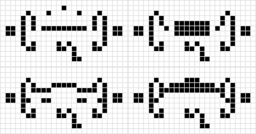
If I understand correctly, an example would be a 2D CA where the neighborhood is all cells within the same row, plus those one cell away.
Code: Select all
x = 54, y = 3, rule = LifeHistory
7.40D$D.D.D2.20DA19D2.D.D.D$7.40D!
I think most cellular automata concepts break down where an infinite neighborhood is involved (speed, period, the notion of finite patterns, etc...). However, you could simulate it by treating each row as a cell in a 1D CA with an infinite number of states. In that case, the 1D CA could still have a sensible speed / speed limit.
If the neighborhood is the whole grid, then position becomes meaningless, since all cells are in each other's neighborhood. A generation of the simulation would take an infinite list of cells, and return an infinite list of cells.
That would be an example. I was thinking of infinite subsets of the grid in general or even the whole grid. If you weighted an infinite neighborhood properly you could guarantee a finite weighted sum of the cells. For example if we weight each neighbor cell by 1/(n^3) where n is the Chebyshev metric from the central cell then even if the neighborhood is the whole grid and all cells are in the on state, the weighted sum still comes out to be approximately 13.15947... or exactly (4(pi)^2)/3 which is finite.
Code:
Select all
x = 51, y = 18, rule = B/SSuper
5$32.H13.J$18.B13.H13.J$2.7J9.B13.H13.J$2.J5HJ9.B13.H13.J$2.JH3BHJ9.B
13.H13.J$2.JHBDBHJ9.B$2.JH3BHJ21.5H8.7J$2.J5HJ$2.7J22.3H9.3J.3J$31.H.
H11.J3.J$31.3H9.3J3.J$31.H.H9.J5.J$31.3H9.3J3.J!
There are (2n+1)^2-(2n-1)^2 cells a Chebyshev distance of n away from any cell and the sequence 8+2+8/9+1/2+ ... + [(2n+1)^2-(2n-1)^2]/n^3]. The infinite sum converges to the value give above. Then we just pick an interval of subset of 0 to(4(pi)^2)/3 and use that as your birth conditions and survival conditions. Obviously this would be a nightmare to code up and probably won't be done.
The point is there are ways of weighting to deal with infinite neighborhoods.
As for Silversmith's position becoming meaningless in infinite grids issue, I am not sure I understand that problem.
Conway's game of life takes place on an infinite grid and we can simulate finite patterns so I don't see the issue with infinite grids
and just because the neighborhood is infinite it does not mean we actually have cells an infinite distance apart.
I would appreciate some elaboration on that from silversmith.
Do rules really need speed limits as long as the next step is determined by the rule?
Are there any other issues I have over looked?
I probably should have put this in the advanced questions thread in hindsight.