
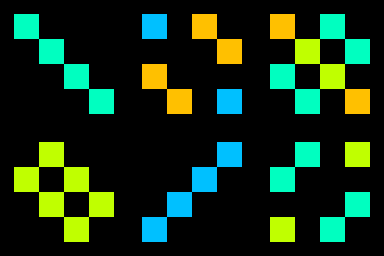
If I'm analyzing this correctly, orthogonal spaceships would have square-grid kinetic symmetries, diagonal spaceships would have some sort of rectangular symmetries forbidding diagonal reflections and 90-degree rotations but preserving orthogonal reflections and 180-degree rotations, and paragonal spaceships would presumably have hexagonal-grid-like symmetries?
3D cubic grid symmetries and naming
Re: 3D cubic grid symmetries and naming
Parity Replicator Collection v1.6 is now live - please send all relevant discoveries here.
Re: 3D cubic grid symmetries and naming
Correct. The paradiagonal spaceships are only allowed the hexagonal symmetries that preserve "vertex coloring". Color all the vertices on a hexagonal grid one of two colors such that adjacent vertices are different colors. The symmetries available to paradiagonal spaceships are the ones that preserve this coloring.muzik wrote: August 30th, 2025, 5:30 pm If I'm analyzing this correctly, orthogonal spaceships would have square-grid kinetic symmetries, diagonal spaceships would have some sort of rectangular symmetries forbidding diagonal reflections and 90-degree rotations but preserving orthogonal reflections and 180-degree rotations, and paragonal spaceships would presumably have hexagonal-grid-like symmetries?
Re: 3D cubic grid symmetries and naming
Ok, since I had the code already written I decided to try counting tesseract symmetries. The results, assuming I didn't make a mistake, are:
686 static symmetries,
2535 with period/mod=2,
38 with period/mod=3,
235 with period/mod=4,
46 with period/mod=6, and
2 with period/mod=8.
I can get generators for these symmetries, but naming them seems messy.
Edit: found a typo in my program and fixed the numbers.
686 static symmetries,
2535 with period/mod=2,
38 with period/mod=3,
235 with period/mod=4,
46 with period/mod=6, and
2 with period/mod=8.
I can get generators for these symmetries, but naming them seems messy.
Edit: found a typo in my program and fixed the numbers.
Last edited by gzaytman on August 31st, 2025, 1:58 am, edited 1 time in total.
Re: 3D cubic grid symmetries and naming
Would probably be a good idea to have these noted down anyway for future reference. I assume it's possible to enumerate symmetries on {3,4,3,3} and {3,3,4,3} as well, for 4D completeness's sake?gzaytman wrote: August 30th, 2025, 7:29 pm Ok, since I had the code already written I decided to try counting tesseract symmetries.
I can get generators for these symmetries, but naming them seems messy.
Parity Replicator Collection v1.6 is now live - please send all relevant discoveries here.
Re: 3D cubic grid symmetries and naming
Ok, I've added the 65 spaceship symmetries of the 3D cubic grid here.
If there are no objections, I'll be transferring the page to the mainspace shortly.
If there are no objections, I'll be transferring the page to the mainspace shortly.
Re: 3D cubic grid symmetries and naming
Seems good to me, ideally we'd have graphics alongside these but I have no idea how to make anything that works good.
Are there any plans to make a user page for the tesseractic symmetry generators, or to enumerate the 16-cell/24-cell grid symmetries? Certainly I want to know how many tetrahedral symetries there are - we'd have the alternation of cube facets, for one, as well as the tesseract's vertices. Would the facets of the 4-demicube be a third, distinct tetrahedral symmetry, or would it duplicate one of the aforementioned two?
Code: Select all
3D version=1 size=96 pos=40,40,40
x=16 y=16 z=16 rule=3D7,8,15,17,21..26/7..9,13,17..26
16o$o14bo$o14bo$o9boo3bo$o8b4obbo$o8b4obbo$obb10obbo$o14bo$o14bo$o3b
oo4boo3bo$obbobbobbobbobbo$obbobbobbobbobbo$o3boo4boo3bo$o14bo$o14b
o$16o/o14bo15$o14bo/o14bo15$o14bo/o3boo4boo3bo4$o$o$o14bo4$o14bo$o14b
o4$o3boo4boo3bo/obbobbobbobbobbo3$o$o$o$o14bo3$o14bo3$o14bo3$obbobb
obbobbobbo/obbobbobbobbobbo3$o$o$o$o14bo3$o14bo3$o14bo3$obbobbobbobb
obbo/o3boo4boo3bo4$o$o$o14bo4$o14bo$o14bo4$o3boo4boo3bo/o14bo6$o14b
o9$o14bo/o14bo6$o14bo9$o14bo/obb10obbo4$15bo$15bo$o14bo4$o14bo$o14b
o4$obb10obbo/o8b4obbo3$15bo$15bo$15bo$o14bo3$o14bo3$o14bo3$obb4o8bo
/o8b4obbo3$15bo$15bo$15bo$o14bo3$o14bo3$o14bo3$obb4o8bo/o9boo3bo4$15b
o$15bo$o14bo4$o14bo$o14bo4$o3boo9bo/o14bo15$o14bo/o14bo15$o14bo/16o
$o14bo$o14bo$o3boo9bo$obb4o8bo$obb4o8bo$obb10obbo$o14bo$o14bo$o3boo
4boo3bo$obbobbobbobbobbo$obbobbobbobbobbo$o3boo4boo3bo$o14bo$o14bo$
16o!- threedimensionalc1.png (41.98 KiB) Viewed 1412 times
Parity Replicator Collection v1.6 is now live - please send all relevant discoveries here.
Re: 3D cubic grid symmetries and naming
A question related to kinetic symmetries: the vertex of {4,3,3,3} (the cell of the standard 5D grid {4,3,3,3,4} used in Visions of Chaos) is {3,3,3}, the regular 5-cell. Is it therefore possible for an oscillator in a five-dimensional rule to have a mod a fifth of its period? In general, will the n–dimensional hypercubic grid be able to support oscillators of mod n (e.g. mods of 7 on a hepteractic grid, 9 on an enneractic grid, and so on)?
Parity Replicator Collection v1.6 is now live - please send all relevant discoveries here.
Re: 3D cubic grid symmetries and naming
Yes. In fact if you use the An lattice instead of the standard lattice, it is possible to have period/mod=n+1 oscillators in n dimensions.muzik wrote: September 18th, 2025, 9:32 am Is it therefore possible for an oscillator in a five-dimensional rule to have a mod a fifth of its period? In general, will the n–dimensional hypercubic grid be able to support oscillators of mod n (e.g. mods of 7 on a hepteractic grid, 9 on an enneractic grid, and so on)?
For example, in two dimensions the A2 lattice, i.e., the hexagonal tiling, can have period/mod=3.
Re: 3D cubic grid symmetries and naming
Ok, I've given the tesseractic symmetries names based on the names for 4D symmetry groups from chapter 4 of Conway and Smith's On Quaternions and Octonions. I have posted the list of groups and their generators as well as the kinetic symmetries here. Aside from the names, which only make sense if you understand how quaternions work, I haven't given them human-friendly descriptions.gzaytman wrote: August 30th, 2025, 7:29 pm Ok, since I had the code already written I decided to try counting tesseract symmetries. The results, assuming I didn't make a mistake, are:
686 static symmetries,
2535 with period/mod=2,
38 with period/mod=3,
235 with period/mod=4,
46 with period/mod=6, and
2 with period/mod=8.
I can get generators for these symmetries, but naming them seems messy.
Edit: found a typo in my program and fixed the numbers.
Re: 3D cubic grid symmetries and naming
I assume the kinetic symmetries list only applies to oscillators (i.e. the spaceship symmetries are yet to be computed so far)?gzaytman wrote: October 4th, 2025, 11:30 pmOk, I've given the tesseractic symmetries names based on the names for 4D symmetry groups from chapter 4 of Conway and Smith's On Quaternions and Octonions. I have posted the list of groups and their generators as well as the kinetic symmetries here. Aside from the names, which only make sense if you understand how quaternions work, I haven't given them human-friendly descriptions.
Parity Replicator Collection v1.6 is now live - please send all relevant discoveries here.
Re: 3D cubic grid symmetries and naming
Correct.muzik wrote: October 6th, 2025, 2:44 am I assume the kinetic symmetries list only applies to oscillators (i.e. the spaceship symmetries are yet to be computed so far)?
higher dimensional symmetries
Ok, I've computed and posted the 24-cell honeycomb symmetries here. These also apply to its dual honeycomb, the 16-cell honeycomb. There are
501 static symmetries,
1569 with period/mod=2,
77 with period/mod=3,
143 with period/mod=4,
70 with period/mod=6,
4 with period/mod=8, and
1 with period/mod=12.
A new phenomenon that shows up is that two of the period/mod=8 symmetries have the same static symmetry and composite symmetry and are in fact conjugate under time inversion, but not under any hyperspace transformation.
Re: 3D cubic grid symmetries and naming
I've added a table here that lists the known symmetry information for notable grids so far. Also there is now gutteroid information listed here for the square grid and here for the hexagonal grid. I assume that in 3D, gutteroids can take the form of central cells, orthogonal, diagonal and paragonal lines, and orthogonal, diagonal and paragonal planes?
Another question I have: is the fact that the tesseractic honeycomb has kinetic symmetries of mod p/8 and the 16-cell and 24-cell honeycombs have kinetic symmetries of mod p/12 linked to the fact that the tesseract and 24-cell have octagonal and dodecagonal Petrie polygons? If so, does this mean that the penteractic grid has a p/10 mod symmetry (and the n-dimensional cubic honeycomb has a p/2n mod symmetry)? In addition, would a p/5 symmetry arise from this if you rotate by twice the angle, and if so, is this a distinct p/5 time symmetry from the one that arises from a penteract's vertex?
Another question I have: is the fact that the tesseractic honeycomb has kinetic symmetries of mod p/8 and the 16-cell and 24-cell honeycombs have kinetic symmetries of mod p/12 linked to the fact that the tesseract and 24-cell have octagonal and dodecagonal Petrie polygons? If so, does this mean that the penteractic grid has a p/10 mod symmetry (and the n-dimensional cubic honeycomb has a p/2n mod symmetry)? In addition, would a p/5 symmetry arise from this if you rotate by twice the angle, and if so, is this a distinct p/5 time symmetry from the one that arises from a penteract's vertex?
Parity Replicator Collection v1.6 is now live - please send all relevant discoveries here.
Re: 3D cubic grid symmetries and naming
What's a gutteroid?muzik wrote: October 9th, 2025, 8:10 pm I've added a table here that lists the known symmetry information for notable grids so far. Also there is now gutteroid information listed here for the square grid and here for the hexagonal grid. I assume that in 3D, gutteroids can take the form of central cells, orthogonal, diagonal and paragonal lines, and orthogonal, diagonal and paragonal planes?
Yes, and yes.muzik wrote: October 9th, 2025, 8:10 pm Another question I have: is the fact that the tesseractic honeycomb has kinetic symmetries of mod p/8 and the 16-cell and 24-cell honeycombs have kinetic symmetries of mod p/12 linked to the fact that the tesseract and 24-cell have octagonal and dodecagonal Petrie polygons? If so, does this mean that the penteractic grid has a p/10 mod symmetry (and the n-dimensional cubic honeycomb has a p/2n mod symmetry)?
The p/5 symmetry would involve rotating by 2pi/5 in one plane, and twice that in a different plane. In high dimensions there's enough room to rotate by different angles in different planes. You still might get distinct symmetries depending on how the static and composite symmetry groups interact.muzik wrote: October 9th, 2025, 8:10 pm In addition, would a p/5 symmetry arise from this if you rotate by twice the angle, and if so, is this a distinct p/5 time symmetry from the one that arises from a penteract's vertex?
Re: 3D cubic grid symmetries and naming
Any area of an oscillator that oscillates at a lower period specifically due to symmetry constraints, for example the line of such cells in this -c+c:gzaytman wrote: October 9th, 2025, 9:38 pmWhat's a gutteroid?muzik wrote: October 9th, 2025, 8:10 pm I've added a table here that lists the known symmetry information for notable grids so far. Also there is now gutteroid information listed here for the square grid and here for the hexagonal grid. I assume that in 3D, gutteroids can take the form of central cells, orthogonal, diagonal and paragonal lines, and orthogonal, diagonal and paragonal planes?
Code: Select all
x = 3, y = 2, rule = B2-ac3aeiq4krtwz5r6i7e8/S1c2ae3eijy4airt5k6-k7e
obo$bo!
[[ AUTOIDENTIFY ]]Code: Select all
x = 2, y = 3, rule = B2ce3iny4aeinqw5acr6-ci7c/S12e3knr4acjrt5ai6e
2o2$bo!
[[ AUTOIDENTIFY ]]
Parity Replicator Collection v1.6 is now live - please send all relevant discoveries here.
Re: 3D cubic grid symmetries and naming
Not paradiagonal planes, but otherwise, yes.muzik wrote: October 9th, 2025, 8:10 pm I assume that in 3D, gutteroids can take the form of central cells, orthogonal, diagonal and paragonal lines, and orthogonal, diagonal and paragonal planes?
Re: 3D cubic grid symmetries and naming
I posted a list of (I believe) minimal objects preserved by the 3d symmetry groups here. Currently, they're given as lists of points, I could probably also give them in rle3 format. Unfortunately, the wiki does not support 3d graphics and I can't post sage notebooks to the wiki.
If someone is interested in a particular format or wants to get sent the sage notebook, let me know.
If someone is interested in a particular format or wants to get sent the sage notebook, let me know.
Re: 3D cubic grid symmetries and naming
Ok, here are all the rle3's for 3d-symmetries. I've also added them to the wiki page.
Code: Select all
3D version=1 size=13 pos=3,3,3
#C O24_c: chiral cubic symmetry centered on a cell
x=7 y=7 z=7 rule=3D0..6/F
$4bo$bo2$5bo$2bo/2bo2$3bo2bo$2bobo$o2bo2$4bo/5bo$o2bo2$bo3bo2$3bo2bo$bo/$2bobo$bo3bo2$bo3bo$2bobo/bo$3bo2bo2$
bo3bo2$o2bo$5bo/4bo2$o2bo$2bobo$3bo2bo2$2bo/$2bo$5bo2$bo$4bo!
Code: Select all
3D version=1 size=11 pos=3,3,3
#C T12_c: chiral tetrahedral symmetry centered on a cell
x=5 y=5 z=5 rule=3D0..6/F
$2bo2$2bo/$3bo$o3bo$bo/bobo2$2bo2$bobo/$bo$o3bo$3bo/$2bo2$2bo!
Code: Select all
3D version=1 size=11 pos=3,3,4
#C D8_c: chiral square prismatic symmetry centered on a cell
x=5 y=5 z=3 rule=3D0..6/F
bo$4bo2$o$3bo/$2bo$bobo$2bo/3bo$o2$4bo$bo!
Code: Select all
3D version=1 size=11 pos=3,3,4
#C C4_cf: chiral square pyramidal symmetry, a.k.a., 90 degree rotation (line goes through cells and faces)
x=5 y=5 z=2 rule=3D0..6/F
$2bo$bobo$2bo/3bo$o2$4bo$bo!
Code: Select all
3D version=1 size=11 pos=4,3,4
#C D4_cf: chiral brick symmetry centered on a cell, orthogonal orientation
x=3 y=5 z=3 rule=3D0..6/F
$2bo2$o/bo2$obo2$bo/$o2$2bo!
Code: Select all
3D version=1 size=11 pos=3,3,4
#C D4_ce: chiral brick symmetry centered on a cell, diagonal orientation
x=5 y=5 z=3 rule=3D0..6/F
bo4$3bo/$bo$2bo$3bo/$o2$4bo!
Code: Select all
3D version=1 size=9 pos=3,3,3
#C D6_ck or simply D6_c: chiral triangular prismatic symmetry centered on a cell
x=3 y=3 z=3 rule=3D0..6/F
2$bo/2bo$bo/$o!
Code: Select all
3D version=1 size=9 pos=3,3,3
#C C3_ck or simply C3: chiral triangular pyramidal symmetry, a.k.a., 120 degree rotation (line goes through vertices and cells)
x=3 y=3 z=3 rule=3D0..6/F
2$bo/2bo$2bo$bo/$2o!
Code: Select all
3D version=1 size=9 pos=3,3,3
#C C2_cf: chiral digonal pyramidal symmetry, a.k.a., 180 degree rotation (line goes through cells and faces)
x=3 y=2 z=3 rule=3D0..6/F
2o/$bo/b2o!
Code: Select all
3D version=1 size=9 pos=3,3,3
#C C2_ce: chiral digonal pyramidal symmetry, a.k.a., 180 degree rotation (line goes through cells and edges)
x=2 y=2 z=3 rule=3D0..6/F
o/$o/$bo!
Code: Select all
3D version=1 size=9 pos=3,3,3
#C C1: no symmetry
x=2 y=3 z=3 rule=3D0..6/F
o/$o/$bo$bo!
Code: Select all
3D version=1 size=7 pos=3,3,3
#C ±O24_c: cubic symmetry centered on a cell
x=1 y=1 z=1 rule=3D0..6/F
o!
Code: Select all
3D version=1 size=11 pos=3,3,3
#C ±T12_c: pyritic symmetry centered on a cell
x=5 y=5 z=5 rule=3D0..6/F
2$bobo/2bo2$2bo2$2bo/$obobo$bobo$obobo/2bo2$2bo2$2bo/2$bobo!
Code: Select all
3D version=1 size=9 pos=4,4,3
#C ±D8_c: square prismatic symmetry centered on a cell
x=1 y=1 z=3 rule=3D0..6/F
o/o/o!
Code: Select all
3D version=1 size=11 pos=3,3,5
#C ±C4_cf: square proprismatic symmetry centered on a cell
x=5 y=5 z=1 rule=3D0..6/F
3bo$obo$bobo$2bobo$bo!
Code: Select all
3D version=1 size=9 pos=3,3,4
#C ±D4_cf: brick symmetry centered on a cell, orthogonal orientation
x=3 y=3 z=1 rule=3D0..6/F
obo$3o$obo!
Code: Select all
3D version=1 size=9 pos=3,3,4
#C ±D4_ce: brick symmetry centered on a cell, diagonal orientation
x=3 y=3 z=1 rule=3D0..6/F
o$bo$2bo!
Code: Select all
3D version=1 size=9 pos=3,3,3
#C ±D6_ck or simply ±D6_c: triangular antiprismatic symmetry centered on a cell
x=3 y=3 z=3 rule=3D0..6/F
o/$bo/2$2bo!
Code: Select all
3D version=1 size=11 pos=3,3,3
#C ±C3_ck or simply ±C3_c: triangular proantiprismatic symmetry centered on a cell
x=5 y=5 z=5 rule=3D0..6/F
$2bo/$bo$o/bo2$2bo2$3bo/2$4bo$3bo/3$2bo!
Code: Select all
3D version=1 size=9 pos=3,4,3
#C ±C2_cf: espic symmetry centered on a cell, axis goes through face
x=3 y=1 z=3 rule=3D0..6/F
o/3o/2bo!
Code: Select all
3D version=1 size=9 pos=3,3,3
#C ±C2_ce: espic symmetry centered on a cell, axis goes through edge
x=3 y=3 z=3 rule=3D0..6/F
o/o$bo$2bo/2$2bo!
Code: Select all
3D version=1 size=11 pos=4,4,3
#C ±C1_c: central inversion symmetry centered on a cell
x=3 y=3 z=5 rule=3D0..6/F
o/$o/$bo/$2bo/2$2bo!
Code: Select all
3D version=1 size=9 pos=3,3,3
#C TO24_c: tetrahedral symmetry centered on a cell
x=3 y=3 z=3 rule=3D0..6/F
2bo2$o/$bo/o2$2bo!
Code: Select all
3D version=1 size=8 pos=3,3,3
#C CD6_ck or simply CD6: triangular pyramidal symmetry (line goes through vertices and cells)
x=2 y=2 z=2 rule=3D0..6/F
2o$o/o!
Code: Select all
3D version=1 size=9 pos=3,3,3
#C CD8_cf: square pyramidal symmetry (line goes through cells and faces)
x=3 y=3 z=2 rule=3D0..6/F
$bo/bo$obo$bo!
Code: Select all
3D version=1 size=9 pos=3,3,3
#C DD8_cf: digonal antiprismatic symmetry centered on a cell, digon is diagonal
x=3 y=3 z=3 rule=3D0..6/F
2bo$bo$o/$bo/o$bo$2bo!
Code: Select all
3D version=1 size=9 pos=3,3,3
#C DD8_ce: digonal antiprismatic symmetry centered on a cell, digon is orthogonal
x=3 y=3 z=3 rule=3D0..6/F
bo2$bo/$bo/$obo!
Code: Select all
3D version=1 size=11 pos=3,3,4
#C CC4_cf: prodappic symmetry centered on a cell
x=5 y=5 z=3 rule=3D0..6/F
3bo4$bo/$2bo$bobo$2bo/$o2$4bo!
Code: Select all
3D version=1 size=9 pos=3,3,4
#C CD4_cfo: digonal pyramidal symmetry (line goes through cells and faces), orthogonal orientation
x=3 y=2 z=1 rule=3D0..6/F
bo$obo!
Code: Select all
3D version=1 size=9 pos=3,3,3
#C CD4_cfd: digonal pyramidal symmetry (line goes through cells and faces), diagonal orientation
x=3 y=3 z=2 rule=3D0..6/F
$bo/o2$2bo!
Code: Select all
3D version=1 size=8 pos=3,3,3
#C CD4_ce: digonal pyramidal symmetry (line goes through cells and edges)
x=2 y=2 z=1 rule=3D0..6/F
2o$o!
Code: Select all
3D version=1 size=9 pos=4,3,3
#C CC2_c: reflection (plane goes through cells, edges, and faces)
x=1 y=3 z=2 rule=3D0..6/F
o$o/2$o!
Code: Select all
3D version=1 size=9 pos=3,3,3
#C CC2_/: reflection (plane goes through cells, faces, edges, and vertices)
x=3 y=3 z=2 rule=3D0..6/F
o/$bo$2bo!
Code: Select all
3D version=1 size=11 pos=3,3,4
#C D8_f: chiral square prismatic symmetry centered on a face
x=5 y=5 z=2 rule=3D0..6/F
bo$2bobo$bobo$obo$3bo/3bo$obo$bobo$2bobo$bo!
Code: Select all
3D version=1 size=9 pos=3,3,3
#C D4_fe: chiral brick symmetry centered on a face, orthogonal orientation
x=3 y=3 z=2 rule=3D0..6/F
2bo$3o$o/o$3o$2bo!
Code: Select all
3D version=1 size=11 pos=3,3,4
#C D4_fk: chiral brick symmetry centered on a face, diagonal orientation
x=5 y=5 z=2 rule=3D0..6/F
$o$bobo$4bo/bo$2bo2$2bo$3bo!
Code: Select all
3D version=1 size=9 pos=3,3,3
#C C2_fe: chiral digonal pyramidal symmetry, a.k.a., 180 degree rotation (line goes through faces and edges)
x=3 y=2 z=2 rule=3D0..6/F
bo$2bo/bo$o!
Code: Select all
3D version=1 size=8 pos=3,3,3
#C C2_fk: chiral digonal pyramidal symmetry, a.k.a., 180 degree rotation (line goes through faces and vertices)
x=2 y=2 z=2 rule=3D0..6/F
2o/o$o!
Code: Select all
3D version=1 size=8 pos=3,3,3
#C ±D8_f: square prismatic symmetry centered on a face
x=1 y=1 z=2 rule=3D0..6/F
o/o!
Code: Select all
3D version=1 size=9 pos=3,4,3
#C ±D4_fe: brick symmetry centered on a face, orthogonal orientation
x=3 y=1 z=2 rule=3D0..6/F
3o/3o!
Code: Select all
3D version=1 size=9 pos=3,3,3
#C ±D4_fk: brick symmetry centered on a face, diagonal orientation
x=3 y=3 z=2 rule=3D0..6/F
o$bo$2bo/o$bo$2bo!
Code: Select all
3D version=1 size=11 pos=3,3,4
#C ±C4_fc: square proprismatic symmetry centered on a face
x=5 y=5 z=2 rule=3D0..6/F
3bo$obo$bobo$2bobo$bo/3bo$obo$bobo$2bobo$bo!
Code: Select all
3D version=1 size=9 pos=3,3,3
#C ±C2_fc: espic symmetry centered on a face, axis goes through cell
x=3 y=3 z=2 rule=3D0..6/F
o$3o$2bo/o$3o$2bo!
Code: Select all
3D version=1 size=9 pos=4,3,3
#C ±C2_fe: espic symmetry centered on a face, axis goes through edge
x=1 y=3 z=2 rule=3D0..6/F
o$o/$o$o!
Code: Select all
3D version=1 size=9 pos=3,3,3
#C ±C2_fk: espic symmetry centered on a face, axis goes through vertex
x=3 y=3 z=2 rule=3D0..6/F
$bo$2bo/o$bo!
Code: Select all
3D version=1 size=9 pos=3,3,3
#C ±C1_f: central inversion symmetry centered on a face
x=3 y=3 z=2 rule=3D0..6/F
$b2o$2bo/o$2o!
Code: Select all
3D version=1 size=9 pos=3,3,3
#C DD8_fe: digonal antiprismatic symmetry centered on a face, digon is diagonal
x=3 y=3 z=2 rule=3D0..6/F
o$bo$2bo/2bo$bo$o!
Code: Select all
3D version=1 size=9 pos=3,3,3
#C DD8_fk: digonal antiprismatic symmetry centered on a face, digon is orthogonal
x=3 y=3 z=2 rule=3D0..6/F
$obo/bo2$bo!
Code: Select all
3D version=1 size=10 pos=3,3,3
#C CC4_fc: prodappic symmetry centered on a face
x=3 y=3 z=4 rule=3D0..6/F
2bo2$o/$obo/bo2$bo/o2$2bo!
Code: Select all
3D version=1 size=10 pos=4,4,3
#C CD4_fe: digonal pyramidal symmetry (line goes through faces and edges)
x=1 y=2 z=4 rule=3D0..6/F
$o/o/o/$o!
Code: Select all
3D version=1 size=10 pos=4,4,3
#C CD4_fk: digonal pyramidal symmetry (line goes through faces and vertices)
x=2 y=2 z=4 rule=3D0..6/F
$bo/o/o/$bo!
Code: Select all
3D version=1 size=9 pos=3,3,3
#C CC2_f: reflection (plane goes through faces, edges, and vertices)
x=3 y=2 z=2 rule=3D0..6/F
2o$2bo/2o$2bo!
Code: Select all
3D version=1 size=10 pos=3,3,3
#C D8_e: chiral square prismatic symmetry centered on an edge
x=3 y=4 z=4 rule=3D0..6/F
$o$2bo/2bo$bo$bo$o/o$bo$bo$2bo/$2bo$o!
Code: Select all
3D version=1 size=10 pos=3,3,4
#C D4_ef: chiral brick symmetry centered on an edge, orthogonal orientation
x=3 y=4 z=2 rule=3D0..6/F
2bo$bo$bo$o/o$bo$bo$2bo!
Code: Select all
3D version=1 size=10 pos=3,3,3
#C D4_ec: chiral brick symmetry centered on an edge, diagonal orientation
x=3 y=4 z=4 rule=3D0..6/F
$o/2bo$bo/2$bo$2bo/2$o!
Code: Select all
3D version=1 size=10 pos=4,3,3
#C C4_ek: chiral square pyramidal symmetry, a.k.a., 90 degree rotation (line goes through edges and vertices)
x=2 y=4 z=4 rule=3D0..6/F
2$bo/bo$o$o/$o$o$bo/$bo!
Code: Select all
3D version=1 size=10 pos=4,4,3
#C C2_ek: chiral digonal pyramidal symmetry, a.k.a., 180 degree rotation (line goes through edges and vertices)
x=2 y=2 z=4 rule=3D0..6/F
o/bo/$bo/$o!
Code: Select all
3D version=1 size=8 pos=3,3,3
#C ±D8_e: square prismatic symmetry centered on an edge
x=1 y=2 z=2 rule=3D0..6/F
o$o/o$o!
Code: Select all
3D version=1 size=10 pos=4,3,4
#C ±D4_ef: brick symmetry centered on an edge, orthogonal orientation
x=1 y=4 z=2 rule=3D0..6/F
o$o$o$o/o$o$o$o!
Code: Select all
3D version=1 size=8 pos=3,3,3
#C ±D4_ec: brick symmetry centered on an edge, diagonal orientation
x=1 y=2 z=2 rule=3D0..6/F
o/$o!
Code: Select all
3D version=1 size=10 pos=4,3,3
#C ±C4_ek: square proprismatic symmetry centered on an edge
x=1 y=4 z=4 rule=3D0..6/F
2$o/o$o$o/$o$o$o/$o!
Code: Select all
3D version=1 size=10 pos=4,3,4
#C ±C2_ek: espic symmetry centered on an edge, axis goes through vertex
x=1 y=4 z=2 rule=3D0..6/F
o$o/2$o$o!
Code: Select all
3D version=1 size=9 pos=3,3,3
#C ±C2_ef: espic symmetry centered on an edge, axis goes through face
x=3 y=2 z=2 rule=3D0..6/F
b2o$2o/b2o$2o!
Code: Select all
3D version=1 size=9 pos=3,3,3
#C ±C2_ec: espic symmetry centered on an edge, axis goes through cell
x=3 y=2 z=2 rule=3D0..6/F
b2o/$2o!
Code: Select all
3D version=1 size=10 pos=3,3,4
#C ±C1_e: central inversion symmetry centered on an edge
x=3 y=4 z=2 rule=3D0..6/F
2bo$bo/2$bo$o!
Code: Select all
3D version=1 size=9 pos=3,3,3
#C DD8_ef: digonal antiprismatic symmetry centered on an edge, digon is diagonal
x=3 y=2 z=2 rule=3D0..6/F
b2o$2o/2o$b2o!
Code: Select all
3D version=1 size=10 pos=3,3,3
#C DD8_ec: digonal antiprismatic symmetry centered on an edge, digon is orthogonal
x=3 y=4 z=4 rule=3D0..6/F
$o$o/2bo$bo$bo$2bo/2bo$bo$bo$2bo/$o$o!
Code: Select all
3D version=1 size=10 pos=4,3,3
#C CD8_ek: square pyramidal symmetry (line goes through edges and vertices)
x=2 y=4 z=4 rule=3D0..6/F
$bo$bo/bo$o$o$bo/bo$o$o$bo/$bo$bo!
Code: Select all
3D version=1 size=10 pos=3,3,3
#C CC4_ek: prodappic symmetry centered on an edge
x=3 y=4 z=4 rule=3D0..6/F
2$o/2bo$bo$bo/$bo$bo$2bo/$o!
Code: Select all
3D version=1 size=10 pos=4,3,4
#C CD4_eko: digonal pyramidal symmetry (line goes through edges and vertices), orthogonal orientation
x=2 y=4 z=2 rule=3D0..6/F
bo$o$o$bo/bo$o$o$bo!
Code: Select all
3D version=1 size=10 pos=4,3,3
#C CD4_ekd: digonal pyramidal symmetry (line goes through edges and vertices), diagonal orientation
x=2 y=4 z=4 rule=3D0..6/F
bo/$o/2$o/3$bo!
Code: Select all
3D version=1 size=12 pos=3,3,3
#C O24_k: chiral cubic symmetry centered on a vertex
x=6 y=6 z=6 rule=3D0..6/F
$2bo$4bo$bo$3bo/3bo$bo2bo$o$5bo$bo2bo$2bo/bo$5bo3$o$4bo/4bo$o3$5bo$bo/2bo$bo2bo$5bo$o$bo2bo$3bo/$3bo$bo$4bo$2bo!
Code: Select all
3D version=1 size=12 pos=3,3,3
#C T12_k: chiral tetrahedral symmetry centered on a vertex
x=6 y=6 z=6 rule=3D0..6/F
$3bo3$2bo/2$3bobo$obo/4bo$3bo$4bo$bo$2bo$bo/bo$2bo$bo$4bo$3bo$4bo/2$obo$3bobo/$2bo3$3bo!
Code: Select all
3D version=1 size=10 pos=3,3,3
#C D8_k: chiral square prismatic symmetry centered on a vertex
x=4 y=4 z=4 rule=3D0..6/F
2bo$o$3bo$bo/$b2o$b2o/$b2o$b2o/bo$3bo$o$2bo!
Code: Select all
3D version=1 size=12 pos=4,3,5
#C D4_ke: chiral brick symmetry centered on a vertex, orthogonal orientation
x=4 y=6 z=2 rule=3D0..6/F
bo$o$o$3bo$3bo$2bo/2bo$3bo$3bo$o$o$bo!
Code: Select all
3D version=1 size=10 pos=3,3,4
#C D4_kf: chiral brick symmetry centered on a vertex, diagonal orientation
x=4 y=4 z=2 rule=3D0..6/F
$2o$2b2o/bo$bo$2bo$2bo!
Code: Select all
3D version=1 size=10 pos=3,3,3
#C D6_kc or simply D6_k: chiral triangular prismatic symmetry centered on a vertex
x=4 y=4 z=4 rule=3D0..6/F
2$bo/2bo$bo2$2bo/$o2bo$2bo/2$bo!
Code: Select all
3D version=1 size=8 pos=3,3,3
#C ±O24_k: cubic symmetry centered on a vertex
x=2 y=2 z=2 rule=3D0..6/F
2o$2o/2o$2o!
Code: Select all
3D version=1 size=12 pos=3,3,3
#C ±T12_k: pyritic symmetry centered on a vertex
x=6 y=6 z=6 rule=3D0..6/F
2$bo2bo$bo2bo/2b2o$bo2bo3$bo2bo$2b2o/$o4bo3$o4bo/$o4bo3$o4bo/2b2o$bo2bo3$bo2bo$2b2o/2$bo2bo$bo2bo!
Code: Select all
3D version=1 size=10 pos=4,4,3
#C ±D8_k: square prismatic symmetry centered on a vertex
x=2 y=2 z=4 rule=3D0..6/F
2o$2o/2o$2o/2o$2o/2o$2o!
Code: Select all
3D version=1 size=10 pos=3,3,4
#C ±C4_ke: square proprismatic symmetry centered on a vertex
x=4 y=4 z=2 rule=3D0..6/F
2bo$3o$b3o$bo/2bo$3o$b3o$bo!
Code: Select all
3D version=1 size=10 pos=3,3,4
#C ±D4_ke: brick symmetry centered on a vertex, orthogonal orientation
x=4 y=4 z=2 rule=3D0..6/F
o2bo$4o$4o$o2bo/o2bo$4o$4o$o2bo!
Code: Select all
3D version=1 size=8 pos=3,3,3
#C ±D4_kf: brick symmetry centered on a vertex, diagonal orientation
x=2 y=2 z=2 rule=3D0..6/F
o$bo/o$bo!
Code: Select all
3D version=1 size=8 pos=3,3,3
#C ±D6_kc or simply ±D6_k: triangular antiprismatic symmetry centered on a vertex
x=2 y=2 z=2 rule=3D0..6/F
o/$bo!
Code: Select all
3D version=1 size=10 pos=3,3,3
#C ±C3_kc or simply ±C3_k: triangular proantiprismatic symmetry centered on a vertex
x=4 y=4 z=4 rule=3D0..6/F
2$bo/2bo$bo$3bo/$o$2bo$bo/$2bo!
Code: Select all
3D version=1 size=10 pos=3,4,4
#C ±C2_ke: espic symmetry centered on a vertex, axis goes through edge
x=4 y=2 z=2 rule=3D0..6/F
2o$2o/2b2o$2b2o!
Code: Select all
3D version=1 size=10 pos=4,4,3
#C ±C2_kf: espic symmetry centered on a vertex, axis goes through face
x=2 y=2 z=4 rule=3D0..6/F
o/o/$bo/$bo!
Code: Select all
3D version=1 size=10 pos=3,4,4
#C ±C1_k: central inversion symmetry centered on a vertex
x=4 y=2 z=2 rule=3D0..6/F
o$bo/2bo$3bo!
Code: Select all
3D version=1 size=8 pos=3,3,3
#C TO24_k: tetrahedral symmetry centered on a vertex
x=2 y=2 z=2 rule=3D0..6/F
o$bo/bo$o!
Code: Select all
3D version=1 size=10 pos=4,4,3
#C DD8_ke: digonal antiprismatic symmetry centered on a vertex, digon is diagonal
x=2 y=2 z=4 rule=3D0..6/F
o$bo/o$bo/bo$o/bo$o!
Code: Select all
3D version=1 size=10 pos=3,3,4
#C DD8_kf: digonal antiprismatic symmetry centered on a vertex, digon is orthogonal
x=4 y=4 z=2 rule=3D0..6/F
$o2bo$o2bo/b2o3$b2o!
Code: Select all
3D version=1 size=10 pos=3,3,3
#C CC4_ke: prodappic symmetry centered on a vertex
x=4 y=4 z=4 rule=3D0..6/F
$o$3bo/$bo$2bo/$2bo$bo/2bo3$bo!Re: 3D cubic grid symmetries and naming
To my knowledge, linking from a mainspace article to a userspace article is usually frowned upon; is there anything that needs to be done to the two 4D symmetry enumeration pages before they can be moved to the mainspace like was done for the 3D symmetries page?
Parity Replicator Collection v1.6 is now live - please send all relevant discoveries here.
Re: 3D cubic grid symmetries and naming
I don't understand the purpose of that rule. It would strike me that linking to the user page from mainspace would help people find who else is interested in a niche topic.muzik wrote: December 20th, 2025, 1:02 pm To my knowledge, linking from a mainspace article to a userspace article is usually frowned upon;
Not particularly. I'm not sure what qualifies as mainspace worthy.muzik wrote: December 20th, 2025, 1:02 pm is there anything that needs to be done to the two 4D symmetry enumeration pages before they can be moved to the mainspace like was done for the 3D symmetries page?
Re: 3D cubic grid symmetries and naming
They both seem fine to me, I was wondering if you were keeping them in the userspace on the basis that they were incomplete (perhaps you planned to enumerate spaceship symmetries as well and didn't want to move to the mainspace until those were all listed).gzaytman wrote: December 21st, 2025, 12:38 amNot particularly. I'm not sure what qualifies as mainspace worthy.muzik wrote: December 20th, 2025, 1:02 pm is there anything that needs to be done to the two 4D symmetry enumeration pages before they can be moved to the mainspace like was done for the 3D symmetries page?
Parity Replicator Collection v1.6 is now live - please send all relevant discoveries here.
Re: 3D cubic grid symmetries and naming
It's a huge struggle with the mess the wiki is in nowadays but I've tried arranging cubic symmetries into a table to improve readability.
Regarding spaceship symmetries: does "any in orthogonal/diagonal plane" mean any direction including knightwise inside the plane, or only symmetric directions inside of the plane (orthogonal, diagonal)? Time-symmetric knightships seem like a rather strange concept I hadn't yet considered.
Regarding spaceship symmetries: does "any in orthogonal/diagonal plane" mean any direction including knightwise inside the plane, or only symmetric directions inside of the plane (orthogonal, diagonal)? Time-symmetric knightships seem like a rather strange concept I hadn't yet considered.
Parity Replicator Collection v1.6 is now live - please send all relevant discoveries here.
Re: 3D cubic grid symmetries and naming
Any direction.muzik wrote: December 25th, 2025, 4:57 am Regarding spaceship symmetries: does "any in orthogonal/diagonal plane" mean any direction including knightwise inside the plane, or only symmetric directions inside of the plane (orthogonal, diagonal)?
They're knightships in a plane and time-symmetric in the direction orthogonal to that plane.muzik wrote: December 25th, 2025, 4:57 am Time-symmetric knightships seem like a rather strange concept I hadn't yet considered.
Re: 3D cubic grid symmetries and naming
Counting symmetries is easy enough, but is it possible to compute the number and types of unique "transformations", i.e. the things LifeViewer provides when identifying something?
They're not one-to-one with kinetic symmetries, e.g. n.c, n.e and n.k 3both map to Rot180 (since they all involve 180-degree rotation), whereas a n/ object could be either Flip/ or Flip\.
For higher dimensions, I assume there would be some other distinctions to be made. For example, on 4D grids with 8-fold and 12-fold rotational symmetry, an object could rotate 1/8 or 1/12 of a full turn in that fraction of its period, but it could also rotate 3/8 or 5/12 of a full turn in p/8 or p/12 which would result in the same kinetic symmetry but a different kind of transformation that yields that symmetry.
Do these things have a name? I don't remember Chris giving them one.
Parity Replicator Collection v1.6 is now live - please send all relevant discoveries here.
Re: 3D cubic grid symmetries and naming
I'm not quite sure what you mean. Do you just mean the order symmetry group modulo translations or something else?muzik wrote: February 13th, 2026, 6:39 pm Counting symmetries is easy enough, but is it possible to compute the number and types of unique "transformations", i.e. the things LifeViewer provides when identifying something?