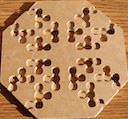
Hexagonal block CA

For discussion of other cellular automata.
Post Reply
User avatar
pcallahan
Posts: 955
Joined: April 26th, 2013, 1:04 pm

Hexagonal block CA

Post by pcallahan »

I had this thought playing around with face-centered cubic packings of rhombic dodecahedrons, which you can see in this 3D print model: https://www.printables.com/model/159006 ... ace-center

My goal was initially to embed a Margolus CA (probably Critters) as constraints on the top and bottom of the cells of an FCC, which emulates Margolus when they are stacked from a square base like this:
20260207_154002.jpg
20260207_154002.jpg (1.7 MiB) Viewed 402 times
Calcyman pointed this out a few years ago. I already have flat snap tiles for this rule, but I think the FCC approach is more elegant and plan to get back to it.

On the way I started to consider the tilted packing, starting with a triangular base. If you look down, you see this:
20260208_122149.jpg
20260208_122149.jpg (469.14 KiB) Viewed 402 times
And if you squint just a little, it's a block CA architecture in which the neighborhoods are the 6 triangles of a hexagon. There are three places to center them, and in an FCC packing, they cycle through them.
hex.png
hex.png (362.05 KiB) Viewed 402 times
In the above diagram, start with hexes with red circles at the center. They are outlined in bold edges. You can apply a rule to bit values in the triangles, and it is a reversible rule if you use a permutation of the 64 possibilities. Alternatively you can see this by coloring the edges of each hex cell as on the right. I'm not sure which is a better visualization.

Next do the same with green-centered hexes, next with blue-centered hexes, and then return to red. I think there should be no problem realizing these with geometry, though you will need to split the rhombic faces into triangles.

Having a neighborhood with 64 states increases the space of reversible rules substantially from 16! to 64!. I'm am not sure what's out there and would probably need to put aside some other work to look into it.

Has anyone explored this? Also, I don't think there's a fatal flaw in this idea that would make it impossible, but let me know if you see one.
User avatar
pcallahan
Posts: 955
Joined: April 26th, 2013, 1:04 pm

Re: Hexagonal block CA

Post by pcallahan »

It would be nice to have self-inverse rules as well. That way, you can reverse an a-b-c, a-b-c, ... cycle just by switching to c-b-a, c-b-a, ...

Unlike Margolus neighborhoods, there is already an unavoidable chirality when you choose the sequence. But suppose you require the rules to be D6-symmetrical with respect to rotation and flips and also preserving the cell count. Now you're really limited in what you can do.

If you have 0 or 6 on cells, you can only use the identity. If you have 1 or 5 on, you need identity or a flip to the opposite position. With 2 or 4, it could already be mirror-symmetric and you'd have to use identity, so I think for the other cases, you are limited to identity or a flip. For 3, you could do bit inverse and there may be others.

It would be interesting to find a rule as interesting as Critters with these constraints. If you allow chirality but keep count conservation, there are many other possibilities such as rotating a single cell clockwise or counterclockwise but then you also lose the self-inverse property.

I haven't thought about it beyond this and there may be mistakes above.
User avatar
pcallahan
Posts: 955
Joined: April 26th, 2013, 1:04 pm

Re: Hexagonal block CA

Post by pcallahan »

I worked this out on paper myself before getting into a discussion with ChatGPT about it, but I relied on it for the write-up below before realizing I needed to correct or at least clarify the direction of axes. I think this works.

This is a rabbit hole, but it should not be too hard to prototype some rules in Python code.

ChatGPT writeup (mostly)
Here is how to get a 3-phase ABC partition (instead of Margolus’ 2-phase) while keeping everything indexable in a simple 3D array.

First divide unit squares along the same NW–SE diagonal into right triangles that can be scaled to equilateral triangles for display. I'm going to assume that i is the row number increasing top to bottom and j is the column number increasing left to right.

The array is:

Code: Select all

A[i][j][t]

i,j = square coordinates
t=0 = bottom triangle
t=1 = top triangle
Phase coloring (mod 3)

Define

Code: Select all

phase(i,j) = (i + j) % 3
This produces the repeating pattern (again, i is row top to bottom, j is column left to right)

Code: Select all

0 1 2 0 1 2
1 2 0 1 2 0
2 0 1 2 0 1
So the lattice splits into 3 cosets (A, B, C).
Cycling ABCABC… corresponds to shifting the origin through these cosets.

Disjoint neighborhood lattice

Neighborhood origins form an index-3 sublattice generated by:

Code: Select all

v1 = (2,1)
v2 = (1,2)
determinant = 2*2 - 1*1 = 3

So same-phase disjoint neighbors of (i,j) are:

Code: Select all

(i+2, j+1)
(i+1, j+2)
Any same-phase origin is:

Code: Select all

(i,j) + a*(2,1) + b*(1,2)
for integers a,b.

The 3 phase offsets

One convenient choice of coset representatives:

Code: Select all

A: (0,0)
B: (0,1)
C: (1,1)
So ABC cycling corresponds to shifting the neighborhood origin:

Code: Select all

(i,j) -> (i,j+1) -> (i+1,j+1) -> ...
The 6 triangles of one neighborhood

For a neighborhood with upper-left square corner (i,j),
the 6 triangles in clockwise order are:

Code: Select all

(i, j, 0)
(i, j, 1)
(i, j+1, 0)
(i+1, j+1, 1)
(i+1, j+1, 0)
(i+1, j, 1)
This forms a 6-cycle in the triangular adjacency graph (a “hex” in the triangulated lattice).

Writing CA code for it (my thoughts, not ChatGPT)
Without optimizing it for sparsity, I would begin by enforcing D6 symmetry on the neighborhoods. The simplest way is to implement the rules for symmetry classes and then generate a lookup table, which will have just 64 values. So the only significant code here is to get the cell values and pack them into keys to do lookups. We would do this starting from (0,0), (0,1), (1,1) offsets.

Maybe we're actually better off just grabbing all 8 triangles (or 4 squares with 2 bit packed representation). Then we can do lookups in a still trivially small 256 value table. The problem here is we would need to mask to avoid overwriting values in squares that overlap neighborhoods, so maybe not.
Last edited by pcallahan on February 14th, 2026, 1:55 pm, edited 2 times in total.
User avatar
R2INT
Posts: 934
Joined: July 2nd, 2024, 7:42 pm

Re: Hexagonal block CA

Post by R2INT »

If I am correct about the neighborhood (I assume that it's vertex-centered) then below are the isotropic transitions for that:

Code: Select all

# 6 neighbors
# 21 isotropic transitions (listed below)
x = 3, y = 3, rule = B/S0123456H
3o$b2o$2bo!

Code: Select all

x = 27, y = 27, rule = 0123456//3H
3B.3B.3B.A2B.3A.3A.3A$.2B2.2B2.AB2.AB2.BA2.2A2.2A$2.B3.A3.A3.A3.B3.B3.
A2$6.3B.A2B.BAB.B2A.3A$7.AB2.2B2.AB2.2A2.BA$8.B3.A3.A3.B3.A2$12.BAB.2B
A.ABA$13.2B2.AB2.2A$14.A3.A3.B2$14.BAB.3B.ABA$15.AB2.2A2.BA$16.B3.A3.
A2$20.2AB$21.2B$22.A2$22.ABA$23.2B$24.A2$24.BAB$25.2A$26.B!
If instead you are using an edge-centered 6-cell neighborhood, then here are the isotropic transitions (rotate2reflect) for that neighborhood:

Code: Select all

x = 36, y = 31, rule = 0123456//3H
.B4.B4.B4.B4.A4.A4.A$4B.A3B.2A2B.3AB.2B2A.B3A.4A$2.B4.B4.B4.B4.A4.A4.
A2$8.B4.B4.B4.A4.A$7.BA2B.A3B.2ABA.B3A.AB2A$9.B4.A4.B4.B4.A2$10.B4.B4.
B4.A4.A$9.4B.ABAB.2A2B.BABA.4A$11.A4.B4.A4.A4.B2$17.B4.B4.A$16.A2BA.A
BAB.B2AB$18.B4.A4.A2$19.B4.B4.A$18.B2AB.A2BA.A2BA$20.B4.A4.A2$21.B4.B
4.A$20.BA2B.B2AB.AB2A$22.A4.A4.B2$23.A4.A4.B$22.4B.A3B.4A$24.A4.A4.B2$
30.A$29.BA2B$31.A!

Code: Select all

# 6 neighbors
# 30 isotropic transitions (listed below)
x = 4, y = 3, rule = B/S0123456H
bo$4o$2bo!
If none of the neighborhoods work, please let me know! It would be helpful to provide a GIF animation of the 3-cycle so that it's easier for me to understand.
Range-2 INT
R2INT's Rule Collection

3-state rules are the final frontier.
User avatar
pcallahan
Posts: 955
Joined: April 26th, 2013, 1:04 pm

Re: Hexagonal block CA

Post by pcallahan »

R2INT wrote: February 14th, 2026, 12:31 am If I am correct about the neighborhood (I assume that it's vertex-centered) then below are the isotropic transitions for that:
I don't think it's any of those. You can see the final illustration on viewtopic.php?f=11&t=7190&p=225384#p225165

The neighborhood consists of the six triangles that make up a hexagon. So the grid itself is triangular, even though I'm calling it a hexagonal block CA. The embedding to an array with upper and lower triangles is a precise definition.
User avatar
R2INT
Posts: 934
Joined: July 2nd, 2024, 7:42 pm

Re: Hexagonal block CA

Post by R2INT »

pcallahan wrote: February 14th, 2026, 12:43 am [...]
I don't think it's any of those. You can see the final illustration on viewtopic.php?f=11&t=7190&p=225384#p225165
[...]
Thanks for the correction! I assume that this neighborhood is triangular; the transitions there are the same as the hexagonal transitions (but there are no births or survivals):

Code: Select all

# "Hexagonal" BCA, vertex-centered
# 2^13 = 8192 rules
x = 39, y = 11, rule = 0123//3LE
$3B3.3B3.3B3.3B3.2BA3.B2A3.3B$3B3.A2B3.2AB3.3A3.3A3.3A3.3B3$12.3B3.2B
A3.B2A$12.ABA3.2AB3.ABA3$12.2BA3.BAB3.B2A$12.A2B3.ABA3.2AB!
Range-2 INT
R2INT's Rule Collection

3-state rules are the final frontier.
Post Reply