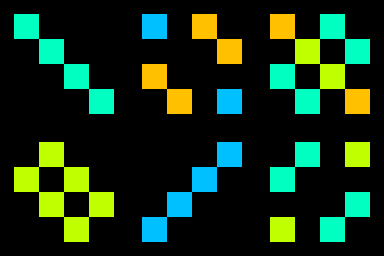
Kinetic symmetries on the hexagonal and triangular grids

For discussion of other cellular automata.
Post Reply
User avatar
muzik
Posts: 6605
Joined: January 28th, 2016, 2:47 pm
Location: Scotland

Kinetic symmetries on the hexagonal and triangular grids

Post by muzik »

It appears as though all possible kinetic symmetries on {6,3} and {3,6} have been enumerated as of around a year ago (see edit), however I'm yet to find a list of examples of these, like what exists for square grids. There also does not appear to have been any efforts so far to invent shorthand names for all 35 possibilities.

Here's a list I've cobbled together of miscellaneous results - do inform me if there are any mistakes here:

Not time-symmetric:
C1

Code: Select all

x = 3, y = 2, rule = B/S0123HT
3o$o!

Code: Select all

x = 2, y = 3, rule = B/S0123LE
$bo$2o!
C2_1

Code: Select all

x = 3, y = 3, rule = B/S0123HT
b2o$bo$2o!

Code: Select all

x = 5, y = 2, rule = B/S0123LE
obo$2bobo!
C2_2

Code: Select all

x = 3, y = 2, rule = B/S0123HT
b2o$2o!

Code: Select all

x = 5, y = 3, rule = B/S0123LE
$obo$2bobo!
C3_1

Code: Select all

x = 4, y = 4, rule = B/S0123HT
o$bo$2o$ob2o!

Code: Select all

x = 6, y = 4, rule = B/S0123LE
3b2o$2b3o$6o$5bo!
C3_3

Code: Select all

x = 4, y = 4, rule = B/S0123HT
2o$b3o$b3o$2bo!

Code: Select all

x = 5, y = 3, rule = B/S0123LE
3b2o$b4o$4bo!
C6

Code: Select all

x = 7, y = 7, rule = B/S0123HT
2bo$2obo$2b2obo$b2ob2o$bob2o$3bob2o$4bo!

Code: Select all

x = 8, y = 5, rule = B/S0123LE
$2bob2o$2b6o$b6o$3b2obo!
D2_x

Code: Select all

x = 3, y = 3, rule = B/S0123HT
obo$b2o$2bo!

Code: Select all

x = 4, y = 2, rule = B/S0123LE
bobo$b3o!
D2_xo

Code: Select all

x = 2, y = 3, rule = B/S0123HT
o$bo$bo!

Code: Select all

x = 2, y = 2, rule = B/S0123LE
2o$2o!
D4_x1

Code: Select all

x = 3, y = 3, rule = B/S0123HT
2o$bo$b2o!

Code: Select all

x = 4, y = 5, rule = B/S0123LE
$2bo$b3o$b3o$2bo!
D4_x4

Code: Select all

x = 2, y = 1, rule = B/S0123HT
2o!

Code: Select all

x = 2, y = 2, rule = B/S0123LE
bo$bo!
D6_1

Code: Select all

x = 4, y = 4, rule = B/S0123HT
o$2o$obo$4o!

Code: Select all

x = 5, y = 4, rule = B/S0123LE
$2bo$b3o$5o!
D6_1o

Code: Select all

x = 3, y = 3, rule = B/S0123HT
bo$2o$2bo!

Code: Select all

x = 6, y = 5, rule = B/S0123LE
$3o$6o$6o$3o!
D6_3

Code: Select all

x = 2, y = 2, rule = B/S0123HT
2o$bo!

Code: Select all

x = 3, y = 2, rule = B/S0123LE
bo$3o!
D12

Code: Select all

x = 3, y = 3, rule = B/S0123HT
2o$3o$b2o!

Code: Select all

x = 4, y = 2, rule = B/S0123LE
b3o$b3o!
Time-symmetric:
C1 flips to D2_x

Code: Select all

x = 3, y = 3, rule = B2/S34H
obo$o$2bo!

Code: Select all

x = 8, y = 4, rule = B45/S23L
3b2obo$2bo4bo$b2o4bo$2bo3bo!
C1 flips to D2_xo

Code: Select all

x = 5, y = 2, rule = B36/S246LB
3b2o$bo2bo!
D2_x flips/rotates 180 degrees to D4_x4

Code: Select all

x = 4, y = 2, rule = B2/S34H
o2bo$2bo!

Code: Select all

x = 7, y = 2, rule = B36/S246LB
o5bo$2b3o!
D2_xo flips/rotates 180 degrees to D4_x1

Code: Select all

x = 2, y = 3, rule = B2/S2H
o$bo$bo!
D6_1o flips/rotates 60 degrees to D12

Code: Select all

x = 3, y = 3, rule = B2/S34H
bo$o$2bo!
C1 rotates 60 degrees to C6

Code: Select all

x = 4, y = 3, rule = B2o/S2oH
2b2o$o2bo$2b2o!

Code: Select all

x = 4, y = 2, rule = B45/S34L
4o$o2bo!
C1 rotates 120 degrees to C3_1

Code: Select all

x = 5, y = 4, rule = B4/S345L
3bo$o$b4o$3bo!
C1 rotates 120 degrees to C3_3

Code: Select all

x = 3, y = 5, rule = B2/S34H
bo$o$obo$2bo$2bo!
C2_1 rotates 120 degrees to C6

Code: Select all

x = 5, y = 7, rule = B2o45/S2o45H
bo$o$obo$b3o$2bobo$4bo$3bo!
D6_1 flips/rotates 60 degrees to D12

Code: Select all

x = 4, y = 2, rule = B2/SLE
2bo$bobo!

Ideally I'd want a few examples of each type so that we can have something to include on the wiki for each symmetry as an easily-digestible visual example.
Parity Replicator Collection v1.6 is now live - please send all relevant discoveries here.
User avatar
muzik
Posts: 6605
Joined: January 28th, 2016, 2:47 pm
Location: Scotland

Re: Kinetic symmetries on the hexagonal and triangular grids

Post by muzik »

C1 rotates 120 degrees to C3_3

Code: Select all

x = 342, y = 146, rule = 34/34/10L
26$117.A$114.DC5A$113.EDEDC2BA$105.2A2BAD3EFEA3BA$103.A2B3CFBGDGHEGAB
2A$103.2ABDCEBDG4IH$107.2E.2HI.IH$107.3E2GF17.I$106.D3EGF18.I$106.2C2D
9.I.I$106.2BC9.HI$118.GIH.2IH$120.HGI2HG!
D12

Code: Select all

x = 6, y = 4, rule = B4/S456L
3bo$b5o$b5o$3bo!
C2 flips to D2_x

Code: Select all

x = 6, y = 4, rule = B139/S2LV
$2b3o$3bobo$b2ob2o!
D12

Code: Select all

x = 4, y = 2, rule = R4,C2,S,B6,NL
b3o$b3o!
D12

Code: Select all

x = 6, y = 4, rule = B367/S24679LB
3bo$b5o$b5o$3bo!
D6_1

Code: Select all

x = 9, y = 6, rule = B367/S24679LB
$2b2ob2o$4bo$o3bo3bo$obo3bobo$b2o3b2o!
D6_1

Code: Select all

x = 6, y = 3, rule = B139/S2LV
2bobo$bobobo$2bobo!
C1 rotates 120 degrees to C3_3

Code: Select all

x = 6, y = 6, rule = B2o3m56/S2-p4oH
bo$3bo$2bo2$o2b3o$bo2bo!
C1 rotates 60 degrees to C6

Code: Select all

x = 3, y = 2, rule = B2o3o4m5/S2H
bo$3o!
Parity Replicator Collection v1.6 is now live - please send all relevant discoveries here.
User avatar
pifricted
Posts: 1143
Joined: May 25th, 2024, 10:26 am
Location: Click here to set your location

Re: Kinetic symmetries on the hexagonal and triangular grids

Post by pifricted »

Which shouid we use for triangular gird?

Code: Select all

x = 44, y = 9, rule = B/S0123456789xyzL
$16o12b16o$2o12b2o11b2o12b2o$2o2b2o2b2o4b2o10b2o2b2o2b2o4b2o$2o12b2o9b
2o12b2o$2o2bo5bo3b2o8b2o2bo5bo3b2o$2o2b7o3b2o7b2o3b7o2b2o$2o12b2o6b2o
12b2o$16o5b16o!
...is enjoying his teenage time.
User avatar
muzik
Posts: 6605
Joined: January 28th, 2016, 2:47 pm
Location: Scotland

Re: Kinetic symmetries on the hexagonal and triangular grids

Post by muzik »

pifricted wrote: July 30th, 2024, 6:29 am Which shouid we use for triangular gird?

Code: Select all

x = 44, y = 9, rule = B/S0123456789xyzL
$16o12b16o$2o12b2o11b2o12b2o$2o2b2o2b2o4b2o10b2o2b2o2b2o4b2o$2o12b2o9b
2o12b2o$2o2bo5bo3b2o8b2o2bo5bo3b2o$2o2b7o3b2o7b2o3b7o2b2o$2o12b2o6b2o
12b2o$16o5b16o!
This would obviously be static symmetries as opposed to kinetic symmetries, and the symmetries on the triangular grid are the same as on the hexagonal grid (every vertex on the triangular grid corresponds to a hexagon on the hexagonal grid, and every triangle on the triangular grid corresponds to a vertex on the hexagonal grid).
Parity Replicator Collection v1.6 is now live - please send all relevant discoveries here.
User avatar
muzik
Posts: 6605
Joined: January 28th, 2016, 2:47 pm
Location: Scotland

Re: Kinetic symmetries on the hexagonal and triangular grids

Post by muzik »

D4_x1

Code: Select all

x = 15, y = 23, rule = B2o3-o4-m56/S2m3o4-o56H
b2o$o3bo$b4o$2bobo$3b2o14$10b2o$10bobo$10b4o$10bo3bo$12b2o!
D4_x4

Code: Select all

x = 14, y = 3, rule = B2o4-p56/S2p34-o56H
ob4ob4obo$14o$bob4ob4obo!
C1 rotates 60 degrees to C6

Code: Select all

x = 5, y = 5, rule = R1,C2,S2-3,6-9,11-15,B5,10-11,14-15,NW410104041H
3bo$ob3o$3o$bobo$b3o!
C1 rotates 120 degrees to C3_3

Code: Select all

x = 7, y = 12, rule = R2,C2,S3,20-36,B13,21,26,33,43,NW0001000000010a0a0100000a000a0000010a0a010000000100H
o$2o$2o$4bo$2bo$3bobo2$3bo$2b2ob2o$2b4o$3b2o$4bo!
D6_3

Code: Select all

x = 25, y = 25, rule = B2o46/S2o46H
b3o$o4bo$7o$obo2bobo$bob3obo2$5bo6$7b3o$8b2o$8b3o$7b6o$8b5o$2o7bo2bo7b
2o$o21bo$4obo12bob4o$2bobo15bobo$bobobo14bobobo$2bob2o15b2obo$3bobobo
12bobobo$5b3o13b3o!
Parity Replicator Collection v1.6 is now live - please send all relevant discoveries here.
User avatar
muzik
Posts: 6605
Joined: January 28th, 2016, 2:47 pm
Location: Scotland

Re: Kinetic symmetries on the hexagonal and triangular grids

Post by muzik »

D2_x flips/rotates 180 degrees to D4_x4

Code: Select all

x = 8, y = 3, rule = B256/SH
o6bo$2bo3bo$4b2o!

Code: Select all

x = 5, y = 3, rule = B2/S34H
3o$b2o$o3bo!

Code: Select all

x = 4, y = 2, rule = B256/SH
o2bo$2bo!
C2_1 flips to D4_x1

Code: Select all

x = 5, y = 3, rule = B256/SH
bo$o3bo$3bo!
C1 flips to D2_xo

Code: Select all

x = 4, y = 6, rule = B256/SH
bo$2o2$o$3bo$2b2o!
D2_xo flips to D4_2

Code: Select all

x = 5, y = 5, rule = B2/S36H
2bo$o2bo$4bo$bo2bo$4bo!
C1 flips to D2_x

Code: Select all

x = 8, y = 5, rule = B2/S36H
o6bo$6bo$bo2bo$7bo$5b2o!

Code: Select all

x = 6, y = 5, rule = B2/S36H
obo$4bo$bobo$2bo2bo$2b3o!
D2_xo flips to D4_x1

Code: Select all

x = 6, y = 9, rule = B2/S36H
bo$o$o2$6o2$2bo$3bo$5bo!
C6 flips to D12

Code: Select all

x = 17, y = 17, rule = B2/S36H
5bo$4bo2bo$bobo$o5bo2bo$11bo$bobo9bo$11bo$2bo11bo2$2bo11bo$5bo$3bo9bobo$5bo$
7bo2bo5bo$13bobo$9bo2bo$11bo!

Code: Select all

x = 29, y = 29, rule = B2/S34H
6bobo$7b2o5$o19bo$bo8bo9bo$2o8bo10b2o2$11b3o2b2o$7bo2bo4bo$8bobo5bo$10bo6bo2$
11bo6bo$12bo5bobo$13bo4bo2bo$11b2o2b3o2$6b2o10bo8b2o$8bo9bo8bo$8bo19bo5$20b2o
$20bobo!

Code: Select all

x = 15, y = 15, rule = B2/S34H
4bo$6bo$bo3b2o$ob2o2b2o$2b3o2bo3bo$10bo$10b3o$3b2o5b2o$2b3o$4bo$3bo3bo2b3o$7b
2o2b2obo$8b2o3bo$8bo$10bo!

Code: Select all

x = 9, y = 9, rule = B2/S34H
bo$b5o$bobobo$7o$bobobobo$2b7o$3bobobo$3b5o$7bo!
C1 rotates 60 degrees to C6

Code: Select all

x = 6, y = 7, rule = B2/S34H
obo$4bo$ob2o$2b2obo$bobo$3bobo$5bo!
C6

Code: Select all

x = 13, y = 13, rule = B2/S36H
o4b2o$o4bo$b2o3bo2$4b3o$4bo2bo2b2o$obobo3bobobo$b2o2bo2bo$6b3o2$6bo3b2o$7bo4b
o$6b2o4bo!
D12

Code: Select all

x = 19, y = 19, rule = B2/S34H
obo4bobo2$o2b2o2b2o2bo$2b9o$2b2o6b2o$3bo7bo$3bo8bo$ob2o9b2obo$2b2o10b2o$o2bo
11bo2bo$3b2o10b2o$2bob2o9b2obo$6bo8bo$7bo7bo$7b2o6b2o$8b9o$7bo2b2o2b2o2bo2$9b
obo4bobo!
C3_1 becomes D12? this isn't listed on the wiki

Code: Select all

x = 13, y = 13, rule = B2/S34H
5bo$2o4bo3$3b2o$5b2obo2bo$bo3bob2o2bo$bo4b2o$6bo$7bo2$6bo4b2o$7bo!
Parity Replicator Collection v1.6 is now live - please send all relevant discoveries here.
User avatar
muzik
Posts: 6605
Joined: January 28th, 2016, 2:47 pm
Location: Scotland

Re: Kinetic symmetries on the hexagonal and triangular grids

Post by muzik »

D2_x flips/rotates 180 degrees to D4_x4:

Code: Select all

x = 4, y = 2, rule = B2o/S2m34H
obo$4o!
D2_xo flips/rotates 180 degrees to D4_x1

Code: Select all

x = 7, y = 5, rule = B2o/S2m34H
3bo$4obo$obobo$b4obo$5bo!
C1 flips to D2_x

Code: Select all

x = 9, y = 11, rule = B2o/S2m34H
3bo$bob3o$4o$bobo$2b4o$2bobobo$2b5o$4bobo$3b5o$6bobo$6bo!
C1 rotates 60 degrees to C6 (rare example with non-p1 gutteroid)

Code: Select all

x = 10, y = 10, rule = B2o/S2m34H
2b2ob$b3ob$3bob$4ob$2ob!
Parity Replicator Collection v1.6 is now live - please send all relevant discoveries here.
User avatar
muzik
Posts: 6605
Joined: January 28th, 2016, 2:47 pm
Location: Scotland

Re: Kinetic symmetries on the hexagonal and triangular grids

Post by muzik »

Big example of C6 flipping to D12:

Code: Select all

x = 27, y = 27, rule = R2,C0,S0-5,10,B0,2-3,6-7,NH
10bo3$o7$23bo6$3bo7$26bo3$16bo!
Sadly Identify does not support B0 so we don't have a way to view the period map for this. We should probably try to find a good non-B0 example for this symmetry, much like the following square grid rf*f oscillator, which clearly shows all six gutteroids in the period map much like the four this square grid oscillator does:

Code: Select all

x = 17, y = 17, rule = B3-r4cekz5aei6-ae78/S2ae3-aei4-cekz5r678
7b5o$9bo3bo$7b5o$bob2ob8o$3b11o$ob11o$ob12o$15obo$ob13obo$ob15o$3b12obo$4b11o
bo$3b11o$3b8ob2obo$5b5o$3bo3bo$5b5o!
Parity Replicator Collection v1.6 is now live - please send all relevant discoveries here.
User avatar
muzik
Posts: 6605
Joined: January 28th, 2016, 2:47 pm
Location: Scotland

Re: Kinetic symmetries on the hexagonal and triangular grids

Post by muzik »

C1 flips to D2_xo

Code: Select all

x = 3, y = 5, rule = B2o456/S34-o56H
3o$3o$obo$b2o$bo!
D2_xo flips/rotates 180 degrees to D4_x1

Code: Select all

x = 8, y = 5, rule = B2o456/S34-o56H
ob2obo$2b4o$2b4o$3b4o$2bob2obo!
C3_1 rotates 60 degrees to C6

Code: Select all

x = 8, y = 8, rule = B2o456/S34-o56H
4o$b5o$b7o$2b6o$2b6o$3b5o$4b3o$5bo!
C6 flips to D12

Code: Select all

x = 19, y = 19, rule = B2o456/S34-o56H
bo4b3o$11o$4ob6o$12o$b10obo$b13o$b15o$bob14o$18o$b17o$b18o$2b14obo$3b15o$5b
13o$6bob10o$7b12o$8b6ob4o$8b11o$10b3o4bo!
C3_3 flips to D6_3

Code: Select all

x = 5, y = 5, rule = B2o456/S34-o56H
3obo$2b3o$2b3o$3bo$4bo!
From my question on the other thread:
C6 flips to D12

Code: Select all

x = 21, y = 21, rule = B2o3-o4-m56/S2m3o4-o56H
5b3o$3bobo$5b5o$obo2b2o5bo$obo3b3o$obo2b6ob4o$b2ob11obo$2b12obobo$bob
6ob5obo$5b3o4b3o2bo$5b4o3b4o$3bo2b3o4b3o$4bob5ob6obo$3bobob12o$4bob11o
b2o$5b4ob6o2bobo$12b3o3bobo$8bo5b2o2bobo$11b5o$15bobo$13b3o!
C3_1 flips to D6_1o

Code: Select all

x = 16, y = 16, rule = B2o3-o4-m56/S2m3o4-o56H
4bo$4b3o$2b2ob2obo$2bobob3o$3bo2b2o$4b4o$4b5o$2o2b6o$2b11o$b10o2bo$2b
2o2b5ob2o$2b2obob5o$5bobo3b4o$6b2o4b4o$12bobo$13bo!
I wonder if there are any loopable reflectorless rotating oscillators which have C3 temporal symmetry.
Parity Replicator Collection v1.6 is now live - please send all relevant discoveries here.
User avatar
muzik
Posts: 6605
Joined: January 28th, 2016, 2:47 pm
Location: Scotland

Re: Kinetic symmetries on the hexagonal and triangular grids

Post by muzik »

Another asymmetric oscillator that rotates 60 degrees:

Code: Select all

x = 5, y = 6, rule = B2o45/S2o45H
2o$2obo$4o$2b2o$bo$o2b2o!
Possibly the first example documented here of something asymmetric that rotates 120 degrees around a cell rather than a vertex. Surely there are examples with non-p1 gutteroids?

Code: Select all

x = 39, y = 42, rule = B2o45/S2o45H
31bo3bo$bo12b2o15bob2obo$o2bo13bo13bobobobo$2ob2o10b4o14bo2bo$15b3o16b
3o$bobobo9b3obo$3b2o14bo15b3o27$30bo7bo$32bo4bo$34b3o$35b2o$36bo2$37bo
2$38bo!
Parity Replicator Collection v1.6 is now live - please send all relevant discoveries here.
User avatar
muzik
Posts: 6605
Joined: January 28th, 2016, 2:47 pm
Location: Scotland

Re: Kinetic symmetries on the hexagonal and triangular grids

Post by muzik »

Another 60-degree rotator with a gutteroid higher than p1:

Code: Select all

x = 5, y = 2, rule = B2/S2-mH
3o$3b2o!
Parity Replicator Collection v1.6 is now live - please send all relevant discoveries here.
User avatar
muzik
Posts: 6605
Joined: January 28th, 2016, 2:47 pm
Location: Scotland

Re: Kinetic symmetries on the hexagonal and triangular grids

Post by muzik »

The first triangular-grid C6 symmetric reflectorless rotating oscillator I know of so far, from this post:

Code: Select all

x = 18, y = 11, rule = R2,C2,S2,5,8,11,15,19,22-26,29,32,43,46-47,49-50,52-53,55-56,67,70-71,73-74,76-77,79-80,82-83,91,94-95,97-98,100-101,103-104,106-107,109-111,B3,6,9,12,27,30,33,36,51,54,57,60,75,78,81,84,99,102,105,108,NW000000000001041c0401041c001c0400040104000000000000L
$10b2obo$8bo7bo$9bo2$5bo$3b2o5b3o3bo$12bo$bo11bo3bo$bo14b2o$o!
[[ ZOOM 4 ]]
Twofold version:

Code: Select all

x = 40, y = 29, rule = R2,C2,S2,5,8,11,15,19,22-26,29,32,43,46-47,49-50,52-53,55-56,67,70-71,73-74,76-77,79-80,82-83,91,94-95,97-98,100-101,103-104,106-107,109-111,B3,6,9,12,27,30,33,36,51,54,57,60,75,78,81,84,99,102,105,108,NW000000000001041c0401041c001c0400040104000000000000L
$32b2obo$30bo7bo$31bo2$27bo$25b2o5b3o3bo$34bo$23bo11bo3bo$23bo14b2o$22b
o9$18bo$b2o14bo$bo3bo11bo$6bo$2bo3b3o5b2o$13bo2$9bo$2bo7bo$5bob2o!
[[ ZOOM 4 ]]
Last edited by muzik on August 30th, 2025, 5:45 pm, edited 1 time in total.
Parity Replicator Collection v1.6 is now live - please send all relevant discoveries here.
gzaytman
Posts: 57
Joined: April 28th, 2020, 12:46 am

Re: Kinetic symmetries on the hexagonal and triangular grids

Post by gzaytman »

muzik wrote: July 30th, 2024, 10:39 am C3_1 becomes D12? this isn't listed on the wiki

Code: Select all

x = 13, y = 13, rule = B2/S34H
5bo$2o4bo3$3b2o$5b2obo2bo$bo3bob2o2bo$bo4b2o$6bo$7bo2$6bo4b2o$7bo!
That's not D12, that's just D6_1.
gzaytman
Posts: 57
Joined: April 28th, 2020, 12:46 am

Re: Kinetic symmetries on the hexagonal and triangular grids

Post by gzaytman »

Posting the mod (or period) in addition to the symmetry group makes the patterns easier to check.
User avatar
muzik
Posts: 6605
Joined: January 28th, 2016, 2:47 pm
Location: Scotland

Re: Kinetic symmetries on the hexagonal and triangular grids

Post by muzik »

Here's something I've been meaning to do for years: a version of Hickerson's notation for the hexagonal grid. Here's a first draft:

Code: Select all

x = 43, y = 25, rule = B/S0123HT
13bo$13bo4bo4bo3bo$2o8bo3bo3bo5bo3b3o$bo3bobo3bo3bo3bo3b2o4bo$2bo3b2o
3bo3bo3bo3bob2o2bo14$20bo$21bobo$19b5o$21bobo3b4o$21b5o2bobo2bo$21bob
o5b2o3b2ob2o$11b3o3b2o5bo5bo3bo3bo3bo!
[[ GRID 
LABEL 2.75 6 16 "n"
LABEL 7.75 6 16 "/"
LABEL 12.25 6 16 "-"
LABEL 16.25 6 16 ".c"
LABEL 20.25 6 16 ".e"
LABEL 25.75 6 16 "rc"
LABEL 30.75 6 16 "rk"
LABEL 13.25 26 16 "+"
LABEL 18.75 26 16 "x"
LABEL 24.75 26 16 "r"
LABEL 31.25 26 16 "*/"
LABEL 35.75 26 16 "*-"
LABEL 39.25 26 16 "*k"
LABEL 43.25 26 16 "*"
ZOOM 16 ]]
I want a good notation that can equivalently be used for the triangular grid as well - not sure if this is the best possible for that use case, so I'll need to set up an example table for that as well. Symbols have been reused quite a bit, but I assume there isn't any actual ambiguities here. As is the case for the square grid, the 21 higher kinetic symmetries would be denoted by appending one symmetry to the other.

Anything that should be changed about this?
Parity Replicator Collection v1.6 is now live - please send all relevant discoveries here.
User avatar
muzik
Posts: 6605
Joined: January 28th, 2016, 2:47 pm
Location: Scotland

Re: Kinetic symmetries on the hexagonal and triangular grids

Post by muzik »

Follow-up to the previous post: here's an equivalent tabulation for the triangular grid. In this case, the sixfold points of symmetry are the vertices and the threefold points of symmetry are the cells, and the edges are perpendicular to those of the hexagonal grid, but the equivalence should still be obvious. In this case, the "c" for "center" and "k" for "korner" may not hold up in the way it does for the hexagonal or square grids, so one thing I'm considering is replacing the c with 3 and k with 6 since we're discussing symmetric areas moreso than faces versus vertices. Any thoughts?

Code: Select all

x = 50, y = 16, rule = B/S0123LE
$25bo10bo$24bo12bobobo4bo$2o14b2o6bo5b2o6bo8bobo$bo6bobo5b2o5bo5b2o6b
o8bo8$13bo2bo14b3o$14b3obo12bo3b2o$o6bo4bob3o6bobo5bo3b2o4bo5b3o$o6bo
6bo2bo6bo6b3o6b3o4b3o!
[[ GRID
LABEL 2 6 8 "n"
LABEL 10 6 8 "/"
LABEL 18 6 8 "-"
LABEL 25 6 8 ".c"
LABEL 31 6 8 ".e"
LABEL 39 6 8 "rc"
LABEL 48 6 8 "rk"
LABEL 1 17 8 "+"
LABEL 8 17 8 "x"
LABEL 16 17 8 "r"
LABEL 25 17 8 "*/"
LABEL 34 17 8 "*-"
LABEL 42 17 8 "*k"
LABEL 49 17 8 "*"
ZOOM 8 ]]
Parity Replicator Collection v1.6 is now live - please send all relevant discoveries here.
gzaytman
Posts: 57
Joined: April 28th, 2020, 12:46 am

Re: Kinetic symmetries on the hexagonal and triangular grids

Post by gzaytman »

muzik wrote: September 25th, 2025, 12:03 pm Symbols have been reused quite a bit, but I assume there isn't any actual ambiguities here. As is the case for the square grid, the 21 higher kinetic symmetries would be denoted by appending one symmetry to the other.
As you've defined it */ and *- could be ambiguous.
User avatar
muzik
Posts: 6605
Joined: January 28th, 2016, 2:47 pm
Location: Scotland

Re: Kinetic symmetries on the hexagonal and triangular grids

Post by muzik »

gzaytman wrote: September 25th, 2025, 5:02 pmAs you've defined it */ and *- could be ambiguous.
I wouldn't say so; * on its own is already the highest possible degree of symmetry, and kinetic symmetries are a low symmetry followed by a richer symmetry. So */ and *- only make sense in a static context.
Parity Replicator Collection v1.6 is now live - please send all relevant discoveries here.
User avatar
muzik
Posts: 6605
Joined: January 28th, 2016, 2:47 pm
Location: Scotland

Re: Kinetic symmetries on the hexagonal and triangular grids

Post by muzik »

To my knowledge, for the following symmetries, we currently have no triangular examples:
- C1 --> C2_1
- C1 --> C2_4
- D2_xo --> D4_x1
- D2_xo --> D4_x4
- D2_x --> D4_x1
- C2_1 --> D4_x1
- C2_1 --> C6
- C2_4 --> D4_x4
- C3_1 --> C6
- C3_1 --> D6_1o
- C3_1 --> D6_1
- C3_3 --> D6_3
- D6_1o --> D12
- C6 --> D12

Triangular rules haven't been researched much at all, so I can't go looking for earlier discoveries.
Parity Replicator Collection v1.6 is now live - please send all relevant discoveries here.
gzaytman
Posts: 57
Joined: April 28th, 2020, 12:46 am

Re: Kinetic symmetries on the hexagonal and triangular grids

Post by gzaytman »

Code: Select all

#C C1 --> C2_1
x = 5, y = 5 rule = B6/S1234L
$b2obo$3bo$b2o$ob2o!

Code: Select all

#C C1 --> C2_4
x = 6, y = 5, rule = B6/S123L
$2bo$b3o$4b2o$4bo!

Code: Select all

#C D2_xo --> D4_x1
x = 8, y = 5, rule = B7/S1234L
$4bo$bob2o2bo$bob2o2bo$4bo!

Code: Select all

#C D2_xo --> D4_x4
x = 7, y = 5, rule = B4/S013L
$o5bo$3b2o$3b2o$o5bo!

Code: Select all

#C D2_x --> D4_x1
x = 4, y = 5, rule = B4/S12L
$2bo$bobo$2bo$2bo!
User avatar
muzik
Posts: 6605
Joined: January 28th, 2016, 2:47 pm
Location: Scotland

Re: Kinetic symmetries on the hexagonal and triangular grids

Post by muzik »

Is there a general way to calculate the symmetries (static and kinetic) of any 2D hyperbolic riling {p,q}?

For prime p and q (e.g. {7,3}, {5,7}, {11,3}, ...) I assume we just need to account for mirror symmetries (all valid lines pass through a vertex and opposing edges of cells), as well as rotation around a central cell or vertex. For odd-composite cells/vertices we'd also need to account for factors for rotational symmetry (e.g. {9,5} would have threefold symmetries around points of ninefold rotation); for even cells/vertices we'd also need to distinguish between lines of symmetry that pass through edges only and lines that pass through vertices only.

I don't know if the total number of symmetries for a selected infinite series of grids (e.g. {6,3}, {7,3}, {8,3}, {9,3}, {10,3}, {11,3}, ... {n,3}) will approach a sufficiently simple integer sequence.
Parity Replicator Collection v1.6 is now live - please send all relevant discoveries here.
User avatar
LaundryPizza03
Posts: 2643
Joined: December 15th, 2017, 12:05 am
Location: Unidentified location "https://en.wikipedia.org/wiki/Texas"

Re: Kinetic symmetries on the hexagonal and triangular grids

Post by LaundryPizza03 »

muzik wrote: October 26th, 2025, 11:03 am Is there a general way to calculate the symmetries (static and kinetic) of any 2D hyperbolic riling {p,q}?

For prime p and q (e.g. {7,3}, {5,7}, {11,3}, ...) I assume we just need to account for mirror symmetries (all valid lines pass through a vertex and opposing edges of cells), as well as rotation around a central cell or vertex. For odd-composite cells/vertices we'd also need to account for factors for rotational symmetry (e.g. {9,5} would have threefold symmetries around points of ninefold rotation); for even cells/vertices we'd also need to distinguish between lines of symmetry that pass through edges only and lines that pass through vertices only.

I don't know if the total number of symmetries for a selected infinite series of grids (e.g. {6,3}, {7,3}, {8,3}, {9,3}, {10,3}, {11,3}, ... {n,3}) will approach a sufficiently simple integer sequence.
The symmetries on any n-dimensional lattice can certainly be calculated using Coxeter group theory.

Code: Select all

x = 4, y = 3, rule = B3-q4z5y/S234k5j
2b2o$b2o$2o!
LaundryPizza03 at Wikipedia
gzaytman
Posts: 57
Joined: April 28th, 2020, 12:46 am

Re: Kinetic symmetries on the hexagonal and triangular grids

Post by gzaytman »

muzik wrote: October 26th, 2025, 11:03 am Is there a general way to calculate the symmetries (static and kinetic) of any 2D hyperbolic riling {p,q}?

For prime p and q (e.g. {7,3}, {5,7}, {11,3}, ...) I assume we just need to account for mirror symmetries (all valid lines pass through a vertex and opposing edges of cells), as well as rotation around a central cell or vertex. For odd-composite cells/vertices we'd also need to account for factors for rotational symmetry (e.g. {9,5} would have threefold symmetries around points of ninefold rotation); for even cells/vertices we'd also need to distinguish between lines of symmetry that pass through edges only and lines that pass through vertices only.

I don't know if the total number of symmetries for a selected infinite series of grids (e.g. {6,3}, {7,3}, {8,3}, {9,3}, {10,3}, {11,3}, ... {n,3}) will approach a sufficiently simple integer sequence.
The number of static symmetries of the 2D hyperbolic (or Euclidean) tiling {m,n} is given by

Code: Select all

2d(m) + d(m/2) + 2d(n) + d(n/2)
where d(x) is the number of positive divisors of x and and we adopt the convention that d(x)=0 for non-integral x.

For {p,q} with p and q odd primes this gives 8 static symmetries:
  • C1: no symmetry
  • C2_e: 2-fold rotation about an edge
  • Cp_c: p-fold rotation about a cell
  • Cq_v: q-fold rotation about a vertex
  • D2: reflection about a line that goes through cells, edges, and vertices
  • D4_e: reflections and 2-fold rotation centered on an edge
  • D2p_c: reflections and p-fold rotation centered on a cell
  • D2q_v: reflections and q-fold rotation centered on a vertex
Last edited by gzaytman on October 30th, 2025, 2:19 am, edited 6 times in total.
gzaytman
Posts: 57
Joined: April 28th, 2020, 12:46 am

Re: Kinetic symmetries on the hexagonal and triangular grids

Post by gzaytman »

gzaytman wrote: October 30th, 2025, 12:50 am
muzik wrote: October 26th, 2025, 11:03 am Is there a general way to calculate the symmetries (static and kinetic) of any 2D hyperbolic riling {p,q}?

For prime p and q (e.g. {7,3}, {5,7}, {11,3}, ...) I assume we just need to account for mirror symmetries (all valid lines pass through a vertex and opposing edges of cells), as well as rotation around a central cell or vertex. For odd-composite cells/vertices we'd also need to account for factors for rotational symmetry (e.g. {9,5} would have threefold symmetries around points of ninefold rotation); for even cells/vertices we'd also need to distinguish between lines of symmetry that pass through edges only and lines that pass through vertices only.

I don't know if the total number of symmetries for a selected infinite series of grids (e.g. {6,3}, {7,3}, {8,3}, {9,3}, {10,3}, {11,3}, ... {n,3}) will approach a sufficiently simple integer sequence.
The number of static symmetries of the 2D hyperbolic (or Euclidean) tiling {m,n} is given by

Code: Select all

2d(m) + d(m/2) + 2d(n) + d(n/2)
where d(x) is the number of positive divisors of x and and we adopt the convention that d(x)=0 for non-integral x.
As for kinetic symmetries, the number of symmetries with period/mod=2 is given by

Code: Select all

d(m) + 4d(m/2) + d(n) + 4d(n/2) + 3
and for period/mod=k>2 by

Code: Select all

φ(k)/2(d(m/k) + d(n/k))
where φ is the Euler φ function.

Notice that all these formulas also work for the Euclidean tilings.
Post Reply