Offhand I'm not seeing that that old message posted anywhere. Here's the relevant part:
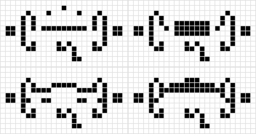
HWSSes are still encoded as 27deee6 in modern apgcodes -- one of the four-rows-tall phases.On 30 September 1992, Alan Wechsler wrote:Subject: Who called that HWSS a [27deee6]?
> Date: Tue, 29 Sep 1992 17:17 EDT
> From: John Conway
>
> ... I have been noting down life configurations in octal for quite a
> long time. So the trouble is that the speakers of this language have
> hitherto been solipsistic! Let's get everyone talking it. JHC
Well then, let's get a formal description down in the archives:
Life patterns that fit in fairly small rectangles can be described by
short character strings as follows. Each column is represented by one
character. Each row is assigned a "weight"; the bottom row has weight
1, the next weight 2, the next 4, the next 8, and so on. A column is
assigned a score by adding the weights of the live cells in that column.
The character that represents the column is then the nth character in
the following (0-origin) string: "0123456789abcdefghijklmnopqrstuvwxyz",
although encoding columns more than 4 rows tall is deprecated. (In
other words, we deprecate the use of characters to the right of "f".)
To mark representations of this sort, we recommend enclosure in square
brackets. For example, [153] is a male glider and [532] a female one.
We usually prefer the bounding rectangle of the pattern be chosen,
although there are times when this is unwieldy; for example, "A blinker
has two phases, [070] and [222].". Here the bounding rectangle has been
chosen to retain a coordinate frame between phases. This issue should
seldom arise; the recommended use of this notation is to describe single
patterns, usually for purposes of naming: "We call the p2 oscillator
[318c] a `beacon'.".
Some notes on canonicalization. Even assuming that the bounding
rectangle is chosen, there are still, in general, 8 orientations to
choose from. We recommend putting the rectangle in "landscape" rather
than "portrait" orientation, so that it has no fewer rows than columns.
Then choose the orientation with the numerically smallest representation.
When describing an oscillator, pick the phase with the smallest number
of rows, breaking ties by choosing the numerically smallest
representation. Thus, the blinker is [111] rather than [7]; the glider
is shown in male phase [153] rather than in female [163]; the eater is
[178c]; and the toad is always shown resting [1332] rather than panting
[2994]. And, oddly enough, we prefer the more populous but squatter
phase of the HWSS, [27deee6], to having to use big digits in [21hh197].
I'm not sure why encoding five-rows-tall patterns was "deprecated"; the extension that happened to make "Extended Wechsler format" seems to have been un-deprecating the sixteen additional characters, g through v, that allow five-row encoding.