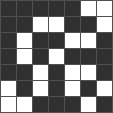
x = 22, y = 5, rule = B3/S23
2o2b2o2b2o2b2o2b2o2b2o$2o2b2o2b2o2b2o2b2o2b2o2$2o2b2o2b2o2b2o2b2o2b2o
$2o2b2o2b2o2b2o2b2o2b2o!
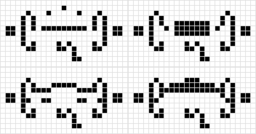
This would be period 8 (4 cells distance * 2 cells per generation = 8 generations). c/2 puffers are actually quite well documented in jslife, you can find this one in c2-extended/c2-0008-puf.lif with a population of 199 cells:
What other conduits are the input/output connectable to in this conduit? Clearance looks really poor.
Serving currently as something of a stenographer within this community, mostly reducing the occasional gun, synthesis reduction, or providing discovery commentary. Will get software to begin searches eventually.
x = 4, y = 4, rule = B3/S23:T5,4
o2bo$4o$o2bo$o2bo!
Also, is this (when extended to the entire plane according to the rules of the Hilbert curve) considered an agar (perhaps a kind of marshland agar) or a wick?
roee.s wrote: June 18th, 2025, 7:44 am
Is this version of the reciprocating agar known?
It's straightforward enough to be the kind of thing that people probably documented somewhere in the 1970s, though I'm not planning to go and look for specific prior art.
roee.s wrote: June 18th, 2025, 7:44 am
Also, is this (when extended to the entire plane according to the rules of the Hilbert curve) considered an agar (perhaps a kind of marshland agar) or a wick?
Neither, really. It's not an agar because it has no unit of repetition. It's not a wick because it's not one-dimensional.
It's always easy to invent patterns that don't quite fit any particular existing descriptive terms. We've got a good fallback term, though -- it's a pattern.
roee.s wrote: June 18th, 2025, 7:44 am
Also, is this (when extended to the entire plane according to the rules of the Hilbert curve) considered an agar (perhaps a kind of marshland agar) or a wick?
dvgrn wrote: June 18th, 2025, 8:03 am
It's not an agar because it has no unit of repetition.
I'm not convinced. As stated in User:H._V._McIntosh/Herparian_agar, chicken wire does not have to be periodic and yet is considered an agar. Also the agar article says that strict translational symmetry is not required to form an agar and fractal symmetry also counts. It is also stated there that the reciprocating agar can be packed irregularly into the plane, which is another example of an irregular agar.
b-engine wrote: June 18th, 2025, 8:13 am
I consider this a wick, as it doesn't have any repeating parts that could qualify as an agar, and it could be burned.
There's an awful lot of prior usage of wick to mean specifically a linearly repeating pattern, though. Wicks that "could be burned" are called fuses, but technically by current definitions they still have to be linear.
If some kind of controlled burning can really be demonstrated, turning the corners without going out of control -- which is certainly possible and has been done before with dragon curves if I remember right -- then maybe we're talking about "a series of connected fuses in a fractal pattern", or something like that.
dvgrn wrote: June 18th, 2025, 8:03 am
It's not an agar because it has no unit of repetition.
I'm not convinced. As stated in User:H._V._McIntosh/Herparian_agar, chicken wire does not have to be periodic and yet is considered an agar. Also the agar article says that strict translational symmetry is not required to form an agar and fractal symmetry also counts. It is also stated there that the reciprocating agar can be packed irregularly into the plane, which is another example of an irregular agar.
Sure -- if you want to call a fractal-form almost periodic pattern an "agar", everyone will know what you're talking about.
The bottom of that list of criteria in the "agar" article is "they just look pretty" -- and beauty is in the eye of the beholder, so you can fit just about any "reasonably ordered" specifiable infinite pattern into the "agar" box if you really want to.
b-engine wrote: June 18th, 2025, 8:13 am
I consider this a wick, as it doesn't have any repeating parts that could qualify as an agar, and it could be burned.
There's an awful lot of prior usage of wick to mean specifically a linearly repeating pattern, though. Wicks that "could be burned" are called fuses, but technically by current definitions they still have to be linear.
If some kind of controlled burning can really be demonstrated, turning the corners without going out of control -- which is certainly possible and has been done before with dragon curves if I remember right -- then maybe we're talking about "a series of connected fuses in a fractal pattern", or something like that.
Indeed it was demonstrated here. I it's also possible to construct an arrangement of these in a Hilbert curve but It'd be less interesting IMO because this kind of fuse can be separated into finite sub-patterns each of which is stable on its own.
Resu wrote: June 18th, 2025, 3:10 pm
Is there a collection of all 2- and 3- glider collisions?
There are only 71 2-glider collisions; there's a file in Golly and a page on the wiki.
Quite a while back, someone wrote a script to enumerate all 3-glider collisions. There's something you can download called "octo3g" ("octo" comes from each collision being identical in any of 8 rotations/translations and only having to list it once rather than eight times), but it was found to have a few duplicates and omissions.
muzik wrote: June 19th, 2025, 10:32 am
Does the strictest definition of a gun require that emission be periodic?
Probably not - according to the wiki:
The wiki wrote:A gun is a stationary pattern that repeatedly emits spaceships (or rakes) forever.
Conway's Game of Life: Mathematics and Construction also features this:
The textbook wrote:We have spent most of this chapter looking at methods of constructing fixed-period guns with evenly
spaced output. We now switch gears slightly and construct some guns that fire gliders more and more
slowly, thus giving us our first examples of patterns with sub-linear (but non-zero) growth rates.
This suggests that a gun can have irregular output, and therefore emission need not be periodic.
Resu wrote: June 19th, 2025, 2:29 pm
Can Confused eaters be made into a "confusion agar"?
Sure, in lots of different ways. Mostly by making chains of confused eaters with two heads, I would assume -- eleveners or integrals would work, for example.
x = 30, y = 30, rule = B3/S23
2o$o$b3o$3bo$3bob2o$4bo3b2o$9bo$6b3o2$9b2o$9bo$10b3o$13bo$12bo$12bo2b
o$15bo$13bobo$13b2o2b2o$17bobo$19bo$19b3o$22bo$21bo$21bo2bo$24bo$22bo
bo$22b2o2b2o$26bobo$28bo$28b2o!
It would be a more confusing agar if there were a way to connect these things densely in two dimensions, and maybe use different phases.
I don't immediately see particularly compelling ways to build anything other than these simple linear connections, though -- which can be stacked close together to make a 2D agar, but I'm not sure that would really be what you're looking for.
dvgrn wrote: June 19th, 2025, 3:30 pm
I don't immediately see particularly compelling ways to build anything other than these simple linear connections, though -- which can be stacked close together to make a 2D agar, but I'm not sure that would really be what you're looking for.
I was looking at this, and I tried (and failed) to make this an agar:
x = 27, y = 29, rule = B3/S23
14bo$14b3o$10bo6bo$10b3o3b2o$4bo8bo$4b3o5b2o10bo$7bo15bobo$6b2o16bo$16b
2o$16b2o3$2o$bo21b2o$bobo19bobo$2b2o21bo$25b2o$10b3o$10bobo$10bobo$11b
o$2bo16b2o$bobo15bo$2bo10b2o5b3o$13bo8bo$9b2o3b3o$9bo6bo$10b3o$12bo!
Serving currently as something of a stenographer within this community, mostly reducing the occasional gun, synthesis reduction, or providing discovery commentary. Will get software to begin searches eventually.
WhiteHawk wrote: June 23rd, 2025, 5:09 pm
Does this count as a honey farm shuttle (the block being part of the catalyst)? If so, it deserves mention on the Honey farm shuttles page
that second hive seems independent from the rest of gliders
This is fairly common in syntheses on Catagolue, especially as the recipes get more complex. Someone didn't bother to split out the stages completely when submitting the synthesis, or simply didn't notice after a rework that the all-at-once synthesis was no longer necessary -- the second beehive might have gotten in the way of a previous variant of the recipe.
It's supposed to be possible to fix this kind of thing. There's a setting in Shinjuku to prefer syntheses with a larger number of stages and the same total cost, and Catagolue theoretically uses that setting. I don't remember if I've seen that actually working, though.
dvgrn wrote: June 24th, 2025, 7:45 am
It's supposed to be possible to fix this kind of thing. There's a setting in Shinjuku to prefer syntheses with a larger number of stages and the same total cost, and Catagolue theoretically uses that setting. I don't remember if I've seen that actually working, though.
Yeah, I don't think I've ever seen it work unless the total cost actually goes down.
PK22 wrote: June 23rd, 2025, 11:37 amSKOP stands for Smallest Known Oscillators by Population. If two oscillators are tied for minpop, but one has a smaller bounding box, I would use that one as the SKOP.
Does it actually mean that? The wiki saids "Smallest Known Oscillator for each Period".
Resu is correct. What oscillators are generally considered SKOPs in life really depends on both Period and Population. Annoyingly, the common inference of an oscillator being SKOP is really that the oscillator is SKOPP - Smallest Known Oscillator by Population for it's Period. SKOP is easier to say, and since SKOPP is usually stated in the form SKOPN (N being the period in question - e.g. SKOP27 is proper since it refers to the Smallest Known Oscillator for Period 27), I think SKOP comes from the logic step that the number is the thing to remove to get the generic term when really the number N is a modification of the real acronym (SKOPP). The P in SKOP therefore means Period, not Population.
Note: Listing the Smallest Known Oscillators by Population (in life anyway) without regard for Period would make a list including Toad and beacon, which are both very small p2 oscillators that are still larger than Blinker (So neither is SKOP2, though they are both some of life Smallest Known Oscillators when measured by Population). Likewise Smallest Known Oscillator for each Period could also refer to the smallest oscillators optimized by bounding box, not population. Therefore, the most clear term is SKOPP - though it has been usurped by the deceptive term SKOP likely due to misunderstanding of terms like SKOP27 or SKOP 27.
Serving currently as something of a stenographer within this community, mostly reducing the occasional gun, synthesis reduction, or providing discovery commentary. Will get software to begin searches eventually.
That sparker is 38 cells, which is smaller than the 42-cell, toaster, the 41-cell “P5 unix”, the short and standard P5 pipsquirters, and a thumb sparker used in the smallest gun_35 (pseudo-period):
x = 12, y = 13, rule = B3/S23
5bo$4bo2bo$3bo6b2o$4b3obo2bo$7b2obo$5b2o2bo$4bob3o$3bo$4bob3o$3bobo3bo
$bobobo2b2o$obo$bo!
Is Matthias Merzenich the discoverer of 38p5/37p5? I was looking into including it as a note on the P5 pipsquirter page since it shares some functionality with that oscillator while being smaller in population and would like to properly reference the correct discovery information
x = 12, y = 13, rule = B3/S23
5bo$4bo2bo$3bo6b2o$4b3obo2bo$7b2obo$5b2o2bo$4bob3o$3bo$4bob3o$3bobo3b
o$bobobo2b2o$obo$bo!
Serving currently as something of a stenographer within this community, mostly reducing the occasional gun, synthesis reduction, or providing discovery commentary. Will get software to begin searches eventually.