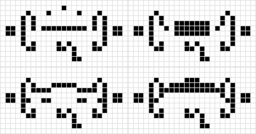
can be a pain. But not with the Offset Standardi(s|z)er™!
Watch what happens when we take this synthesis and run it through the Offset Standardi(s|z)er™ first before using the incremental-to-continuous script:
For just three easy payments of $19.99, you too can get your hands on an Offset Standardi(s|z)er™. Don't wait, call now!
Code: Select all
"""
This script is meant to be used in conjunction with the incremental-to-continuous script made by Chris Cain and Dave Greene:
https://github.com/dvgrn/b3s23life/blob/master/synthesis-tools/incremental-to-continuous-synthesis.py

This script converts the syntheses displayed on Catagolue object pages into a format understood by the script above.
To use it, paste a synthesis from Catagolue into Golly, run this script first, then run the incremental-to-continuous script

Created by Ian07, with the exception of the find_best_selection() function

Caveats:
-Vertical offset between steps still isn't allowed, but this shouldn't be a problem if you're copying the synthesis straight from Catagolue
-The script assumes that any 30-or-more-wide gap with no cells is a boundary between synthesis steps; if the synthesis in question involves an xWSS that has been converted into gliders
-If your synthesis contains especially large individual steps or especially large spaces, you may need to increase the maximum offset check
-Sometimes an "openClipboard failed" error appears. I don't know what causes this, but it doesn't appear to actually affect anything; just a minor annoyance.
-The actual incremental-to-continuous script isn't perfect, and tends to fail in situations involving intermediate oscillators and relatively large individual steps
"""

import golly as g

# Reset the universe so script works correctly
g.select(g.getrect())
g.copy()
g.new("output")
g.paste(0, 0, "or")

max_offset_check = int(g.getstring("Enter maximum offset to check for:","128"))

# Copied this function from the original script, with slight modifications:
def find_best_selection():
    r = g.getrect()
    all = g.getcells(r)
    sep = 33 # minimum possible offset is 30 empty columns + width of a single glider, no need to check for lower values
    # - run the pattern for 4096 ticks, get the new settled pattern
    # - try XORing new pattern with original pattern for every possible offset up to 512
    # - one of the offsets should give the lowest total population
    #      (will probably decrease the population instead of increasing it,
    #       unless what is being built is a prolific puffer or gun or some such)
    bestscore, bestsep = len(all),-1  # = population * 2
    allplus = g.evolve(all, 4096)
    g.addlayer()
    while sep<=max_offset_check:
        g.show("Finding stage spacing -- testing " + str(sep))
        g.new("sep=" + str(sep))
        g.putcells(all)
        g.putcells(allplus,sep,0,1,0,0,1,"xor")
        score = int(g.getpop())
        if bestscore>score: bestscore, bestsep = score, sep
        sep += 1
    g.dellayer()

    sep = bestsep
    g.show("found separation: " + str(sep))
    bestblockscore, bestoffset = -999999, -1
    for offset in range(sep):
        g.select([r[0]-offset, r[1], sep, r[3]])
        g.update()
        blockscore = 0
        for blockx in range(r[0]-offset,r[0]+r[2],sep):
            g.select([blockx, r[1], sep, r[3]])
            blockrect = g.getselrect()
            block = g.getcells(blockrect)
            if len(block)==0:  # ran into empty block, this must not be the right separation
                g.exit("Invalid pattern format found at separation = " + str(sep) + ": selected block is empty.")
            g.shrink(1)
            shrunkblockrect = g.getselrect()
            leftdiff = shrunkblockrect[0]-blockrect[0]
            rightdiff = (blockrect[0]+blockrect[2])-(shrunkblockrect[0]+shrunkblockrect[2])
            blockscore += leftdiff + rightdiff
            if leftdiff<10: blockscore -= (10-leftdiff)**2
            if rightdiff<10: blockscore -= (10-rightdiff)**2
        if blockscore>bestblockscore: bestblockscore, bestoffset = blockscore, offset
    g.select([r[0]-bestoffset, r[1], r[2]+offset, r[3]])
    return sep

# Current "streak" of empty columns; if this reaches >=30 it deems that a new step because that's how Catagolue displays syntheses
empty_columns = 0

# Point at which the most recent step began
last_x = 0

width = g.getrect()[2]
height = g.getrect()[3]

# Each synthesis step, formatted as a list of cell lists
step_list = []

for column in range(width+1):
    g.select([column, 0, 1, height])

    if len(g.getcells(g.getselrect())) == 0:
        empty_columns += 1
    else:
        if empty_columns >= 30:
            g.select([last_x, 0, column - last_x - empty_columns, height])
            step_list.append(g.getcells(g.getselrect()))

            # Mark this as the start of the next synthesis step
            last_x = column

        empty_columns = 0

# Once we've reached the end, append the final step
g.select([last_x, 0, column - last_x, height])
step_list.append(g.getcells(g.getselrect()))

g.addlayer()
max_offset = 0

# Record the offset value between each pair of consecutive steps
offset_list = []

for i in range(len(step_list) - 1):
    g.putcells(step_list[i])
    g.putcells(step_list[i+1])

    current_offset = find_best_selection()
    offset_list.append(current_offset)
    max_offset = max(max_offset, current_offset)

    g.select(g.getrect())
    g.clear(0)

# Now let's put them all back together, this time with equal offset rather than equal separation
total_offset_so_far = 0

# The first fencepost
g.putcells(step_list[0])

for i in range(len(offset_list)):
    total_offset_so_far += max_offset - offset_list[i]
    g.putcells(step_list[i+1], total_offset_so_far)

#Reset universe again so next script works correctly
g.select(g.getrect())
g.copy()
g.new("output")
g.paste(0, 0, "or")

g.show("Offset standardization complete. Maximum offset: " + str(max_offset))