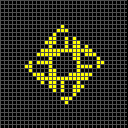
What I mean by this is whether there are any small spaceships (10 cells or less) in this rulespace. Here, when I am using the term non-explosive, I mean rules that are stable and do not explode. For example, here is a non-explosive rule that isn't zebra-complimentary, to give an example:confocaloid wrote: February 22nd, 2025, 12:39 pmAs far as I can see, the post didn't require (or even define, for that matter) nonexplosivity. If I understand the intended idea, then the spaceship I posted provides an example to answer "There are no spaceships that are currently known in this rulespace, though."R2INT wrote: February 22nd, 2025, 10:40 amAre there any small spaceships in non-explosive zebra-complementary rules (refer to the last post)?
I'm not sure whether I understand the intended idea (it's often hard to follow such explanations with unstated assumptions and problematic terminology). I just tried to guess what was meant there, maybe I guessed correctly, maybe not, there was no confirmation or correction so far either.
Likewise, to be able to answer questions involving "non-explosive" (to enable an interesting discussion) one would need to define nonexplosivity, or at least explain what is more likely to count as nonexplosive. (This is likely to be hard to define. E.g. how to deal with soups that "apparently grow forever chaotically" but then either unexpectedly settle at some time or produce a regular growth?)
In many cases, referring to / reusing an existing concept from a wider field (mathematics, computer science) is going to be objectively better than reinventing some variation of it, in those cases when there is choice at all.
Code: Select all
#R B2-a/S12
!
# [[ RANDOMIZE ]]