Code: Select all
x = 30, y = 15, rule = LifeHistory
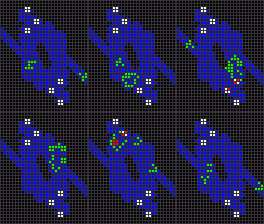
7.2B$7.3B$6.4B$6.6B16.A$5.D6B15.A.A$4.2D6B14.2BAB$5.2D4B16.2B$5.7B13.
3B$3.9B9.A2.4B$.B.9B8.A.A.5B$2A5BC5B8.A.3BC2B$2A4B3C4B9.3B3C2B$.4B2C
4B11.2B2C2BDB$.3B.5B14.2B3D$8.B!Code: Select all
x = 30, y = 15, rule = LifeHistory
7.2B$7.3B$6.4B$6.6B16.A$5.D6B15.A.A$4.2D6B14.2BAB$5.2D4B16.2B$5.7B13.
3B$3.9B9.A2.4B$.B.9B8.A.A.5B$2A5BC5B8.A.3BC2B$2A4B3C4B9.3B3C2B$.4B2C
4B11.2B2C2BDB$.3B.5B14.2B3D$8.B!
Code: Select all
x = 84, y = 76, rule = S23/B3
21b3o23$18bobob3o$19b2o$19bo22$3o2$66bo$66bo$66bo11$81b3o13$38b3o!
Code: Select all
x = 75, y = 43, rule = B3/S23
2bo$obo71bo$b2o71bo$74bo$3b3o38$55b3o!
Code: Select all
x = 73, y = 40, rule = B3/S23
35b2o$35b2o33$71b2o$2bo68b2o$obo$b2o2$3b3o!
Code: Select all
x = 79, y = 42, rule = B3/S23
76b3o9$45b3o28$2bo$obo$b2o2$3b3o!
Code: Select all
x = 42, y = 6, rule = Life
16b2o$bo14b2o14bo$obo5bo22bobo5bo$b2o5b3o21b2o5b3o$8bobo28bobo$10bo30b
o!
Code: Select all
x = 11, y = 5, rule = Life
2o$obo5bo$b2o5b3o$8bobo$10bo!
Code: Select all
x = 36, y = 4, rule = Life
bo6bo18bo6b2o$b2o4bobo17b2o4bobo$2o5bobo16b2o5bobo$7b2o24b2o!
Code: Select all
x = 72, y = 1, rule = Life
72o!
Code: Select all
x = 4, y = 7, rule = Life
2bo$3o$bo3$2b2o$2b2o!
Code: Select all
x = 46, y = 8, rule = B3/S23
6bo$2o4bo22bo13bo$bo3bobo19b2o14b3o$29bobo11bobo$31bo13bo2$29b2o13b2o$
30bo14bo!

Code: Select all
x = 15, y = 13, rule = B3/S23
5b2ob2o$2b2o2bobo2b2o$o2bobo3bobo2bo$2obob2ob2obob2o$3bo2bobo2bo$3b2o
5b2o$7bo$7bo$3bo2bo2bo$4bo7b2o$bo2bo2b3ob3o$bob9o$4bo2bo2bo2bo!
Code: Select all
x = 8, y = 11, rule = B3/S23
3bo$2bobo$3bo2$b5o$o2bo2bo$2o3b2o2$4bo$4b2o$3b2ob2o!
Code: Select all
x = 39, y = 39, rule = B3/S23
2bo$obo16bo$b2o17b2o$19b2o2$23bo$24b2o$23b2o2bob2o$9b2o16b2obo2b2o$5b
2o2bobo20b2o$6b2o3bo22bo$5bo5b2o$37b2o$b2o10bo22b2o$2b2o8b2o24bo$bo10b
obo2$17bo$16b2o$16bobo5$o$b2o$2o14bo$16bobo$4bo11b2o$5b2o6b2o$4b2o6bob
o$12bo$10bobo6b2o$10b2o6b2o$7b2o11bo$6bobo$8bo14b2o$22b2o$24bo!
I'm surprised you didn't also include eater2s (eating gliders on four adjacent incoming lanes) and tub-with-tail eaters (eating glider from two different directions).gmc_nxtman wrote:Introducing... Eaters! As you've never seen them before.
Well, I just thought that the eater2 would be already known, but the other's wouldn't be. Also, what is the smallest way to make glider-toggleable data? Is it a boat-bit?dvgrn wrote:I'm surprised you didn't also include eater2s (eating gliders on four adjacent incoming lanes) and tub-with-tail eaters (eating glider from two different directions).gmc_nxtman wrote:Introducing... Eaters! As you've never seen them before.
See Golly's Patterns/Life/Still-Lifes/eaters.rle, and the other two "eater" patterns in the same folder.
It's very common theme in the gun collection. This is also very common problem in catalyst search (those are added to any escaping glider as valid catalysts). CatForce actually has special feature added to it to erase these cases (I think it's the only catalyst utility that fully solves this problem).gmc_nxtman wrote:Well, I just thought that the eater2 would be already known, but the other's wouldn't be.
That's pretty cool!simsim314 wrote:It's very common theme in the gun collection. This is also very common problem in catalyst search (those are added to any escaping glider as valid catalysts). CatForce actually has special feature added to it to erase these cases (I think it's the only catalyst utility that fully solves this problem).gmc_nxtman wrote:Well, I just thought that the eater2 would be already known, but the other's wouldn't be.
Bellman with glider input, you'll find a lot but not all. In the collection of eaters, I guess someone just checked a lot of still life combinations.gmc_nxtman wrote:Is there a search program for eaters?
It's hard to beat a boat-bit for size -- though it takes a bigger mechanism to read the state of the boat-bit, if you don't know whether it's there or not. Here's a recent example.gmc_nxtman wrote:Also, what is the smallest way to make glider-toggleable data? Is it a boat-bit?
Couldn't find that recent post offhand -- I think I remember one where the still life is changed to its mirror image, but I'm not seeing that one right away either.gmc_nxtman wrote:Another thing - Recently I read a post on this thread(?) about a still life that rotates itself 90º when hit by a glider. Are there any other known patterns that do this?
Code: Select all
x = 9, y = 7, rule = B3/S23
bo$2bo$3o$6bo$5bobo$5bo2bo$6b2o!Is it known?I wrote:Last but not least, this one generates "Trans-mirrored offset hooks" at about T=700 (that unfortunately gets destroyed) and later creates a cis-boat and dock:
Code: Select all
x = 9, y = 8, rule = Life
7bo$6b2o$7b2o3$b2o$obo$bo!
Code: Select all
x = 42, y = 9, rule = B3/S23
2obo2bo11b2ob2o10b2o5b2o$bob4o12bobo3bo7bobobo3bo$bo17bo2b4o9bob4o$2o
3b2o10bobo15bo$5bo11b2o5b2o8b2o3b2o$4obo17bobo13bo$o2bob2o10b4o2bo10b
4obo$17bo3bobo9bo3bobobo$20b2ob2o8b2o5b2o!
Those are not loops, but C4 still lifes. And yes they are trivial.gmc_nxtman wrote:, are these loops known?
simsim314 wrote:Those are not loops, but C4 still lifes. And yes they are trivial.gmc_nxtman wrote:, are these loops known?
You're right, I will check those out.simsim314 wrote:I would suggest for starters to read some of the articles in the GOL links thread, to get more familiar with what's known and what's not.
Two more quick suggestions:simsim314 wrote:I would suggest for starters to read some of the articles in the GOL links thread, to get more familiar with what's known and what's not.
Dean Hickerson found many of those with a search program called "dr", short for "drifter". Nowadays some of them could also be re-discovered with Mike Playle's Bellman program.gmc_nxtman wrote:Is there a search program for eaters? I saw a file in Golly's still-lifes folder with crazy novel eaters, but I don't know how to find them...
Hmm- maybe people could submit still lifes to an online database, and have a program which just places a random glider to collide, and checks out what happens?dvgrn wrote:There are still plenty of new discoveries that could be made in this area -- new record longest recovery times, for example. And somewhere out there is the smallest "crazy novel eater" where the active spark finds its way to an edge of the eater and turns into a 90-degree glider, while the eater returns to its initial state. Unfortunately that kind of thing probably isn't findable by re-running searches using existing programs -- some kind of new approach will be needed.
Why do you need online database for this?gmc_nxtman wrote:Hmm- maybe people could submit still lifes to an online database
This is exactly what bellman does, in extremely optimized way. To explain in short, take this reaction:gmc_nxtman wrote:and have a program which just places a random glider to collide, and checks out what happens?
Code: Select all
x = 8, y = 9, rule = B3/S23
bo$2bo$3o3$4b2o$4bo$5b3o$7bo!
Code: Select all
x = 61, y = 13, rule = B3/S23
bo9bo9bo9bo9bo9bo$2bo9bo9bo9bo9bo9bo$3o7b3o7b3o7b3o7b3o7b3o5$6b2o8b2o
8b2o8b2o8b2o8b2o$6bo3bo5bo9bo9bo3bo5bo3bo5bo$7b4o6b3o7b3o7b4o6b4o6b3o$
20bo8bo30bo$9b2o6b2obo5bobo8b2o8b4o6b3o$9b2o6bobo6b2o9b2o8bo2bo6bo!
There are algorithms for randomly generating large still lifes, and it's easy to try all possible input gliders for a given still life. But unfortunately the Sun might burn out before the first randomly-generated still life happens to produce a glider and return to its initial state. There are just too many possible still lifes, and the odds are too low that a randomly chosen one will respond really nicely to being hit by a glider.gmc_nxtman wrote:Hmm- maybe people could submit still lifes to an online database, and have a program which just places a random glider to collide, and checks out what happens?
Code: Select all
x = 10, y = 7, rule = B3/S23
2b2obo2b2o$2bob2ob2o$9bo$6o$o4bo$3bo$3b2o!Incidentally, is there a reference for collisions with Spartan objects? It's a simple thing, but I don't want to have to do that search again by hand.dvgrn wrote:H. Koenig at pentadecathlon.com has programmatically checked glider collisions with all still lifes up to some number of bits -- was working on 17-bit objects, I believe, but that was quite a few years ago. Very very occasionally a glider collision would increase the size of the still life, along these lines --
-- but mostly the glider causes either a catastrophic explosion or (much more rarely) a partial collapse.Code: Select all
x = 10, y = 7, rule = B3/S23
2b2obo2b2o$2bob2ob2o$9bo$6o$o4bo$3bo$3b2o!
dvgrn wrote:There are algorithms for randomly generating large still lifes, and it's easy to try all possible input gliders for a given still life. But unfortunately the Sun might burn out before the first randomly-generated still life happens to produce a glider and return to its initial state. There are just too many possible still lifes, and the odds are too low that a randomly chosen one will respond really nicely to being hit by a glider.gmc_nxtman wrote:Hmm- maybe people could submit still lifes to an online database, and have a program which just places a random glider to collide, and checks out what happens?
Of course we might get lucky... but it would be nice to improve the odds a little, above what we're likely to get from pure random trials.
There might be 10 trillion distinct 48-bit still lifes, and 25 trillion 49-bit still lifes, and 60-70 trillion 50-bit still lifes, and so on (assuming 2.5 times as many N+1-bit still lifes as N-bit still lifes, which seems to be about right.)
With modern computers it's easy to check a million different still lifes, and a billion is possible with enough time, and a trillion can maybe be done with enough time and a huge distributed search... but much above 50 bits and an exhaustive search starts to be completely out of reach, practically speaking.
H. Koenig at pentadecathlon.com has programmatically checked glider collisions with all still lifes up to some number of bits -- was working on 17-bit objects, I believe, but that was quite a few years ago. Very very occasionally a glider collision would increase the size of the still life, along these lines --
-- but mostly the glider causes either a catastrophic explosion or (much more rarely) a partial collapse.Code: Select all
amazingness
Code: Select all
x = 7, y = 9, rule = B3/S23
2bo$obo$b2o3$2bobo$2b2obo$5bo$5b2o!I reckon that from the accidental discoveries thread, correct?Kazyan wrote:Anyway, if you liked that collision, this one upgrades a hook-with-claw into something with 6 additional cells.
Yeah... I just can't find that many interesting results by handKazyan wrote:Check out the LifeHistory rule built into Golly; it works on the same principle as your rule idea. Looks like you're getting the hang of things work, but just aren't up to speed on all the minutae in this hobby...which is understandable, as we don't have a Conway's Game of Life Handbook, just a far-from-comprehensive wiki.

That's pretty cool!Kayzan wrote:Anyway, if you liked that collision, this one upgrades a hook-with-claw into something with 6 additional cells.
Code: Select all
x = 7, y = 9, rule = B3/S23
2bo$obo$b2o3$2bobo$2b2obo$5bo$5b2o!

Code: Select all
#C [[ THUMBNAIL AUTOSTART LOOP 100 ZOOM 5 ]]

x = 13, y = 8, rule = Life

10bo$10b3o$10bobo$12bo$bo$obo$obo$bo!Code: Select all
x = 12, y = 4, rule = Life
9bo$9b3o$3o6bobo$11bo!
You missing a point - eaters could consist of several SLs. Even if you take combinations of two SLs from 1M options you get 10^12, multiply it by location (say 10x10), and glider positioning (at least 10 as well) you easily get 10^15.dvgrn wrote:There might be 10 trillion distinct 48-bit still lifes
Dang, fast reply!by simsim314 less than a minute ago
I am not sure what you mean by that, but if you meant this, then it is known.gmc_nxtman wrote:By the way, nobody answered my question. Is the R_pentomino-boat interaction known?