A forum for topics that don't fit elsewhere. Introduce yourselves to other members of the forums, discuss how your name evolves when written out in the Game of Life, or just tell us how you found it. Forum rules still apply.
confocaloid wrote: April 14th, 2024, 2:57 pm
Which reactions or types of patterns would you choose for a CA-inspired or CA-based "never-ending animation"?
I wouldn't choose fixed patterns but if I did I'd want them to randomly be selected from a library of my favorites and I'd want the patterns to run with different color schemes every time they are loaded and restarted.
In my Collidoscope screen saver for Windows I implemented:
- Rectangular and hexagonal color CA rules chosen at random from a library of rules
- Random starting configurations with random symmetry
- Randomly assigned dynamically changing colors
Nowadays there are much better CA rules and computers available than there were 20 years ago.
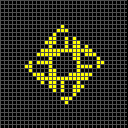
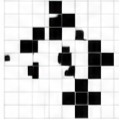
This isn't an agar, it eventually settles into noninteracting photons. However, if someone discovers a high-period agar like this (made of repeatedly "chaotically" colliding moving objects), that could make an interesting screensaver:
#C Imagine that this never settles into anything simple
#C (actually this settles into a "boring" p160 pattern on the torus)
x = 16, y = 16, rule = /2/3:T160,119
2.AB5.BA2.B.B$.BA.B.B2.B4A.A$6.3BA3.A$2.B.A7.A2BA$2.A5.A2B3.BA$.3BA.B
2A.A4.B$.A.AB2A.A2.B.A$A.B.BA2.B2.2BA$B2.B.AB2.A2.B.B$2.A7.2BA.2A$AB
2A.A.AB.AB.A.A$2.A2B.2A.A$.AB2.B.2A2BAB.A$.A.B6.B2.A$.ABAB2.B3.3BAB$
2.2A2B2AB.BA.BAB!
confocaloid wrote: October 5th, 2024, 8:35 pm
[...]
One could either just evolve until the current generation is a phase of an oscillator and only census the final pattern (simpler, faster), or attempt to detect temporary objects that appear during evolution and can be isolated but then collide again later (slower):
x = 16, y = 16, rule = /2/3:T60,60
A2.A.BA2.2A4.B$B.3A5.B3.B$.A.A.A3B2.B.2B$2.B.B2.2A$A5.A.4BAB.B$2BA.A
3.3A3.B$B7.A2.B3.A$2BA2B.B2.B2A.BA$B.A.A4.A2.B2.A$.B.BA.BA.BA2.AB$.B.
A.BA.BA.B.2AB$7.AB5.AB$B.B2.3A2.BA.A.B$3AB4.B2.A.3A$2.A.B.B2.B2.AB.B$
.B.AB3.B.2B2.2A!
127:1 B3/S234cUser:Confocal/R (isotropic CA, incomplete)
Unlikely events happen.
My silence does not imply agreement, nor indifference. If I disagreed with something in the past, then please do not construe my silence as something that could change that.
#C Imagine that this never settles into anything simple
#C (actually this settles into a "boring" p160 pattern on the torus)
x = 16, y = 16, rule = /2/3:T160,119
2.AB5.BA2.B.B$.BA.B.B2.B4A.A$6.3BA3.A$2.B.A7.A2BA$2.A5.A2B3.BA$.3BA.B
2A.A4.B$.A.AB2A.A2.B.A$A.B.BA2.B2.2BA$B2.B.AB2.A2.B.B$2.A7.2BA.2A$AB
2A.A.AB.AB.A.A$2.A2B.2A.A$.AB2.B.2A2BAB.A$.A.B6.B2.A$.ABAB2.B3.3BAB$
2.2A2B2AB.BA.BAB!
#C Imagine that this never settles into anything simple
#C (actually this settles into a "boring" p160 pattern on the torus)
x = 16, y = 16, rule = /2/3:T160,119+1
2.AB5.BA2.B.B$.BA.B.B2.B4A.A$6.3BA3.A$2.B.A7.A2BA$2.A5.A2B3.BA$.3BA.B
2A.A4.B$.A.AB2A.A2.B.A$A.B.BA2.B2.2BA$B2.B.AB2.A2.B.B$2.A7.2BA.2A$AB
2A.A.AB.AB.A.A$2.A2B.2A.A$.AB2.B.2A2BAB.A$.A.B6.B2.A$.ABAB2.B3.3BAB$
2.2A2B2AB.BA.BAB!
x = 69, y = 101, rule = /2/3:T160,119+1
59.B2.B$59.A2.A$60.2B$60.2A7$60.B$60.A2B$61.2A3$59.B$59.A$58.B$58.A$
59.B$59.AB$60.AB2.B$46.B14.A2.A$46.A15.2B$44.2B16.2A$44.2A10$57.B$57.
A$58.2B$58.2A11$43.B$43.AB$44.AB5.B$45.AB3.BA$46.AB2.A$47.A2B$48.2A3$
45.2B$45.2A10$8.B$7.BA$6.BA$2.B3.A$2.A2.B$3.2BA$3.2A6$B2.B$A2.A$.2B$.
2A8$68.B$38.B29.A$37.A28.2B$31.2A3.B29.2A$31.2B3.ABA$37.A.B$38.BA$36.
2BA$36.2A!
I was looking for a high-period agar which would never settle into a bunch of noninteracting low-period objects.
127:1 B3/S234cUser:Confocal/R (isotropic CA, incomplete)
Unlikely events happen.
My silence does not imply agreement, nor indifference. If I disagreed with something in the past, then please do not construe my silence as something that could change that.
confocaloid wrote: February 14th, 2025, 12:15 pm
[...] I was looking for a high-period agar which would never settle into a bunch of noninteracting low-period objects. [...]
Use sphere: [...]
What is the eventual period, when it evolves into a phase?
127:1 B3/S234cUser:Confocal/R (isotropic CA, incomplete)
Unlikely events happen.
My silence does not imply agreement, nor indifference. If I disagreed with something in the past, then please do not construe my silence as something that could change that.
confocaloid wrote: February 14th, 2025, 12:15 pm
[...] I was looking for a high-period agar which would never settle into a bunch of noninteracting low-period objects.
x = 180, y = 180, rule = /2/3:S180
32$81.AB$79.AB$79.AB7$110.BA$112.BA$112.BA$111.BA$110.BA3$66.AB$64.AB
$64.AB82.AB$66.AB80.AB41$140.AB$140.AB3$65.2A$65.2B$64.A57.AB$64.BA
55.AB$65.BA54.AB$66.BA$65.A.BA$65.BA.B$66.2A$67.B8$83.AB$81.AB$81.AB!
127:1 B3/S234cUser:Confocal/R (isotropic CA, incomplete)
Unlikely events happen.
My silence does not imply agreement, nor indifference. If I disagreed with something in the past, then please do not construe my silence as something that could change that.
confocaloid wrote: February 14th, 2025, 12:15 pm
[...] I was looking for a high-period agar which would never settle into a bunch of noninteracting low-period objects.